
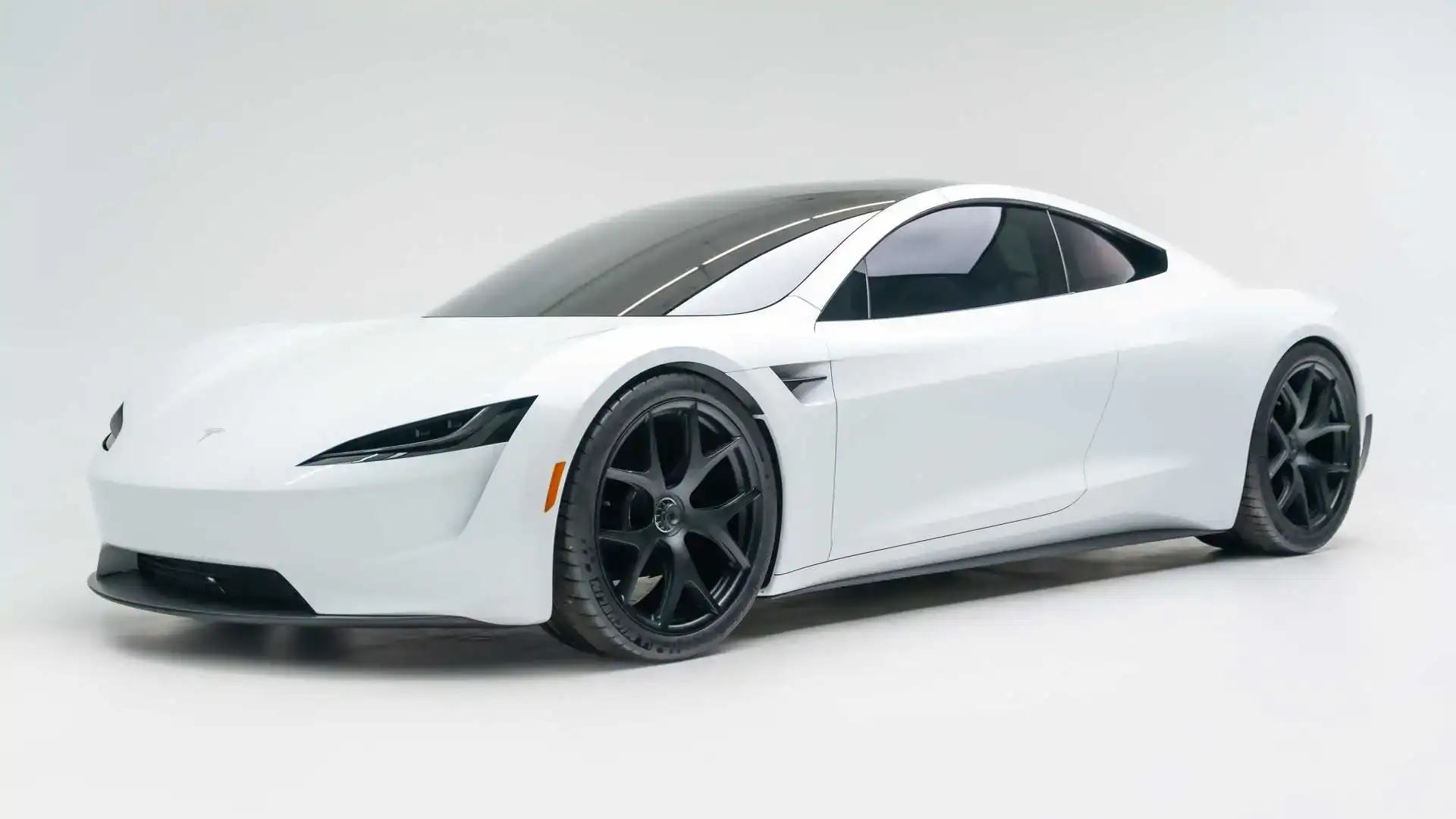
Tesla has postponed the demonstration of its next-generation Roadster by two weeks. The event originally scheduled for October 1, 2026, will now take place on October 15 after the company cited severe weather forecasts and the fact that the presentation can only be held outdoors.
Tesla said it had been tracking the forecast with local meteorologists before deciding to reschedule. The company has not yet published the full programme for the new date. The event is expected to take place in the Waco, Texas area, close to SpaceX's McGregor facility, based on information sent to invitees and reported by automotive outlets.
A demonstration, not a confirmed production start
The current wording describes the event as a Roadster event or demonstration. It does not confirm that series production will begin after October 15. Tesla has not published a final delivery date, a definitive production location, a final price or a complete homologation specification for the new Roadster. The October appearance should therefore be treated as a technical and design presentation rather than a confirmed commercial launch.
Tesla first showed the second-generation Roadster in November 2017 at the same event where it presented the Semi. At the time, the company quoted a 0–60 mph time of 1.9 seconds, a top speed above 250 mph and a claimed range of 620 miles. In metric terms, those targets are roughly 2.1 seconds to 100 km/h, more than 400 km/h and about 1,000 km. They remain Tesla-published targets, not independent test results or final certification data.
Tesla's official Roadster page still lists those headline figures. It also describes a four-seat cabin and a lightweight removable glass roof that can be stored in the trunk. The page presents the car as an all-electric supercar designed around performance and aerodynamic efficiency. Tesla has not confirmed whether every detail shown on the current page will remain unchanged on the production vehicle or on the car used for the October demonstration.
Why the event depends on the weather
Tesla says the event can only be held outdoors. The company has not released a full technical plan, but recent reporting has connected the demonstration with the possibility of cold-gas thrusters developed with SpaceX. Elon Musk has previously discussed such a system as a way to improve the Roadster's performance. Tesla has not established that the technology will be fitted to a street-legal production car, and it has not confirmed that a demonstration prototype would share the same specification as a customer vehicle.
An outdoor test involving an experimental vehicle requires different conditions from a static indoor reveal. The available surface, visibility, safety perimeter and atmospheric conditions can affect the schedule. Tesla's explanation for the postponement specifically refers to the weather forecast and the lack of an indoor alternative. It does not identify a technical fault with the Roadster.
The original event was teased with a Tesla image carrying the words “Go for launch” and the October 1 date. Tesla vehicle engineering vice president Lars Moravy and Semi programme lead Dan Priestley also teased a Roadster appearance at the end of a recent Semi presentation. Those previews showed only limited parts of the car. Suggestions about a full-width light bar, an active rear element or a new Cyber-inspired design remain interpretations until Tesla provides more information.
A long development timeline
The second-generation Roadster was announced in 2017 with a planned production date of 2020. That target passed without customer deliveries, and the project has moved through several revised presentation and demonstration windows. Tesla and Musk mentioned different dates during 2025 and 2026, but the vehicle has not entered publicly confirmed series production.
That history matters when interpreting the October 15 schedule. The new date confirms that Tesla has moved the event, but it does not prove that deliveries will follow immediately. Tesla has not released a final technical sheet, a production ramp plan or a full equipment list for the customer version.
The official performance claims also need to be read carefully. The 1.9-second acceleration, more than 400 km/h top speed and approximately 1,000 km of range appear on Tesla's product page as the promoted Roadster specification. The page does not present an EU test-cycle result or an independent verification alongside those figures. Real-world range would depend on the battery, tyres, temperature, speed and driving style.
What Tesla may clarify on October 15
The demonstration could reveal the final exterior, the propulsion layout, battery architecture and the number of motors. It may also show how Tesla intends to use any SpaceX-related hardware. Tesla will need to distinguish between a standard version, a special demonstration car and any limited performance package if more than one configuration appears.
Commercial questions remain open as well. Tesla has not confirmed a European price, a delivery date for Romania or an annual production capacity. A reservation or deposit would not by itself prove that the vehicle has been homologated or that series production has started.
The verified update is therefore limited but clear: Tesla moved the Roadster event from October 1 to October 15, 2026, because severe weather was forecast for an outdoor-only presentation. The remaining specifications are either Tesla's published targets or claims that still need confirmation during the demonstration.


