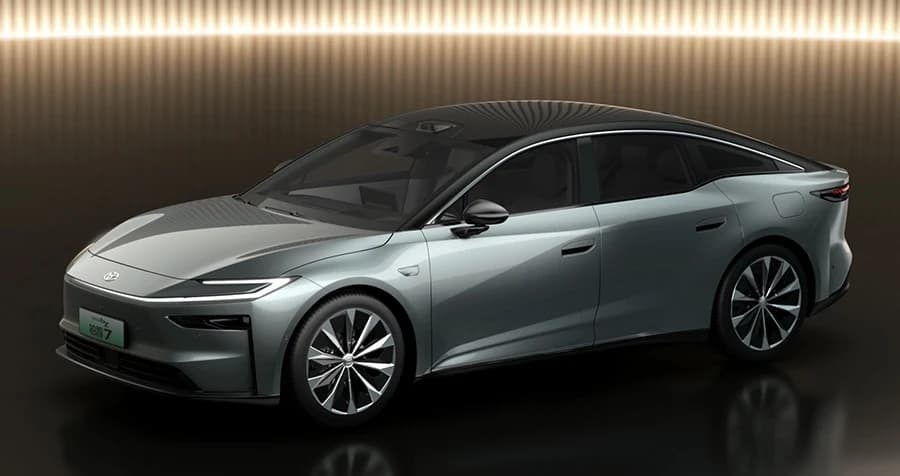
Photo: Toyota Motor Corporation / Toyota Global Newsroom. Official bZ7 image used as an illustration.
Toyota may build its first range-extender EV in China
Toyota is reportedly preparing its first extended-range electric vehicle for the Chinese market. Nikkei Asia says production could begin in April 2027, starting at a few hundred vehicles per month before increasing to roughly 200,000 units during 2027 and about 400,000 in 2028. The report has been repeated by specialist automotive publications.
Toyota has not publicly confirmed the model name, technical specifications, pricing, factory, supplier or export plans. The figures should therefore be described as reported production targets, not as a confirmed launch schedule or guaranteed sales volume.
What an EREV does differently
An extended-range electric vehicle, or EREV, uses an electric motor to drive the wheels. Its petrol engine is primarily a generator: it produces electricity for the battery and the electric drivetrain when the stored energy needs replenishing. In the usual EREV layout, the combustion engine does not mechanically send power to the axles.
That gives the car an electric driving response while retaining a fuel-based backup for long journeys. The battery can be charged from the grid for daily use, and the generator can supply energy when a trip is longer than the practical battery range or charging access is limited.
The system is different from Toyota’s conventional hybrids. In a hybrid powertrain, the combustion engine and electric machines can both contribute to wheel propulsion through the vehicle’s hybrid transmission. In an EREV, the electric motor remains the component that drives the car, while the combustion engine supplies electricity.
The reported China production plan
According to the Nikkei Asia report, Toyota could start production in China in April 2027. The initial output would be only several hundred vehicles per month. The plan would then scale to around 200,000 vehicles in 2027 and approximately 400,000 in 2028.
Those numbers may represent internal production targets rather than confirmed customer deliveries. No public information explains how many plants would be involved, which Toyota or joint-venture entity would build the vehicle, or how the target would be divided between model versions. The source material also does not identify the car’s body style.
Building the vehicle in China would allow Toyota to use local suppliers, software partners and manufacturing expertise in a market where extended-range products have gained visibility. It would also let the company respond more quickly to local demand than importing a global model. Nothing in the report confirms that the vehicle will be sold in Europe or North America.
Why range extenders are gaining attention in China
An EREV tries to address two concerns at once. A manufacturer can use a battery smaller than the one needed for very long all-electric range, potentially reducing mass and cost. The generator then provides additional flexibility on longer trips. For a driver with home charging, most weekday travel can still be electric.
The trade-off is that an EREV retains a combustion engine, fuel tank, exhaust system and related maintenance. It is not a zero-tailpipe-emission vehicle whenever the generator is running. Its efficiency also depends on how regularly the driver charges the battery and how often the petrol engine is required.
China has become an important market for this format. Li Auto built much of its product identity around range-extended vehicles, while other Chinese companies have introduced similar systems. Toyota would be entering an established segment with strong local competition, rather than creating a category from scratch.
Toyota’s local electric line-up
Toyota was slower than some rivals to expand its battery-electric portfolio, but it has been adding China-specific models. The bZ4X was introduced as a global BEV, while vehicles such as the bZ3, bZ3X, bZ5 and bZ7 have been developed or produced with Chinese partners.
Toyota’s official 2025 announcement introduced the bZ7 at Auto Shanghai. The company described the five-metre-plus sedan as a BEV developed locally by Guangzhou Automobile Group, Guangzhou Toyota and Toyota’s local Intelligent ElectroMobility R&D Center. The bZ7 is a battery-electric vehicle rather than an EREV, but it demonstrates Toyota’s decision to develop products for Chinese customers with local partners.
Toyota calls its wider strategy multi-pathway. Its official communications continue to refer to hybrids, plug-in hybrids, BEVs and fuel-cell vehicles rather than a single global powertrain solution. A range-extender vehicle would add another option to that strategy, not necessarily replace Toyota’s existing hybrids or battery-electric models.
The engineering challenge
An EREV needs a traction battery, electric motor or motors, inverter, onboard charger and a combustion engine sized mainly as a generator. Control software must decide when the generator starts, how much power it supplies and how the battery is maintained within an efficient operating window.
Toyota’s long experience with hybrid energy management could be useful, but an EREV is not simply a conventional hybrid with a larger battery. The calibration must deliver a natural electric response while managing generator noise, vibration, cooling, emissions and the transition between grid energy and fuel-based electricity.
What remains unknown
The report does not name the vehicle or say whether it will be based on an existing bZ architecture. Battery capacity, electric range, total range, motor output, fuel-tank size, charging performance and price are also unknown. The identity of the production plant and the local technical partners has not been confirmed.
There is no evidence yet of a European launch. A China-market vehicle would need to meet different certification, software, safety, emissions and data requirements before being sold in the European Union. Toyota could also decide to keep the project exclusive to China, where the business case and competitive landscape are different.
Could it matter to buyers elsewhere?
The concept could appeal to drivers who want electric operation in towns but still travel long distances where public charging is less predictable. It could be especially relevant in markets with uneven charging coverage. However, the benefit depends on charging the battery regularly. If the generator runs frequently, the vehicle behaves more like a fuel-powered hybrid and carries the maintenance burden of a combustion engine.
For buyers in Romania and other European countries, the key questions would be price, warranty, servicing, parts supply, charging compatibility and real-world fuel consumption with a depleted battery. None of those details has been released for Toyota’s reported project.
The measured conclusion
Nikkei Asia reports that Toyota could begin China production of its first EREV in April 2027, with targets of roughly 200,000 vehicles in 2027 and 400,000 in 2028. Toyota has not confirmed the project in public detail, and the name and specifications remain unknown.
If it goes ahead, the vehicle would broaden Toyota’s multi-pathway approach beyond conventional hybrids and BEVs. For now, the accurate description is a reported China programme, not a confirmed global model or a product announced for Europe.