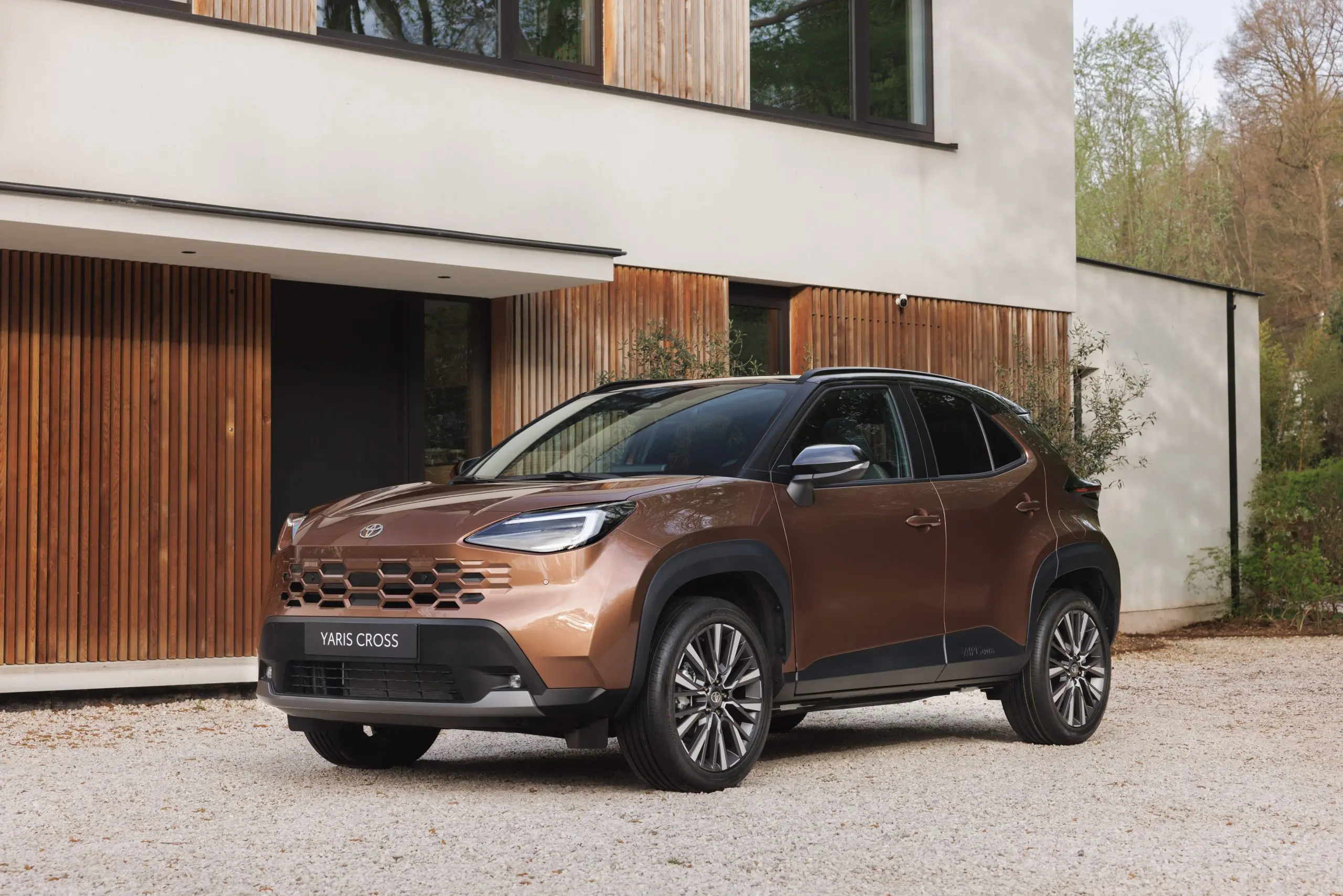
The facelifted Toyota Yaris Cross in Precious Bronze. Photo source: Toyota.
Toyota Yaris Cross 2027: what UK buyers can actually order
Toyota UK has opened orders for the 2027-model-year Yaris Cross. The important facts are unusually specific: the revised compact SUV starts at £27,445 on the road, every UK grade uses the Hybrid 130 powertrain, and Toyota says customer deliveries begin in September 2026. The range has four grades—Icon, Design, Excel and GR Sport—with prices rising to £35,095 before accessories or dealer-specific finance costs.
This is a confirmed British launch, not a promise that every European market will use the same names, equipment or timing. Toyota Europe has described the refreshed design and the broad technical package, but local distributors still control their own order books, homologation paperwork, taxes and prices. For a UK reader, however, the decision is no longer about a rumour. There is a published range to compare with outgoing stock.
The confirmed UK range and prices
Toyota’s UK on-the-road prices are:
- Icon: £27,445.
- Design: £29,995.
- Excel: £33,695.
- GR Sport: £35,095.
The prices are useful because they are tied to an actual UK offer rather than a currency conversion from a continental press release. They are not a universal European price list, and they do not include every optional paint finish, accessory pack, insurance product or finance charge. A buyer should ask for a written quotation showing the vehicle specification, registration fee treatment, paint, accessories, delivery charges and total amount payable.
Toyota says the cars are available to order now, with customer deliveries from September. “From September” is a start point, not a guaranteed date for every derivative. A popular colour, a bi-tone roof, AWD-i hardware, a factory option or a dealer allocation can move an individual handover. The order form and the dealer’s estimated delivery date matter more than the headline month.
The 2027 label also needs careful handling. It describes Toyota’s model-year positioning in the UK; it is not evidence that the car is a new generation. The facelift keeps the existing Yaris Cross identity and compact-SUV format. Toyota Europe says the model is built in Europe for European customers, but the update does not announce a new platform or a substantially different body.
What the facelift changes
The most obvious change is the front end. Toyota gives the upper grille a body-coloured honeycomb mesh that joins the surrounding surfaces more cleanly. A black lower grille remains below it, while the flared wheel-arch protection and side sills retain the tougher visual cues that distinguish the Yaris Cross from the Yaris hatchback.
The headlights have a new graphic and incorporate the daytime-running lights. Design and Excel receive new 17- and 18-inch alloy-wheel designs respectively in the UK specification. GR Sport has its own bumper treatment and sportier detailing. Toyota also highlights bi-tone paint, Ultrasuede seat upholstery and grey 18-inch wheels within the range or its associated specification, but the exact combination depends on grade and selected equipment.
The available colours include Precious Bronze, Persian Salt and Storm Grey. Excel can be specified with a contrasting black roof and pillars. Colour names and availability are market-specific, so a British press photograph should not be treated as proof that the same paint is orderable in every country.
Inside, the architecture remains familiar rather than revolutionary. The higher UK grade receives a 12.3-inch digital driver’s display and a 10.5-inch Toyota Smart Connect multimedia screen. The specification also includes practical upgrades such as a powered tailgate and heated steering wheel on Excel. The point of the facelift is breadth: a fresher face, clearer grade separation and more equipment, not a wholly new cabin concept.
Hybrid 130 is now the UK default
The UK’s defining change is the powertrain policy. Toyota removes the 116 DIN hp Hybrid 115 from the new British range and makes Hybrid 130 standard across all four grades. It is a 1.5-litre, three-cylinder petrol full-hybrid system using Toyota’s e-CVT automatic transmission. Toyota quotes 130 DIN hp, or 96 kW, for system output.
Toyota Europe previously described Hybrid 130 as the stronger version of the established Yaris Cross hybrid system. Its published technical material quotes 185 Nm of electric-motor torque and an official 0–100 km/h time of 10.7 seconds for the front-wheel-drive car. Those are manufacturer figures. They are not Carboratory measurements, and they should not be read as a promise that every wheel, tyre and market configuration will produce precisely the same result.
The UK launch material gives a combined WLTP consumption range of roughly 4.4–5.1 l/100 km, depending on specification. That is an approval figure for comparison between versions. Cold weather, motorway speed, traffic, passengers, roof loads, tyre pressures and heating use can all move real consumption away from it. The full-hybrid battery is charged by the car through energy recovery and the petrol engine; this is not a plug-in vehicle and it has no meaningful charging routine for a home wallbox.
Front-wheel drive is the standard layout. Toyota UK lists intelligent AWD-i as available on Excel. A separate electric motor drives the rear axle when the system decides extra traction is useful. AWD-i may help on wet roads, snow or loose surfaces, but it does not turn this small crossover into a low-range off-roader. It adds cost and hardware, and the buyer should check the exact boot volume, official CO2 figure and fuel-consumption figure for the selected derivative.
Equipment: what the grades mean
Icon is the entry point, but it is not a bare specification. Toyota UK lists 16-inch wheels, a reversing camera, a 9-inch multimedia display, LED headlights, automatic high beam and electrically folding mirrors. That gives the base car the central elements many buyers actually use every day.
Design adds wireless smartphone charging, parking sensors and sport-profile front seats. The grade is also where the optional Safety Pack is relevant. Toyota describes front and rear parking sensors with Intelligent Clearance Sonar and automatic braking, Rear Cross Traffic Alert, Blind Spot Monitor, Safe Exit Assist and Lane Change Assist. The buyer needs to confirm whether an advertised vehicle includes the pack or merely has it available.
Excel brings the larger digital displays, powered tailgate, heated steering wheel and richer seat trim. It is the point in the range at which the price rises sharply, so buyers should decide whether the extra convenience and driver information justify almost £4,000 over Design before options. Excel is also the UK grade associated with the AWD-i choice.
GR Sport is a styling and chassis-oriented proposition, with its own front treatment and sportier details. It may appeal to someone who wants a more distinctive appearance, but the badge does not make it a performance SUV. The same basic Hybrid 130 system remains the core of the car. A test drive should answer whether the suspension and tyre specification improve the experience on the roads the owner actually uses.
The Skyview panoramic roof is optional on Excel and GR Sport. Toyota also offers accessory packs for style and protection. Accessories can be useful, but they can quietly inflate a monthly payment and may not return their full cost at resale. Add them to the cash price before comparing a dealer’s offer with another car.
Tax: a hybrid is not tax-free in Britain
The UK ownership calculation changed just as hybrid buyers became used to a small VED advantage. GOV.UK says the £10 annual discount for hybrid and alternatively fuelled vehicles has been removed. For cars first registered on or after 1 April 2017, the standard rate from 1 April 2026 to 31 March 2027 is £200. The new Yaris Cross is therefore not exempt from vehicle tax simply because it uses a full-hybrid system.
The exact first-year and ongoing treatment depends on the registered vehicle details and the rules in force when it is registered. The government’s 2026–27 tables show different first-year rates by CO2 band, while the standard rate is £200 for the relevant post-2017 cars. The dealer should provide the exact CO2 figure for the chosen derivative rather than relying on a range copied from a different wheel or drivetrain.
For company-car users, the recorded CO2 value and the applicable benefit-in-kind rules are more important than a general statement that the car is economical. A 98 g/km example and a higher-emitting AWD-i or heavily optioned car should not be assumed to sit in the same tax position. Fleet managers should use the exact registration specification and tax-year calculation.
Fuel saving is still the main financial argument. A full hybrid can recover energy in traffic and use electric drive during some low-load phases without charging equipment. It will not necessarily be the cheapest choice for a driver who spends almost every mile at a steady motorway speed, nor will it eliminate petrol purchases. The right comparison is total cost over the intended ownership period.
Insurance and service costs
Toyota’s list price does not tell a buyer the insurance premium. UK insurers use their own risk data, and the Association of British Insurers points to factors including repair costs, theft, vehicle prices, insurance tax and the wider claims environment. A facelift can change the quoted group or the repair estimate even when the underlying car is familiar. Get a quote for the exact registration or vehicle specification before signing a finance agreement.
Comprehensive cover, excess, windscreen treatment, replacement-car terms and protection for optional accessories can matter more than a small difference in the first annual premium. AWD-i, larger wheels and a panoramic roof may affect repair costs or replacement values. The insurer’s wording takes precedence over a dealer’s verbal description.
Servicing, tyres and finance deserve the same discipline. Toyota’s hybrid reputation does not guarantee a particular annual cost. Ask for the service schedule, the price of the first relevant services, the warranty conditions and the terms of any additional cover. A finance offer should be compared using the total amount payable, deposit, mileage allowance, interest rate, final payment and any mandatory products—not just the monthly figure.
Toyota UK may run launch contributions or representative APR campaigns, but a temporary finance incentive is not the same thing as a permanent reduction in the list price. A discounted outgoing car bought with cash can be better value than a new facelift bought through expensive credit, while a supported new-car deal can reverse that result. The arithmetic has to be done on the buyer’s own deposit and mileage.
Rivals in the UK
The Yaris Cross sits among small SUVs rather than in a class of Toyota-only alternatives. The Ford Puma remains a natural comparison for a driver who values a familiar UK network and a more conventionally petrol-led driving character. Renault Captur can appeal to buyers who want flexible rear-seat packaging and a different electrified offer. Peugeot 2008 competes with strong styling and a broad range, while Volkswagen T-Cross leans on a familiar badge and practical cabin.
Hyundai Kona is larger in feel and may suit a family that finds the Yaris Cross tight in the back. Nissan Juke has a similar urban footprint but a different interior and powertrain strategy. A buyer should also compare a hatchback or estate if the raised seating position is not essential; the SUV shape is not automatically the most spacious or economical answer.
The Toyota’s specific proposition is straightforward: automatic driving, compact dimensions, a full-hybrid system and no charging cable. That combination is strongest in urban and suburban use. It is not a claim that the Yaris Cross is the cheapest car in the segment, the quietest at motorway speed or the roomiest for four adults. Those are questions for a back-to-back drive and a careful look at the boot and rear seat.
Buy now or wait?
In Britain, waiting is sensible if the new front end, Hybrid 130 standardisation, updated displays or a particular grade is important. Toyota has confirmed the range, published prices and stated September deliveries. The buyer can place an order with a defined product rather than reserving an undefined future model.
Buying outgoing stock is also defensible when the discount is real and the car is available now. Hybrid 115 is not made obsolete by the facelift; it is simply the outgoing British configuration. A large saving can outweigh the newer grille, especially for an owner who plans to keep the car for many years. Check the build date, registration date, warranty start, specification code, tyre condition and whether the vehicle has been pre-registered.
The practical rule is to compare two written offers. For the new car, include options, delivery, VED assumptions, insurance and finance interest. For the outgoing car, include the same items and allow for the older model year at resale. If the gap is small, the facelift has the stronger case. If the gap is large, the current car may be the rational purchase.
What Toyota UK has not confirmed
The UK announcement does not establish prices or grades for every European country. It does not guarantee that every market will receive the same colours, Safety Pack, roof option or AWD-i combination. It also does not turn Toyota’s official WLTP and acceleration figures into independent test results. Those boundaries matter because a press photograph and a UK price table can travel much faster online than the local distributor’s actual order information.
For a UK buyer, the evidence is sufficient to make a decision. For anyone comparing an imported car or a future continental specification, it is not. The exact VIN, specification sheet and local contract remain the final authority.
Sources
- Toyota UK — sales launch, UK grades, prices and September deliveries
- Toyota Europe — refreshed Yaris Cross design and European technical overview
- Toyota Europe — Hybrid 130 technical figures
- GOV.UK — vehicle tax for electric, zero-emission and low-emission vehicles
- Association of British Insurers — how motor insurance pricing works