
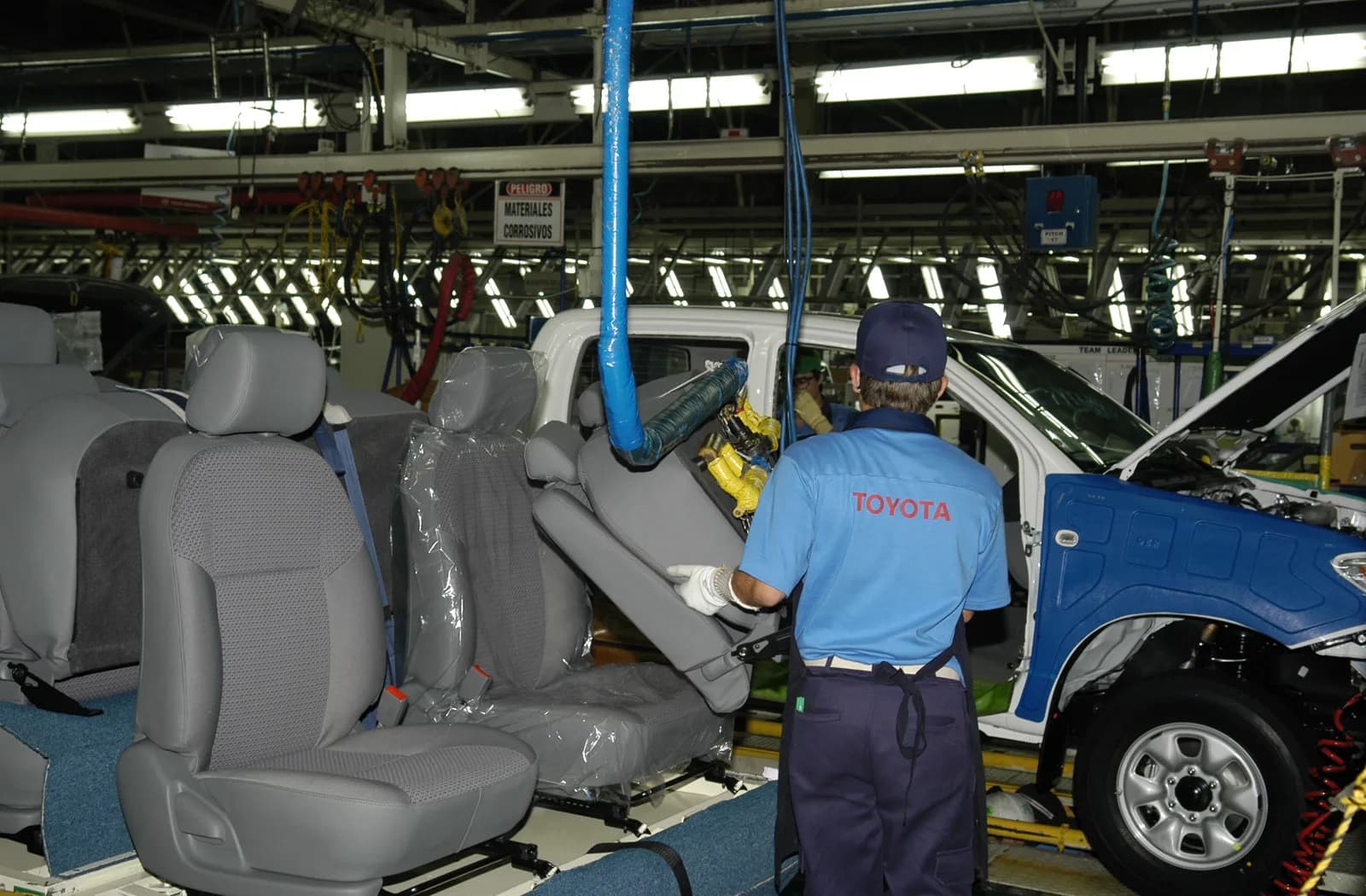
Toyota Argentina has received approval to enter the Régimen de Incentivo para Grandes Inversiones, or RIGI, with a $1.341 billion project at its Zárate industrial complex in Buenos Aires province. The plan covers a new production facility for an electrified vehicle. Toyota has not yet identified the model, battery technology or production start date, so reports connecting the project to an electric Hilux should be treated as unconfirmed.
What has been announced
Argentina’s economy minister Luis Caputo announced the decision on 30 September 2026. Toyota Argentina subsequently confirmed that the approval allows the project to move forward within the RIGI framework. Argentine authorities and business publications describe it as the largest approved investment so far in the country’s automotive industry.
The official description is deliberately broad: Toyota refers to an “electrified vehicle”. That wording can cover a battery-electric vehicle, a hybrid or a programme with more than one powertrain. It does not confirm a battery size, range, power output or production schedule. Local reporting has linked the project to the next-generation Hilux and a possible electric version, but Toyota has not published a final product announcement.
The government presented the project as strongly export-oriented. Its estimates point to about $1.28 billion in annual exports, or close to 70 per cent of planned production. The same announcement refers to more than 3,600 jobs during construction and more than 2,600 jobs during operations, including direct and indirect employment.
Those figures are project estimates rather than operating results. They will depend on Toyota’s final corporate approval, the construction schedule, supplier capacity and demand in the Latin American markets that could receive the vehicles.
Why the RIGI status matters
RIGI is Argentina’s framework for large-scale investments. Depending on the project, it can provide fiscal, customs and foreign-exchange benefits. For an automaker, those conditions may affect the purchase of production equipment, the import of selected components, the development of local suppliers and the ability to plan an export programme over several years.
Toyota’s project is described as the first automotive project to reach approval under the regime. The $1.341 billion figure applies to the newly announced initiative. It should not be confused with Toyota Argentina’s accumulated investment since the plant opened, or with earlier spending on the current Hilux, SW4 and Hiace programmes.
Zárate already has a regional role
Toyota began production in Argentina in 1997. In 2023, the company announced that its Zárate plant had passed two million vehicles. The total included 1,679,096 Hilux pickups and 320,904 SW4 SUVs.
The plant currently builds the Hilux, SW4 and Hiace, and serves as a regional production and export base. Toyota has said that Hilux and SW4 contain 40 per cent local parts and 65 per cent regional content. Those figures show why a new vehicle programme would involve more than the assembly building: a network of South American suppliers would also need to support the required components and processes.
Toyota reported more than 8,500 employees and roughly 35,000 people across its value chain in its 2023 information about the plant. Electrified vehicles would introduce different industrial requirements, including battery systems, power electronics and new control software. Toyota has not explained how much of that work would be done locally.
Why the Hilux keeps appearing in reports
The Hilux is the most frequently mentioned candidate because it is the plant’s best-known product and a major regional export. Argentine reports have suggested that the next generation could include electrified versions. Toyota has not confirmed that the new facility will build an electric Hilux or that Hilux will be the first product assigned to it.
There are therefore no confirmed figures for battery capacity, driving range, power, payload, price or homologation. For a pickup used by commercial operators, the choice between a battery-electric system, a hybrid and another solution depends on charging infrastructure, duty cycles and export-market requirements. Some reports mention mining and fleet applications for a possible electric version because those vehicles can return to a base for charging, but Toyota has not yet presented those details as a final product strategy.
What happens next
Admission to RIGI does not mean the new factory is already built. Toyota still has to complete internal approvals, define the production plan, select suppliers, establish capacity and publish a construction timetable. Those announcements will determine when the project moves from an approved investment to an operating industrial programme.
The project could expand Argentina’s role as a regional pickup and electrified-vehicle production base. For now, the confirmed fact is narrower: Toyota has approval for a $1.341 billion Zárate project to produce an electrified vehicle, while the model and final technical specification remain open.


