China’s car market recorded its eleventh consecutive month of decline in August 2026, while exports reached a record level. Manufacturers are trying to offset weak domestic demand with larger deliveries abroad, a shift that will intensify competitive pressure in Europe as well.
Data published by the China Passenger Car Association (CPCA) show that about 1.54 million passenger cars were sold at retail in China in August. The volume fell 23.6% from the same month in 2025, although it rose 5.5% compared with July 2026.
In the opposite direction, exports of passenger cars produced in China reached about 888,000 units, 77.8% more than in August 2025. Compared with the previous month, exports fell 4.2%, but they accounted for 38% of manufacturers’ total deliveries.
The domestic market falls, but electrification hits a new record
Electrified cars were not spared the overall contraction. Retail sales of new energy vehicles, the NEV category in China that includes battery-electric, plug-in hybrid and fuel-cell cars, totalled 1.005 million units.
The result is 10.1% lower than in August 2025, but 5.7% above July. Because conventional cars fell even more sharply, the NEV share rose to a record 65.2% of the passenger-car market. The figures appear in CPCA’s monthly analysis, also summarised by CnEVPost.
From these volumes it follows that about 536,000 passenger cars with combustion engines and no external charging were sold. Compared with August 2025, the segment lost around 40%. The decline of the Chinese market therefore does not mean a turn away from electrification; on the contrary, purely electric models were the only major category still to record a slight year-on-year increase.
Exports become the Chinese car industry’s safety valve
The gap between the domestic market and exports explains the increasingly visible strategy of Chinese manufacturers. Factories have large capacity, local competition is fierce, and price cuts can no longer support volumes on their own. Manufacturers are looking for customers in Europe, Southeast Asia, Latin America, the Middle East and Africa.
NEV vehicle exports rose by about 155% from August 2025, to around 557,000 units, according to CPCA data cited by ChinaEVHome. They accounted for almost two-thirds of China’s passenger-car exports.
BYD and Geely set new monthly export records, and foreign manufacturers that produce in China are using the same direction. Tesla’s Shanghai plant exported 36,119 cars in August, 38.7% more than a year earlier. At the same time, Tesla sold 50,047 cars on the Chinese market, 12.4% fewer than in August 2025.
CPCA secretary-general Cui Dongshu estimates that China’s total car exports could reach 12 million vehicles in 2026. The estimate includes more than the passenger cars in the monthly retail statistic and should be treated as a forecast, not a result already achieved.
Why sales in China fell
The contraction has several overlapping causes. Incentives for replacing cars were reduced, and economic uncertainty and persistent problems in the property sector have affected buyer confidence. Some customers are postponing a purchase while waiting for further discounts, fed by the price war among the dozens of brands active on the market.
The year-on-year comparison is also difficult: in 2025, support programmes pushed demand to high levels. CPCA expects the commercial season in September and October, together with the car-replacement programme, to slow the rate of decline. There is not yet, however, evidence of a lasting recovery.
The situation should not be read as a collapse of Chinese industrial capacity. Domestic sales are lower, but available production is being redirected to export, and local brands are expanding factories, dealer networks and assembly partnerships abroad.
What it means for Europe and Romania
For the European market, the export wave can bring more models, competitive prices and greater pressure on traditional brands. The effect will not be uniform: the European Union applies additional countervailing duties to certain electric cars produced in China, and manufacturers are responding with European plants, local partnerships and a larger plug-in hybrid offer.
Romania is a small market relative to China’s volumes, but it is part of this expansion. BYD, MG, Geely, Leapmotor, Omoda and Jaecoo are already present or are developing their local networks. Higher exports do not automatically guarantee lower prices in Romanian showrooms: logistics costs, European duties, the exchange rate, type approval and the size of the service network remain decisive.
For the buyer, a larger number of options is an advantage only if the offer is examined in full. The price should be compared together with the warranty, parts availability, residual value, charging speed and access to service. A large discount at purchase can be cancelled by faster depreciation or an insufficient after-sales network.
The message of the August figures is clear: weak domestic demand does not stop China’s car industry, but pushes it more firmly towards foreign markets. For European manufacturers, competition no longer comes only from imports, but also from future factories and alliances developed in Europe itself.
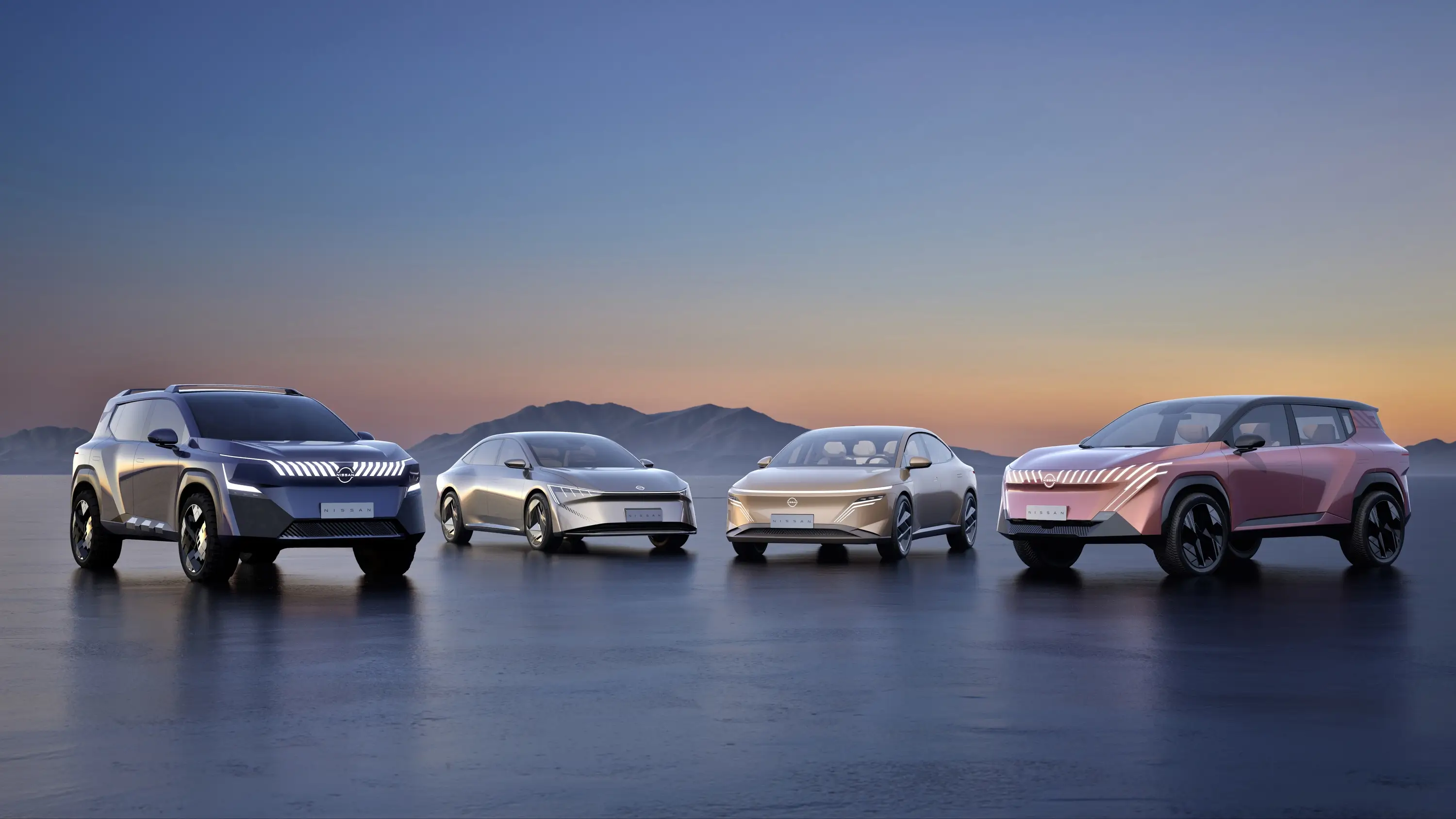
Photo: Nissan