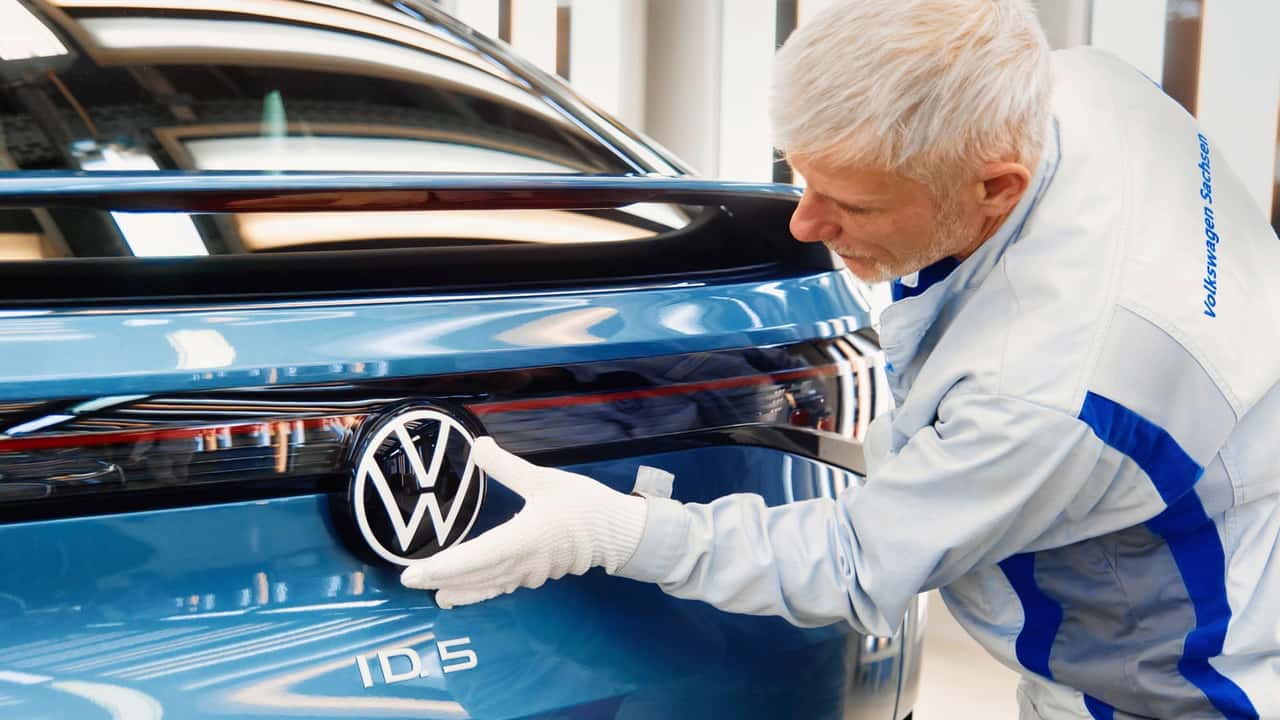
The Volkswagen ID.5 production line. The group says its European factories have surplus capacity of more than 500,000 cars a year. Photo: Volkswagen
Volkswagen warns the situation is critical: high costs and plants without enough output after 2030
Volkswagen Group chief executive Oliver Blume says the group’s situation is “more than critical”, even though the company continues to make a profit. The problem is not an immediate lack of liquidity, but that the current result does not allow long-term financing of new technologies, models and plants.
In the first half of 2026, Volkswagen Group reported revenue of €158.1 billion and an operating result of €5.9 billion, 11.6% below the level in the same period of the previous year. The operating margin was 3.8%.
Blume considers this margin comparable with the industry average under current conditions, but insufficient for the investment needs of a group that includes Volkswagen, Audi, Škoda, Seat, Cupra, Porsche, Bentley and Lamborghini.
Volkswagen is selling fewer cars, and profit has fallen
Between January and June 2026, the group sold almost 4 million cars, 8.4% fewer than in the same period of 2025. Deliveries to customers fell 6.3%, to 4.126 million units, and production by 7.7%, to 4.171 million.
Management lists several causes: customs tariffs applied in the United States, the market decline and price pressure in China, stronger competition in Europe and the costs of the transition to electric cars and software.
At the same time, Volkswagen says the internal structure is too complex. The group has numerous management layers, duplicated functions, and platforms and versions that sit close to one another across brands. Reducing that complexity is one of the main sources of savings pursued by management.
There are two different figures on staff reductions
Blume’s statements distinguish between a programme already agreed and an additional calculation circulating in the press.
Since 2024, Volkswagen, Audi, Porsche and the software division Cariad have agreed to cut about 50,000 jobs in Germany by 2030. The measures are to be applied mainly through partial or early retirement and voluntary departures. According to Blume, about 37,000 contracts were already signed in August 2026.
Separately, the figure of another 50,000 jobs worldwide has appeared. This is not a redundancy target and does not represent an approved decision. Blume says the number is a theoretical calculation: it shows the staffing equivalent of the cost gap the group must close if it used only that lever.
The costs of Volkswagen’s support functions are about 30% above the level of comparable companies, according to the chief executive. The final staff reduction will depend on savings also obtained by simplifying structures, streamlining processes and adjusting labour costs.
Four German factories still lack secured work for the 2030s
The plants in Emden, Zwickau, Hanover and Neckarsulm do not, at present, have enough allocated production to operate competitively in the next decade. Volkswagen estimates that its European factories together have surplus capacity of more than 500,000 cars a year.
This situation does not mean that the closure of the four sites has been decided. Blume stated explicitly that there is no decision to close specific factories. The group’s brands are analysing where they can produce future models at competitive costs, and the plants must win new projects.
If a factory does not receive a successor model, the group says it will look for partners, investors or other industrial activities. In Osnabrück, for example, Volkswagen is in talks with firms in the defence industry.
German plant costs have fallen, but not enough
Volkswagen says it has cut average production costs at car plants in Germany by 20% in a single year. Blume described the result as progress, but said the gap with the most efficient European factories remains too large.
Competition does not come only from traditional manufacturers. Chinese brands are expanding production in Europe through new plants, designed for lower costs and with fewer inherited structures.
For Volkswagen, the response includes reducing the number of models and versions, wider use of shared platforms and faster software development.
The group’s range will be cut from about 150 to 75 models
Volkswagen Group currently offers about 150 models across all its brands. Management’s plan is for the portfolio to reach around 75, by eliminating overlaps and derivatives that generate low volumes.
The first effects are expected to become visible from 2027. Blume argues that the aim is to obtain higher volume for each remaining model, not to withdraw the group from important segments.
The number of equipment combinations will also be reduced. In the Progressive brand group, which includes Audi, Bentley and Lamborghini, there are now more than 2,600 seat variants. Management wants to reach about 100.
For customers, the result may be an offer that is easier to configure, but also the disappearance of some body styles, engines or features with low demand. Volkswagen has not yet published the list of models that will be dropped.
What the restructuring could mean for Romania
Romania does not have a Volkswagen plant, but the measures can influence the local market indirectly. A narrower range will reduce the number of available configurations, and a redistribution of production can change delivery times for certain models.
There is no announcement of dealership closures, a reduction of the service network in Romania or the brand’s withdrawal from the market. Nor do the difficulties described by Blume mean the group is insolvent: Volkswagen remained profitable and generated net cash flow of €3.2 billion in the automotive division in the first half of 2026.
Management’s message is that current profitability is not enough for future investment and that measures must be taken before financial reserves are consumed. The concrete timetable for plants, models and any further staff reductions is not yet set.