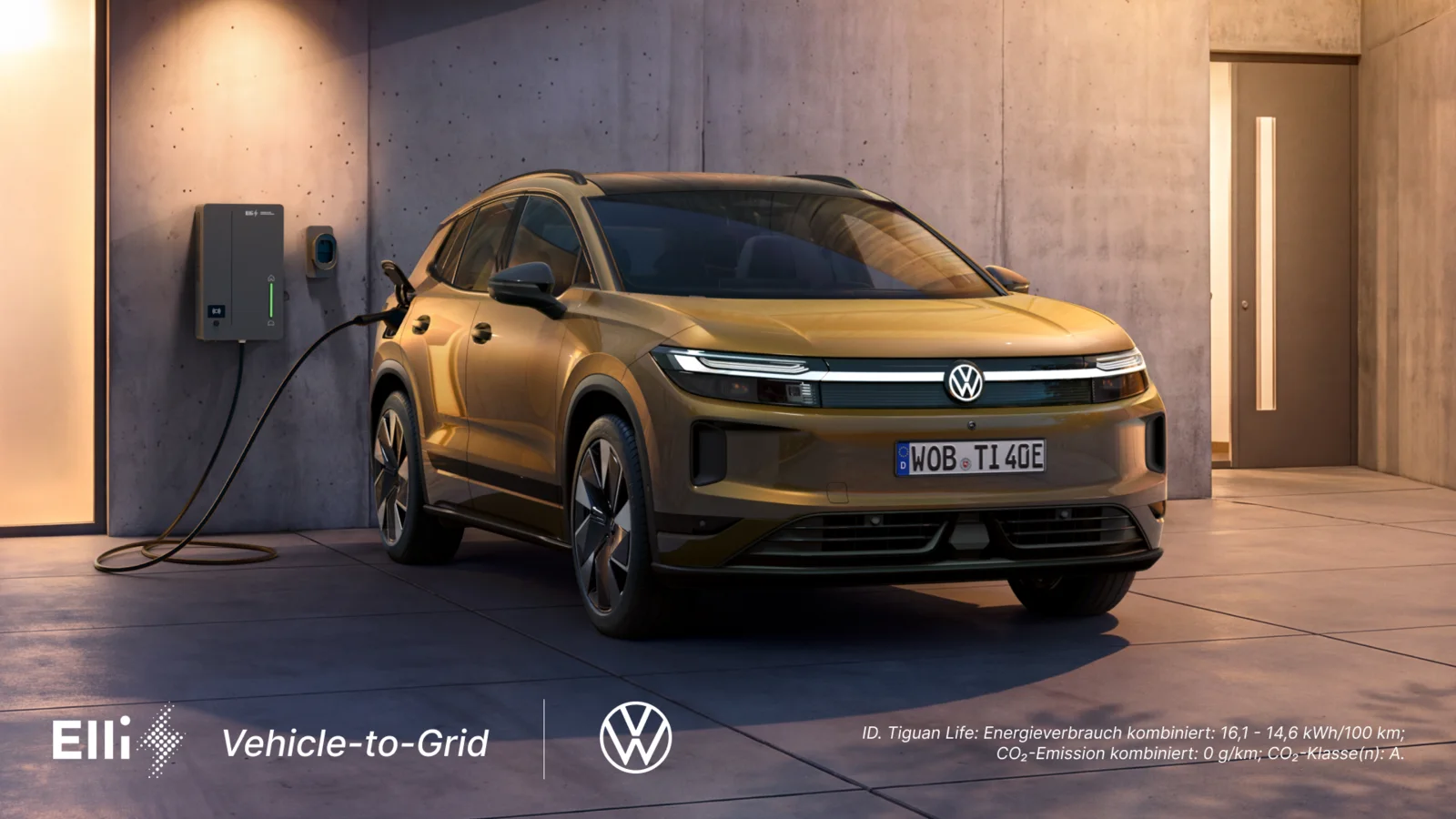
Volkswagen Group energy subsidiary Elli will put its first retail Vehicle-to-Grid package on sale in Germany in December 2026. The offer combines a bidirectional DC home charger, two electricity tariffs, installation services and an app that decides when a compatible car should charge or return energy to the grid. It turns a technology often confined to trials into a product with a published hardware price and customer payment model.
The initial rollout is limited to Germany. Elli says more European markets are planned for 2027, but has not named them. That distinction matters: a technically compatible EV cannot use the German tariff from another country simply because it has the correct battery and software.
An 11 kW DC charger for €1,995
The Elli BiDi Charger costs €1,995 in Germany, including VAT and shipping. Installation is separate and depends on the property. The compact unit supplies up to 11 kW, can be installed indoors or outside, and supports both 400-volt and 800-volt vehicle architectures. Communication is based on ISO 15118-20, the international standard designed to support two-way energy exchange between cars and charging equipment.
Unlike a conventional AC wallbox, this unit handles direct current and is designed from the outset for energy to move in both directions. The equipment alone is not enough. Customers need an eligible vehicle, a suitable electrical installation, a compatible smart meter and the linked energy contracts.
Elli recommends arranging the smart meter early because fitting one can take time. When sales open, an online technical pre-check will establish whether the site meets the requirements. An installation partner will then provide an individual quote, and the charger can only be ordered after that process has been completed.
The €720 figure is a connection bonus
The headline customer benefit is a payment of €0.24 for each eligible hour the car remains connected to the DC charger. A session must last at least three hours. At 250 connected hours per month, Elli calculates a monthly payment of up to €60, or €720 over the first 12-month contract.
This is a payment for availability, not a guarantee that a fixed amount of energy will be taken from the battery. Elli explicitly says there is no minimum volume that must be exported during a session. The company also plans a future payment of €0.40 per kWh for electricity actually fed into the grid, but describes that remuneration as a later option rather than an immediate universal entitlement.
Two Volkswagen Naturstrom contracts underpin the system. V2G Flow covers household consumption and vehicle charging. V2G Return is the separate export tariff used to settle energy discharged from the car. Both run for 12 months. Anyone calculating a payback period therefore needs the full tariff prices, installation quote and likely plug-in routine, not only the maximum bonus.
The driver defines when the car must be ready
Through the Elli BiDi V2G App, a customer enters the next departure time and the minimum battery level required at that moment. The software can then choose charging and discharging windows within those limits. This is central to the proposition: grid participation should not take priority over the range the driver has reserved for the next trip.
Vehicle support remains model-specific. Volkswagen says availability depends on the bidirectional functions approved for each car, so an EV being built on a suitable platform does not automatically make it eligible. More than one million MEB-based vehicles in Europe are described as technically prepared for bidirectional charging, including about 360,000 in Germany, but the commercial service will still apply compatibility checks.
The cross-brand offer includes eligible models from Volkswagen, CUPRA and Škoda, with Volkswagen Commercial Vehicles using separate ordering arrangements. Technology partner The Mobility House Energy supplies the bidirectional hardware and uses its FlexEngine platform to aggregate and optimise the available battery capacity for energy markets.
V2G and V2H solve different problems
Vehicle-to-Grid gives the energy market access to a controlled share of a car battery. Vehicle-to-Home keeps that energy behind the household meter and can, for example, allow solar power collected during the day to be used in the evening. Elli is developing these as distinct products rather than presenting every bidirectional charger as an automatic home-backup system.
The company has completed a 12-month V2H pilot involving 20 German households. Across the project, chargers accumulated around 85,000 online hours and carried out more than 6,500 charging and discharging sessions. Elli plans a standalone V2H offer for 2027, informed by the trial. Its value will depend heavily on the home’s solar generation, consumption profile and electrical design.
What buyers should verify
The €1,995 charger price is only one part of the investment. A prospective customer should ask for the installed cost, smart-meter timetable, list of eligible vehicle software versions, tariff rates, contract exit conditions and the treatment of battery cycling under the vehicle warranty. The maximum €720 first-year bonus can offset part of the hardware cost, but it should not be treated as a guaranteed annual return.
The German launch is significant because it packages the awkward parts of V2G—hardware, metering, market access and scheduling—under one customer relationship. It does not remove local regulation or vehicle restrictions. For drivers elsewhere in Europe, the announcement is evidence that the technology is becoming commercially structured, not confirmation that they can export electricity today.