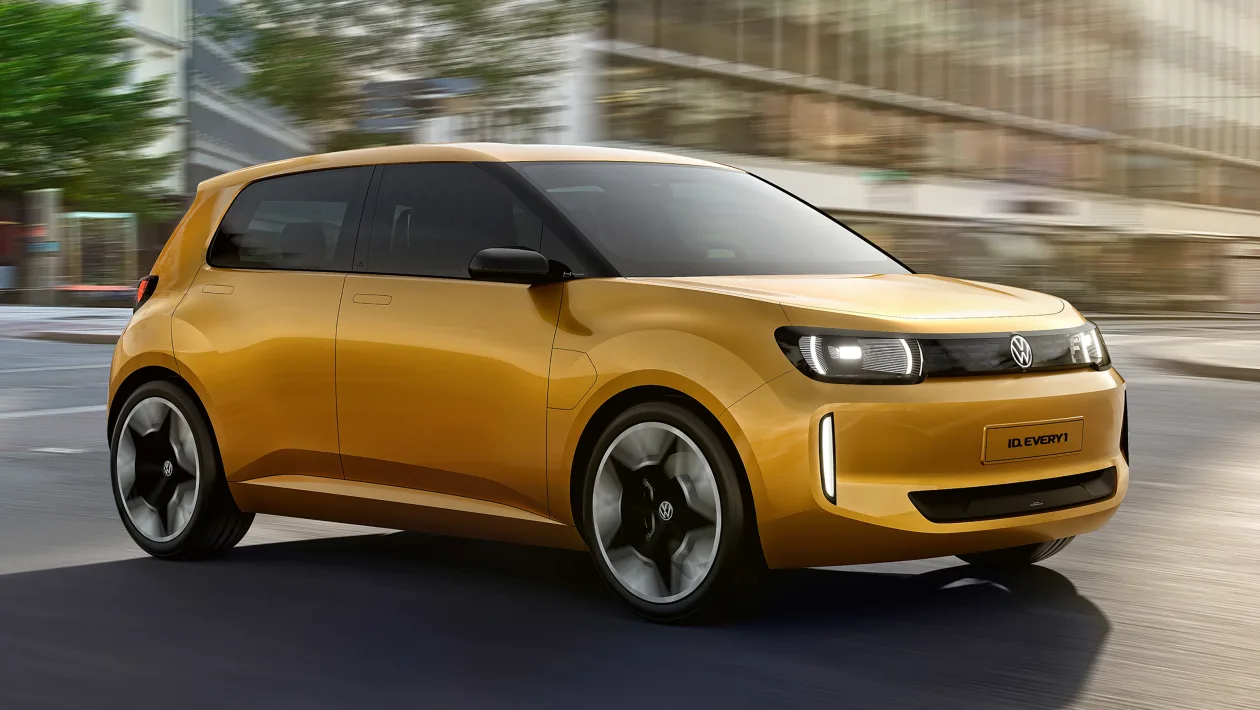
The Volkswagen ID. EVERY1 is the concept that previews the production model scheduled for 2027
Volkswagen prepares a €20,000 urban EV with Rivian technology
Volkswagen will launch in 2027 a city electric car with a target price of about €20,000, derived from the ID. EVERY1 concept. The new model will be the group’s first car to use a production version of the electronic architecture developed with Rivian.
Auto Express reports that the commercial name could be Volkswagen ID. up, a direct reference to the former urban up! model. The manufacturer has not yet confirmed the name. In official communications, the project continues to be presented as the production version of the ID. EVERY1 concept.
The car will sit below the ID. Polo, the electric B-segment model that reaches the market in 2026 at a price of about €25,000.
The ID. up name is not yet official
The forthcoming EV was previously associated with the names ID.1 and Lupo. Auto Express now says Volkswagen has chosen ID. up, as the brand starts replacing the numeric badges of the electric range with familiar names.
That strategy is already visible on the ID. Polo, the production version of the ID.2all concept. The British press also anticipates use of the ID. Tiguan name for a future electric SUV.
Until the official presentation, ID. up remains a probable but unconfirmed designation. Volkswagen has, however, set the timetable: the production model will be launched in 2027 and will be the entry point into the European electric range.
Auto Express indicates a first interior presentation at CES Las Vegas in January 2027, followed by the full premiere at the Munich Motor Show in September. Volkswagen has not published this programme separately in the available press releases.
Rivian technology does not mean a Rivian mechanical platform
The link with Rivian concerns first of all the electronic architecture and the software, not the American manufacturer’s chassis, battery or motors. The joint company Rivian and Volkswagen Group Technologies, called RV Tech, is developing a zonal architecture for software-defined vehicles.
In a traditional car, numerous separate computers control individual functions. A zonal architecture groups those tasks into more powerful central computers and reduces the number of modules, cables and distinct interfaces.
For the customer, the system should allow over-the-air updates, digital functions added after purchase, and more coherent integration between infotainment, driver assistance and the car’s controls. For the manufacturer, the stake is shorter development time and lower cost.
Volkswagen says a completely new model could be developed in about three years with the new software base, and a major update in 24–26 months. Those intervals are development targets, not promises about how often each car will receive updates.
The ID. EVERY1 has already been through winter testing
RV Tech used ID. EVERY1 prototypes to validate the electronic architecture in winter conditions. The tests were run in Phoenix, United States, and Arjeplog, Sweden, alongside Audi and Scout reference vehicles.
Volkswagen announced in March 2026 that this stage had been completed successfully. The cars were technical prototypes with a provisional body, and their appearance did not represent the final production shape.
The ID. EVERY1 is the group’s first project scheduled to use the initial version of the SDV architecture. Models built later on the SSP platform will adopt more extensive generations of the same technology.
What the car takes from the ID. EVERY1
The concept is 3,880 mm long, about 280 mm longer than the old Volkswagen up!. The dimensions remain suitable for the city, but the wheelbase and electric architecture allow a cabin for four people.
The boot volume announced for the concept is 305 litres, about 50 litres more than the former up!. Volkswagen says the design study is about 80% relevant for the production model.
The commercial version is expected to keep the proportions, wheel-arch treatment and general window shape. Smaller wheels, conventional door handles and changes to the headlights and taillights are expected.
The concept cabin combines a small driver display with a central screen and physical controls for climate, volume and seat heating. The final layout has not been shown, and equipment levels will vary by version.
95 hp and 250 km are the concept figures
The ID. EVERY1 uses an electric motor of 70 kW, equivalent to about 95 hp, and has a declared top speed of 130 km/h. The estimated range for the concept is at least 250 km.
Volkswagen has not published the battery capacity of the production model. Auto Express estimates a pack of about 35–40 kWh and considers LFP chemistry likely, but those two details are not confirmed by the manufacturer.
The British title also mentions the possible use of the 37 kWh battery prepared for the base ID. Polo, in which case range could increase. Integration into the shorter wheelbase and commercial availability remain unannounced.
The final figures that will matter are WLTP range, DC charging power, the battery’s thermal equipment and consumption. For an urban car, the difference between modest rapid charging and a well-supported one can count on occasional trips outside the city.
How Volkswagen is trying to reach €20,000
Volkswagen says the model would not be profitable if it were developed entirely separately. The project reuses components and solutions from the group’s urban electric family, which includes the ID. Polo, ID. Cross, Cupra Raval and Skoda Epiq.
The front end as far as the A-pillar is technically close to the ID.2all concept, while the rear axle comes from the current Polo ecosystem. The motor, battery and wheelbase are adapted for the smaller car.
The savings do not come only from a smaller battery. Standardising structural components, cutting the number of computers, simplifying the wiring and shortening development are needed if a price of about €20,000 is also to generate a profit.
The target is expressed for the base version and is not yet a list price in Romania. Taxes, standard equipment and the battery configuration can change the figure at launch.
Rivals of the future urban Volkswagen
The electric city-car segment will be more crowded in 2027. Renault is preparing the new electric Twingo, Citroën offers the ë-C3, Fiat has the Grande Panda Electric, and Dacia and Leapmotor cover the lower price zone with the Spring and T03.
Volkswagen will try to differentiate itself through interior space, the service network and a software platform capable of updates. Success will depend, however, on the real price and the equipment of the base version. A car announced at €20,000 can become considerably more expensive if rapid charging, a heat pump or important assistance systems are optional.
What it means for Romania
The model is being developed under the “from Europe for Europe” strategy, so a regional launch is confirmed. Volkswagen has not yet published the date of entry into Romania, local prices or the configurations that will be available.
At about €20,000 before any incentives, the forthcoming EV would sit in a price zone close to some combustion city cars and below most current European electric models.
For Romanian buyers, battery warranty, rapid charging, winter range and the inclusion of connected services will matter. The Rivian architecture may improve the software, but it does not compensate for a battery that is too small for the owner’s real journeys.
Frequently asked questions
When will the production ID. EVERY1 model be launched?
Volkswagen schedules the launch for 2027.
Will it be called Volkswagen ID. up?
Auto Express indicates this name, but Volkswagen has not confirmed it officially. ID.1 and Lupo were other names previously floated.
How much will it cost?
Volkswagen’s target is about €20,000 for the base version. The final price for Romania has not been announced.
What technology does Rivian provide?
The joint company RV Tech is developing the zonal electronic architecture and the software. The mechanical platform and propulsion components come from Volkswagen Group projects.
What range will it have?
The ID. EVERY1 concept announces at least 250 km. The WLTP range of the production model is not yet public.
Will it be sold in Romania?
The model is intended for Europe, but the timetable and the offer for Romania have not been communicated.