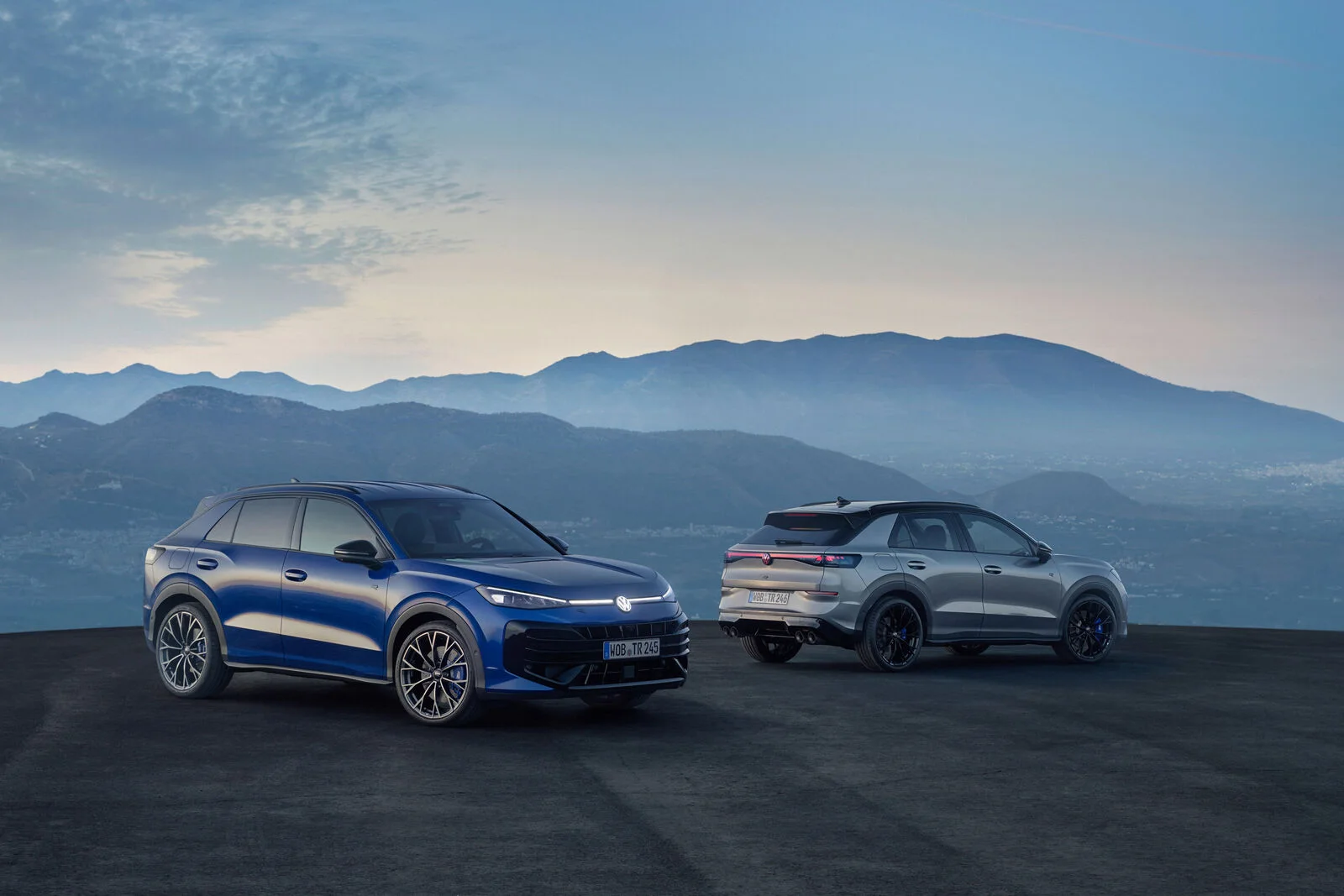
Volkswagen has unveiled the second-generation T-Roc R with a 245 kW (333 PS) 2.0-litre mild-hybrid petrol engine, 420 Nm and a German starting price of €59,995. The compact performance SUV reaches 100 km/h from rest in five seconds and is electronically limited to 250 km/h. German pre-sales open on 19 November 2026, one day after the world premiere.
Those commercial details apply to Germany. Volkswagen has not published a complete European market list, country-by-country prices or delivery timing. It also describes the quoted fuel consumption of 7.9–8.3 l/100 km and CO₂ emissions of 181–190 g/km as preliminary forecast values. Both ends of that range sit in German CO₂ class G.
A 48-volt system designed for response as well as recovery
The EA888 evo5 engine introduces 48-volt technology to a Volkswagen R model for the first time. An electrically driven compressor raises torque at low engine speed while the exhaust-driven turbocharger builds pressure. Volkswagen says the arrangement avoids a noticeable interruption in tractive effort, although that description and the five-second acceleration figure are manufacturer claims rather than independent test results.
The electrical system also captures energy during braking and deceleration. Recovered energy enables the combustion engine to switch off during suitable coasting phases. This is a mild hybrid, not a plug-in hybrid: Volkswagen does not claim a useful electric-only driving range, and there is no external charging connection.
A seven-speed dual-clutch gearbox is standard. Launch control helps produce the official acceleration time, while 4MOTION sends drive to both axles. The final specification therefore confirms much of what had previously been inferred from the closely related Golf R, but it does so with an explicitly electrified engine installation.
Torque vectoring extends across the rear axle
The R-Performance torque-vectoring system can alter drive distribution between the front and rear axles and between the two rear wheels. Volkswagen says new control software improves behaviour on a split-friction surface, where the tyres on one side of the vehicle have less grip than those on the other. Wet paint, patchy ice or a road edge covered in loose material are the type of conditions in which that control problem matters.
Race mode changes the responses of the engine, DCC dampers, progressive steering, torque splitter and all-wheel drive through an R button on the steering wheel. Special mode uses settings developed for the Nürburgring Nordschleife. Drift mode is also standard, but Volkswagen explicitly describes it for closed courses. It should not be read as permission to disable ordinary road-safety margins.
The torque splitter is a more consequential distinction than the four visible exhaust outlets. It gives the control system a way to influence the car's attitude under power rather than merely reacting through the brakes. Volkswagen has not yet supplied independent handling data, a kerb weight or a Nürburgring lap time, so the effect cannot be quantified from the launch material alone.
Standard DCC and an 18-inch braking system
Adaptive DCC sports suspension, progressive steering and 18-inch brakes with blue callipers are standard. The basic chassis layout combines MacPherson struts at the front with a multi-link rear axle. Volkswagen says the powertrain, braking system and chassis completed final tuning on a circuit, but the release does not provide braking distances, lateral-acceleration figures or comparative test results.
Standard Zandvoort alloy wheels measure 19 inches. Optional 20-inch Warmenau forged wheels reduce wheel mass, although Volkswagen has not stated the saving or the option price. Larger wheel and tyre packages can change ride quality, replacement cost, rolling resistance and the homologated consumption figure; the company includes the same qualification in its regulatory note.
The four-outlet sports exhaust is standard. An Akrapovič titanium R-Performance system is optional. Again, the announcement contains neither its German price nor a measured weight difference. Buyers will need the configurator rather than the press release to decide whether that option has a practical benefit beyond material and sound.
R-specific controls and a 3,000 rpm start routine
Inside, the T-Roc R gets sports seats with blue R logos and contrast stitching, R door-sill plates and a dedicated steering wheel with shift paddles. Digital Cockpit Pro adds a rev counter, gear-shift prompts, a GPS lap timer, an accelerometer and a display showing all-wheel-drive torque distribution.
One unusual routine deliberately raises engine speed at start-up. The driver holds the Engine/Start button for at least 1.5 seconds without pressing the brake, then starts the engine while pressing the brake pedal. Engine speed briefly rises to 3,000 rpm and the exhaust produces a louder start. It is a theatre feature rather than a performance prerequisite.
Lapiz Blue metallic remains an R-exclusive colour. Canary Yellow, Pure White, Wolf Grey metallic and Grenadilla Black metallic complete the announced palette. All except Grenadilla Black can be paired with a black roof. High-gloss black exterior attachments, a specific front bumper and rear diffuser identify the R without relying solely on badges.
What the €59,995 figure does and does not answer
The German list price establishes a useful reference because it includes the major dynamic hardware: 333 PS, torque-vectoring 4MOTION, DCC, progressive steering, the large brakes, 19-inch wheels and the three performance driving modes. It does not reveal how the car will be equipped or priced in France, Italy, Spain, Romania or other markets, nor does it cover the optional titanium exhaust and 20-inch wheels.
Final WLTP certification also matters. A preliminary upper figure of 8.3 l/100 km makes clear that the 48-volt system is being used partly to sharpen engine response and recover energy, not to deliver full-hybrid urban economy. Before ordering, buyers should compare the final national price, standard warranty, tyre cost and confirmed consumption with the regular T-Roc 4MOTION and other performance crossovers. Volkswagen's next practical step is to publish those local price lists and delivery dates.