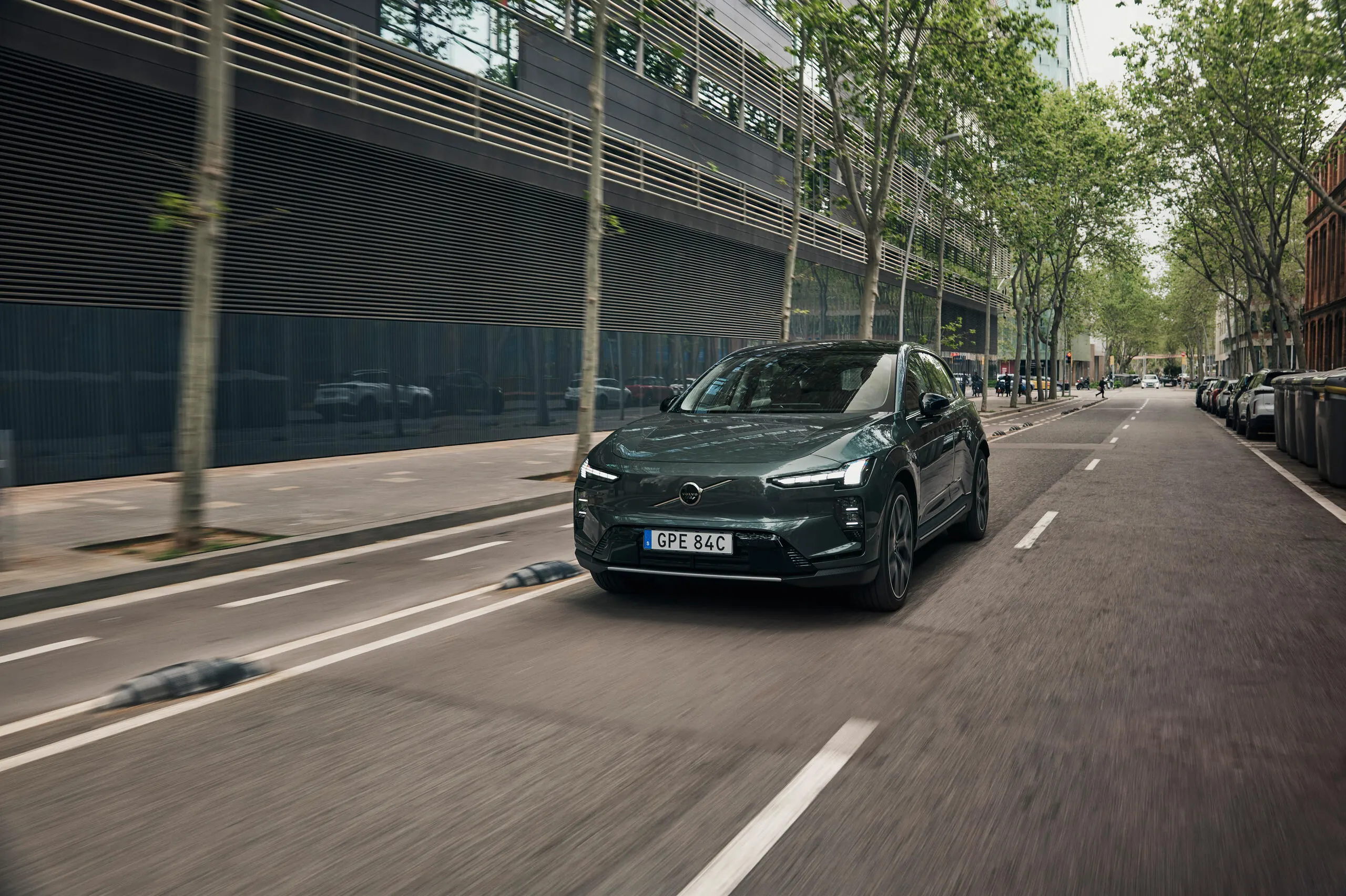
The Volvo EX60 has been named Carwow Car of the Year 2027, while also winning the publication's Outstanding EV category. Carwow announced the result on 19 November 2026 after its road-testing team, led by chief content officer Mat Watson, assessed hundreds of cars. It cited comfort, family practicality, restrained Scandinavian design, driving manners and the combination of long range with rapid charging.
The wording requires one important qualification. This is Carwow's own editorial award in the United Kingdom. It is not the separate European Car of the Year prize decided by an international jury of motoring journalists. The EX60 is one of seven finalists for that European title, but its winner is not due to be announced until 8 January 2027. Carwow's result is final; the European contest remains open.
Why Carwow chose the EX60
The EX60 was the only vehicle to take both the overall award and one of the 14 named categories. Watson's published reasoning concentrated on qualities that matter during ordinary family use: comfortable seats, a calm cabin, usable space and a ride that remains forgiving over broken surfaces without making the car feel clumsy through corners. Carwow then linked those qualities to the top version's claimed range and charging ability.
Those observations are the judgement of a commercial automotive media team, not measurements from a regulatory or independent laboratory protocol. Carwow has not published a numerical formula showing how the EX60 scored against every category winner. The award is therefore best read as an informed editorial recommendation based on the outlet's testing, not as universal proof that the Volvo leads every electric SUV in safety, efficiency, reliability or ownership cost.
The second trophy provides useful context. By naming the EX60 Outstanding EV as well as its overall winner, Carwow said the electric powertrain was a strength without reducing the car to its battery specification. A long laboratory range would have been less persuasive if rear-seat space, suspension comfort or control usability had undermined the family-car brief.
The official technical claims behind the verdict
Volvo builds the five-seat EX60 on its SPA3 electric architecture. In European specification, the P12 AWD version uses a nominal 117 kWh battery and an 800-volt electrical system. Volvo lists up to 810 km of combined WLTP range and a 10–80% DC charging time of 19 minutes when connected to a compatible 400 kW charger under suitable conditions.
WLTP is a standardised comparison figure, not a promise for every journey. Speed, weather, battery temperature, cabin heating, load and wheel choice all affect real consumption. The charging time also assumes that the battery can accept a high rate and that the charger can deliver it; preconditioning and starting state of charge matter. Carwow's award does not change those limits.
Official European data list the P12 AWD at 500 kW and 790 Nm, with 0–100 km/h in 3.9 seconds and a 180 km/h governed maximum speed. Volvo's national pages sometimes show small differences in published output, which is why local homologation and order documents should take precedence over a foreign press release.
The P10 AWD sits below it with a nominal 95 kWh battery, up to 660 km WLTP range and a stated 10–80% time of 16 minutes. Volvo lists 375 kW, 710 Nm and 4.6 seconds from 0–100 km/h for this derivative. The version range and standard equipment differ by market, and the UK award announcement is not an availability or price statement for every European country.
A mid-size SUV with full-size numbers
The EX60 is 4,803 mm long, 1,908 mm wide excluding mirrors and 1,635 mm tall, with a 2,970 mm wheelbase. Volvo's model-year technical sheet gives 523 litres of luggage capacity with the rear seats in place and as much as 1,647 litres when they are folded. The cited AWD derivatives can tow a braked trailer weighing up to 2,400 kg.
Those measurements explain why practicality featured prominently in Carwow's decision. The EX60 is not a small urban crossover; it is positioned in the heart of the premium family-SUV class previously served by the XC60. Buyers should consider the other side of that scale too: a large battery, high kerb weight and substantial tyre sizes can affect energy use, replacement costs and manoeuvrability even when the cabin package is convincing.
The model was not merely an unreleased prototype when it received the award. Volvo began European customer deliveries in July 2026, initially in Sweden, and said production and deliveries would ramp up during the second half of the year. That does not prove long-term reliability, residual value or winter range, but it does mean early customer cars were already on European roads.
The other 2027 Carwow winners
Carwow spread its 14 awards across very different use cases. The Geely EX5 won Smart Spender, Renault's Twingo E-Tech took Urban Living and the Kia PV5 Passenger won Family Values. Toyota's Hilux was the Adventurer's Choice, while the Jaecoo 8 was named Hybrid Hero.
The BMW 7 Series won Comfortable Cruiser, and the Porsche 911 GT3 S/C took Pleasure of Driving. Pagani's Huayra Codalunga Speedster was selected for Desirability. The Kia PV5 Cargo became Van of the Year, BYD Flash Charging won Tech Trailblazer, BYD was named Brand of the Year and the Geely Galaxy Cruiser concept became 2026's Most Talked About Car.
This list shows why the awards are not a conventional league table. A pick-up, van, compact city EV, limousine and limited-production supercar can each win because they answer different questions. The EX60's overall victory reflects Carwow's view that it forms the most complete package, not a claim that it can substitute for every category winner.
What prospective buyers still need to verify
An award cannot replace the local order sheet. Buyers need to confirm battery and motor version, wheel size, standard driver-assistance equipment, charging curve, battery warranty and a realistic delivery date in their own market. The ability to precondition the battery before a rapid-charging stop is particularly relevant if the advertised 19-minute session influences the purchase decision.
The 810 km WLTP maximum makes model-to-model comparisons possible under a common cycle, but it cannot predict a winter motorway journey, towing consumption or a fully loaded family holiday. A route-specific test and a look at the charging network are more informative than applying the maximum figure to every scenario.
The precise conclusion on 19 November is consequently narrower than the headline can suggest: the Volvo EX60 has won Carwow Car of the Year 2027 and Outstanding EV. It is a significant editorial endorsement for an electric SUV already entering European service, but it is neither the result of the separate European Car of the Year vote nor a guarantee of identical price, specification or real-world range in every country.