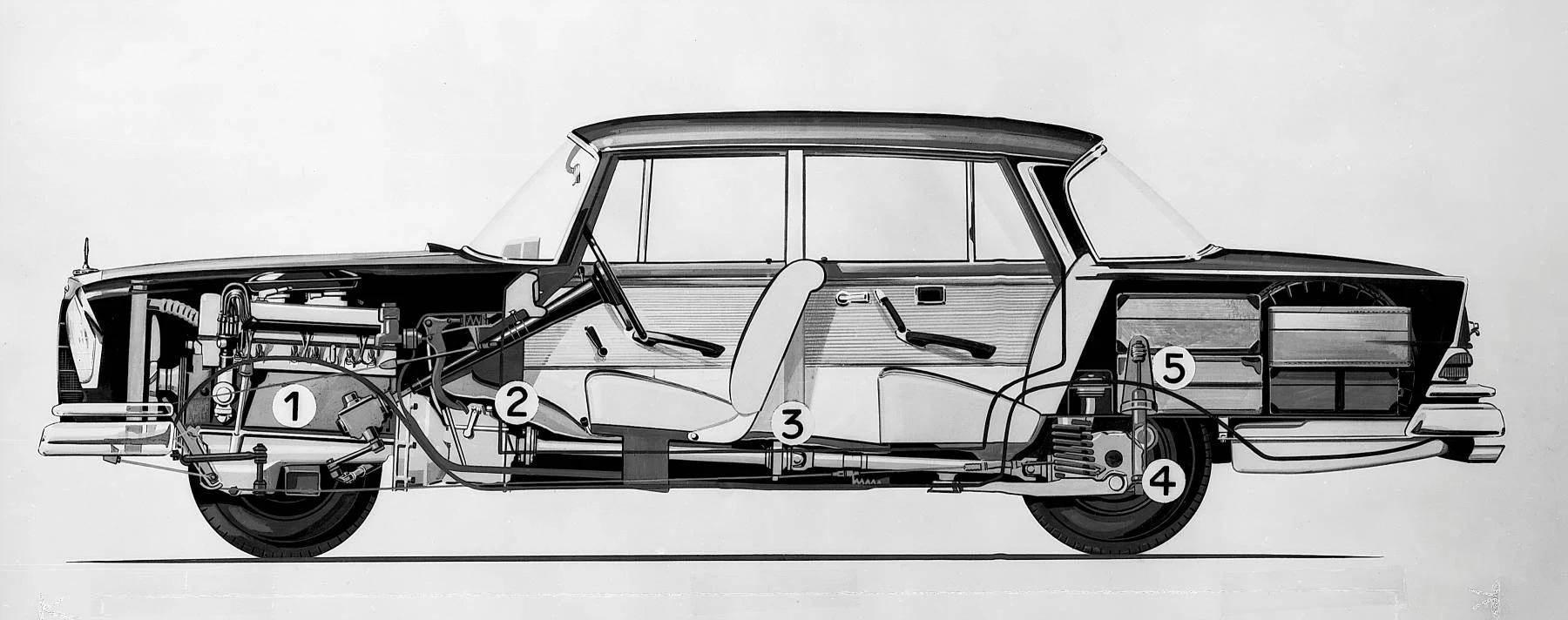
A modern car with its bonnet folded and front structure crushed has not necessarily failed. Controlled deformation can show that the body has used its outer structure to manage collision energy before it reaches the occupants. Engineers do not try to keep every panel intact. They aim to preserve survival space in the passenger compartment and coordinate the structure with seat belts and airbags.
The body therefore contains parts with deliberately different jobs. Front and rear structures are designed to collapse progressively in relevant impacts. The central safety cage is much stronger and should limit the movement of the dashboard, steering column, pedals, pillars and floor into the cabin.
A moving car's energy has to go somewhere
Kinetic energy increases with mass and with the square of speed. If speed doubles while mass stays the same, the energy that must be managed increases fourfold. That is why a seemingly modest increase in impact speed can cause a disproportionately severe crash.
NHTSA explains frontal crashworthiness in terms of two linked problems: rapid deceleration of the occupant compartment and loss of survival space through structural crush. A controlled front end extends the time over which the vehicle slows. The interval is still extremely short, but a less abrupt change in velocity can reduce peak forces on restrained occupants.
The metal does not make energy disappear. Longitudinal rails, crossmembers and designed failure points bend, fold and sometimes tear, transforming energy through deformation as well as heat and sound. The sequence is engineered so the load follows intended paths rather than reaching the cabin as an uncontrolled collapse.
Why making the whole car rigid would not work
A completely rigid vehicle could stop very abruptly and transmit more deceleration to the people inside. A body that is too weak creates the opposite danger: it runs out of crush space and intrudes into the passenger compartment. Good crashworthiness lies between those extremes.
IIHS describes a crashworthy vehicle as a system: a strong occupant compartment, crumple zones, effective side structure, a roof that resists collapse, and restraints that keep people positioned while managing loads. An airbag cannot compensate for a collapsing safety cage, and a strong cage cannot protect an unrestrained occupant by itself.
Seat-belt pretensioners remove slack, load limiters control forces on the chest, and airbags spread loads while reducing contact with hard surfaces. Their timing is calibrated around the crash pulse, the pattern of deceleration generated as the body deforms.
The safety cage must behave differently
NHTSA distinguishes beneficial front-end crush from occupant-compartment collapse. Intrusion can bring the steering mechanism, pedals or structure into direct contact with occupants or trap them by reducing survival space. Crash laboratories therefore measure both dummy injury values and the movement of structural reference points.
This makes a post-crash photograph difficult to judge. A shortened engine bay and folded rails may be expected. Large movement of an A-pillar, footwell or floor is a separate concern. Visible exterior damage alone does not establish whether a car performed well.
Side impacts have much less room
At the front there is distance between the bumper and cabin. At the side, the occupant may be only a short distance from the door. Sills, pillars, door beams and floor crossmembers must distribute loads quickly, while side and curtain airbags protect the head and torso. There is far less structure available to absorb energy before intrusion begins.
Euro NCAP uses destructive laboratory tests covering frontal, side and pole impacts as well as different occupant sizes. Its 2026 framework expands the dummy population and scenarios and adds further rollover-protection requirements. The rating assesses a complete protection strategy rather than merely the thickness of the body panels.
Size, weight and crash compatibility
IIHS notes that a bigger, heavier vehicle generally protects its occupants better than a smaller, lighter vehicle, all else being equal. A longer front end offers more crush distance. In a collision between vehicles of different mass, the lighter vehicle also tends to experience the greater change in speed.
That does not mean maximum rigidity and height are desirable for society. Vehicle structures need to align so their energy-absorbing components engage each other. Euro NCAP's mobile progressive deformable barrier test considers not only protection inside the tested car but also how aggressive its front structure may be toward a collision partner.
Larger vehicles can also create greater risks for pedestrians and cyclists. Occupant protection, compatibility and vulnerable-road-user protection are separate but connected design problems.
The idea dates to Béla Barényi
Mercedes-Benz credits engineer Béla Barényi with the modern safety-body concept. His patent application was filed on 23 January 1951 and the patent was granted in 1952. It divided the vehicle into deformable front and rear sections surrounding a dimensionally stable passenger cell.
The principle entered series production in 1959 with the Mercedes-Benz W 111 “Fintail” saloons. Mercedes-Benz also links the design to the beginning of its systematic crash testing that year. Materials, simulation and test methods have changed dramatically, but this division of duties remains fundamental.
Repairability is a different question
A structure that protects occupants can still be expensive to repair. Crash boxes, rails, bonded joints, restraint components and sensors may need replacement after doing their job. Cameras and radar units located near bumpers can require calibration even after a relatively moderate collision.
An electric vehicle adds high-voltage inspection requirements, but the same safety principle applies: energy-absorbing structures must work around a protected occupant cell and battery enclosure. Any repair must follow the manufacturer's procedures. Pulling a rail back into shape without restoring its material properties and joints may change its behaviour in a second crash.
What buyers can check
Euro NCAP, IIHS and NHTSA results should be matched to the precise model year and version. Test protocols evolve, so identical star counts from different years do not always represent the same standard. Ratings also describe specific test conditions, not a guarantee for every real collision.
For a used car, accident history and repair quality matter alongside the original rating. Uneven seams, disturbed structural sealant or undocumented airbag replacement deserve professional inspection. A car designed well can lose that protection if repaired incorrectly.
Crumple zones do not make crashes harmless and cannot overcome unlimited speed. They provide distance and time for the structure and restraints to manage forces. The goal is not simply for a car to “fall apart”; it is for selected parts to deform predictably while the space occupied by people stays as intact as possible.