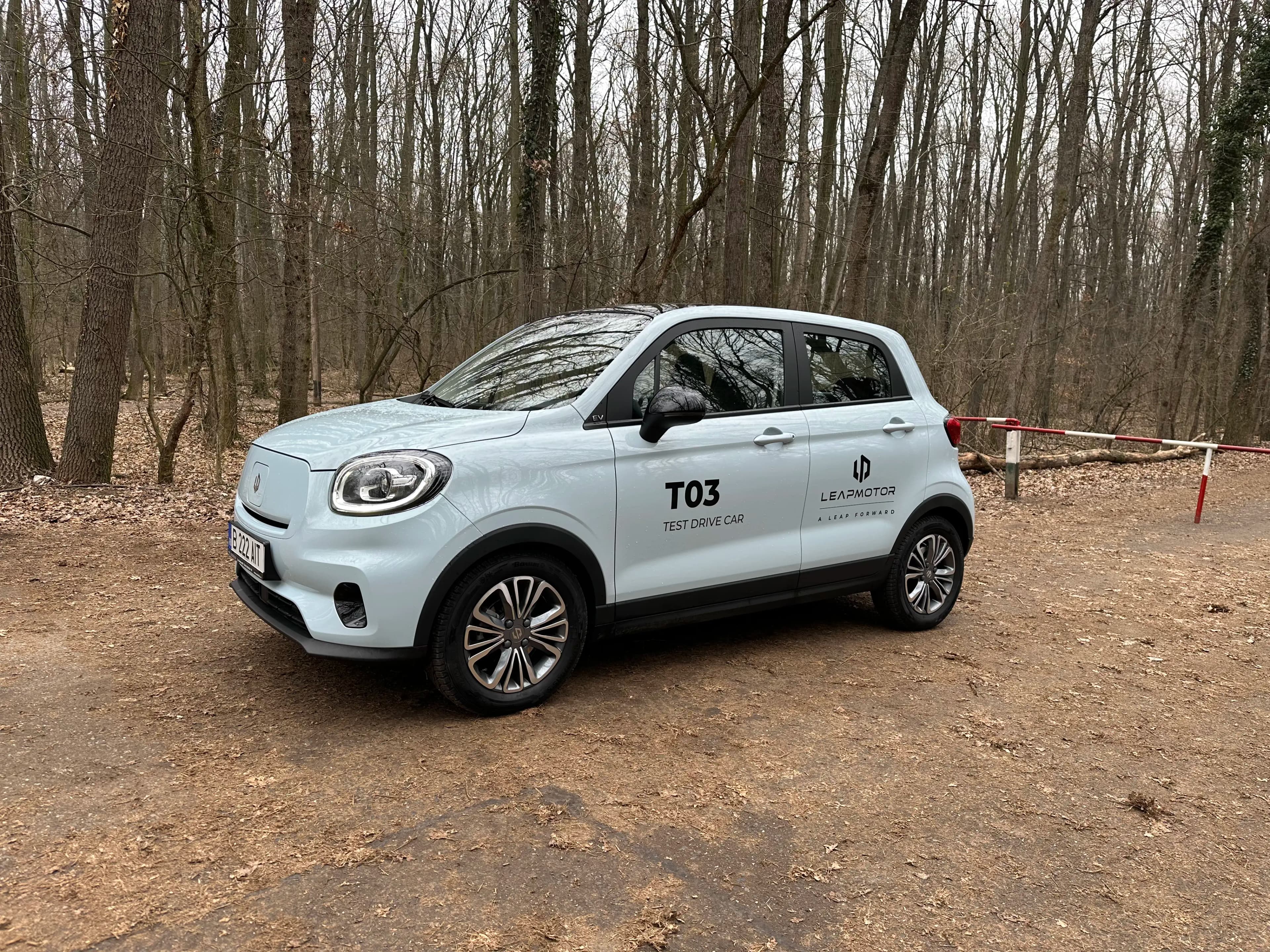
In an increasingly diverse electric car landscape, the Leapmotor T03 stands out as an interesting proposal for the European market. This compact vehicle from Chinese maker Leapmotor enters the EV scene promising an affordable, efficient alternative for urban mobility — attractive design and small dimensions make it practical in congested cities.
The Leapmotor T03 arrives as demand for accessible electric cars grows, while traditional manufacturers seem to have abandoned the city-car segment in favour of larger, pricier models. T03 targets buyers who want to switch to electric mobility without a large investment, yet still receive a surprisingly rich technology and safety package for the class.
In this test drive we explore what Leapmotor T03 brings to the Romanian market in detail — performance, equipment, comfort and value for money. We examine real urban range, charging times, road behaviour and specification levels to give a complete picture of this new player in compact EVs.
Through this analysis we aim to give readers an objective view of T03’s advantages and potential drawbacks, helping them judge whether it fits their urban mobility needs. As the electric market evolves quickly, T03 is a proposal worth considering — especially for those seeking an electric alternative to conventional city cars.
The Leapmotor T03 stands out with compact, modern design perfectly suited to urban life. At just 3.62 metres long, it fits the city-car category with excellent manoeuvrability in tight spaces and easy parking. The exterior is pleasant, with clean lines and balanced proportions — discreet but attractive in busy streets.
The front is dominated by a compact grille and modern LED headlamps giving a friendly, contemporary face. The side profile highlights compact form; a slightly arched roofline helps aerodynamics without sacrificing interior space. The rear features elegantly integrated LED tail-lights, completing a clean, functional look.
Standard 15-inch alloy wheels are aesthetic and practical, contributing to energy efficiency and ride comfort. Body colours include modern, attractive shades for personalisation.
A distinctive exterior element is the panoramic glass roof — unusual in this class — adding elegance and significantly improving light and spaciousness inside. It shows Leapmotor’s attention to comfort and aesthetics, not just function.
Despite compact dimensions, T03 looks robust and well proportioned. Design is not revolutionary but distinct enough to stand out without being loud — suitable from young urban drivers to families wanting a second city car.
The Leapmotor T03 interior pleasantly surprises with space and equipment, exceeding expectations for the class. Although exterior dimensions are compact, designers maximised cabin room, delivering remarkable comfort for four adults. Front seats are comfortable with a good driving position and excellent visibility.
The dashboard centres on an 8-inch digital instrument display and a 10.1-inch central touchscreen for infotainment — intuitive interface with navigation, Bluetooth and smartphone compatibility. Material quality is mixed: some hard plastics, but also superior-feeling elements such as the eco-leather steering wheel.
The panoramic roof brings abundant natural light and amplifies spaciousness. An electric blind for the panoramic roof is an appreciated detail, allowing brightness to be controlled according to preference.
Rear passenger space is surprisingly generous for the size, with adequate leg and headroom for adults. Boot capacity is 210 litres — enough for daily shopping or small luggage — expandable to 880 litres with the rear seat folded.
Single-zone automatic climate control is efficient and easy to use. Front and rear electric windows with one-touch and pinch protection add comfort and safety.
Ergonomically, most controls are well placed. Dependence on the touchscreen for some functions can be awkward while driving. The driver’s seat adjusts manually in six directions for a comfortable position for most users.
Overall, the T03 interior balances functionality and comfort, exceeding expectations for a small, affordable electric car. Some materials could improve, but equipment level and detail attention make the onboard experience pleasant and relaxing.
The Leapmotor T03 uses an electric motor producing 70 kW (95 hp) and 158 Nm peak torque. Figures may seem modest versus pricier EVs but suit a compact urban car. 0–100 km/h takes about 12.7 seconds; top speed is electronically limited to 130 km/h — class-average and sufficient for city and national-road use.
The lithium-ion battery has a capacity of 37.3 kWh, offering a declared WLTP range of up to 265 km in mixed use and an impressive 395 km in exclusively urban driving cycles on paper. In real mixed urban and extra-urban testing, range varied significantly with driving style, traffic and climate use. We measured approximately 220–240 km — good for the class.
Average energy consumption sat around 15–16 kWh/100 km in normal use, rising to about 18–20 kWh/100 km with aggressive driving or heavy traffic and frequent air conditioning. In winter with low temperatures and intensive heating, range and consumption can worsen noticeably.
For charging, T03 accepts AC up to 6.6 kW and DC fast charging at 48 kW. A full charge at a domestic socket takes about 6–7 hours; at DC, 30–80% takes about 36 minutes. Those times are competitive for the target segment, making T03 practical for users with home or workplace charging.
Dynamics prioritise comfort and efficiency over sport. Suspension balances comfort and stability, absorbing most urban bumps. Steering is light and precise for tight manoeuvres; regenerative braking aids efficiency and smooth urban driving.
Overall, T03 performance and range fit primary urban use, balancing energy efficiency and daily practicality.
The Leapmotor T03 impresses with technology and connectivity beyond its price class. The 10.1-inch infotainment screen offers an intuitive interface and broad functionality.
Multimedia includes integrated navigation, Bluetooth connectivity for audio streaming and hands-free calls, plus smartphone compatibility. Although Apple CarPlay and Android Auto are not offered, the proprietary interface is well conceived and easy to use. The screen has good resolution and responds quickly to inputs, making navigation through menus and settings a pleasant experience.
An 8-inch digital instrument cluster gives clear, customisable essential driver information — speed, remaining range, energy consumption, power flow and other EV-relevant data.
Connectivity includes integrated Wi-Fi hotspot and 4G modem, enabling over-the-air (OTA) software updates without service visits.
An innovative Bluetooth key allows unlock and start via smartphone, complemented by standard keyless entry for daily convenience.
The audio system is not cutting-edge, but the four integrated speakers deliver decent sound quality for everyday listening. Buyers who want a richer experience can upgrade to a more capable system where offered.
For driver assistance, T03 comes with a set of advanced systems, including adaptive cruise control, lane keeping assist, forward collision warning with autonomous emergency braking and blind-spot monitoring. These systems can feel overly sensitive in heavy urban traffic, yet they contribute significantly to safety and comfort while driving.
A driver fatigue monitoring system uses a camera to detect tiredness and warn the driver — rare in this class.
Overall, T03’s technology package is impressive for the price, with connectivity and assistance rivalling costlier models. Smartphone platform integration could improve, but tech is a clear strength.
The Leapmotor T03 emphasises safety with a wide driver-assistance suite — surprising protection for the price. Leapmotor invested heavily, fitting advanced tech usually seen on more expensive cars.
The body structure targets optimal crash protection. T03 has not yet been Euro NCAP tested, but design follows current safety standards. Six airbags are fitted: front driver and passenger, side thorax and curtain head protection for full coverage.
Active safety systems include ESC (Electronic Stability Control), which incorporates ABS (anti-lock braking), BAS (brake assist) and TCS (traction control). These systems work together to maintain vehicle control in critical situations and help prevent skids on slippery or uneven surfaces.
E-Call can automatically alert emergency services after a serious accident, transmitting exact location — crucial if occupants cannot call for help.
Driver assistance technologies include:
These can feel oversensitive in heavy urban traffic but significantly improve safety and reduce accident risk. Sensitivity can be adjusted within limits so drivers can tailor behaviour to traffic and preference.
Rear parking sensors and a reversing camera help tight manoeuvres and reduce minor parking bumps.
In conclusion, T03’s safety and assistance package is impressive for the class, rivalling costlier models — a significant competitive advantage for buyers who refuse to compromise on protection in a compact urban EV.
The Leapmotor T03 driving experience is tailored to urban life — comfort, easy manoeuvring and efficiency. During testing we explored behaviour in varied urban and suburban traffic for a complete daily-use picture.
Compact dimensions are a major advantage in congestion. At 3.62 metres, the car slips through tight gaps and parks where larger vehicles struggle. A small turning circle makes U-turns and tight spaces easy.
Acceleration is not spectacular but sufficient for city needs. Instant electric torque gives prompt getaways for merging. At higher speeds performance is moderate but adequate for occasional national roads or ring roads.
Suspension balances comfort and stability, absorbing most urban surfaces from smooth asphalt to cobbles and small bumps. At speed on rougher roads, compact character shows with some vibration transmitted to the cabin.
Steering is light and precise with decent feedback at higher speeds. Braking, including regeneration, is effective and easy to modulate. Regeneration levels are adjustable, enabling one-pedal driving in much urban traffic.
Interior noise is low. Absence of a combustion engine and good insulation create a calm cabin even at speed, reducing fatigue on long urban runs.
Visibility is generally good; relatively slim A-pillars preserve forward view. Reversing camera and parking sensors compensate for typical compact-car rear visibility limits.
Assistance systems, though sometimes sensitive, add safety and comfort. Adaptive cruise works well on arterial roads; lane keeping assists subtly without feeling intrusive.
On efficiency, T03 excels in town. Low stop-and-go consumption and effective regen maximise range. In winter urban-only testing we easily exceeded 200 km real range.
In conclusion, T03 is clearly aimed at urban use, where it excels in manoeuvrability, comfort and efficiency. It is not built for sport or long motorway hauls, but proves an ideal daily city companion — relaxed and economical.
One of the most attractive T03 aspects is low running and maintenance cost typical of EVs. This section analyses ownership economics and long-term savings.
Electricity to charge the battery costs far less than fuel for a comparable combustion city car. At observed consumption of about 15–16 kWh/100 km and average Romanian electricity prices, cost per 100 km sits around €3–4 — substantial savings versus petrol for a similar-size car.
Maintenance is generally simpler and cheaper than for combustion vehicles — no oil filter, spark plugs or timing belt replacements. Regenerative braking reduces brake wear, extending pad and disc life.
Leapmotor offers a three-year or 100,000 km vehicle warranty and eight years or 160,000 km on the battery — extended protection against unexpected costs. Batteries eventually may need replacement at significant cost, though technology progress may lower future prices.
Insurance falls in a favourable class thanks to moderate power and advanced safety systems, potentially lowering premiums versus conventional peers.
Charging infrastructure matters: home wallbox users see the lowest long-term costs; public charging varies but generally stays below fossil fuel.
On depreciation, EVs often retain value better than combustion equivalents due to evolving technology and rising demand for low-emission cars. As a new European brand, T03 resale is hard to predict precisely.
In conclusion, T03 running and maintenance costs are significantly lower than comparable combustion cars. Fuel and service savings can offset higher purchase price over time — attractive for high-mileage urban users with charging access. For drivers who cover many urban kilometres and can charge at home or at work, the T03 can be a financially sound long-term choice.
In the compact electric segment, Leapmotor T03 faces growing competition. To provide a complete perspective, we compare T03 with its main rivals on the Romanian market, highlighting the strengths and weaknesses of each model in this increasingly crowded field.
Compared with these competitors, Leapmotor T03 stands out for:
Areas where T03 may be surpassed by rivals include:
In conclusion, Leapmotor T03 positions itself as a competitive alternative in the compact electric vehicle segment, offering a good balance between price, equipment and performance. Although it faces challenges related to brand recognition and the support network, T03 has the potential to attract buyers through its advanced technology package and attractive quality-to-price ratio.