In the dynamic automotive market, the Mercedes-Benz GLA 250e stands out as an attractive option for those seeking a versatile and efficient vehicle. This compact plug-in hybrid SUV promises to combine Mercedes prestige with the advantages of eco-friendly technology, offering an apparently ideal solution for those who want to make a good impression both in the company car park and at the gym. But does the GLA 250e deliver the premium experience and performance expected of a Mercedes? Let us explore in detail what this vehicle offers and whether it truly deserves your attention.
The GLA 250e represents a significant evolution over its predecessor, bringing notable improvements in interior space, onboard technology and energy efficiency. With refined exterior design and a luxurious cabin, this compact SUV targets those who value style and functionality equally. The plug-in hybrid system promises impressive electric range for daily urban trips, while the petrol engine provides the freedom needed for longer journeys.
In this article we analyse the Mercedes GLA 250e in depth, examining design, performance, technology and the driving experience. We assess whether this model successfully combines characteristic Mercedes luxury with plug-in hybrid efficiency and whether it is indeed the ideal choice for the modern executive looking for a premium company car.
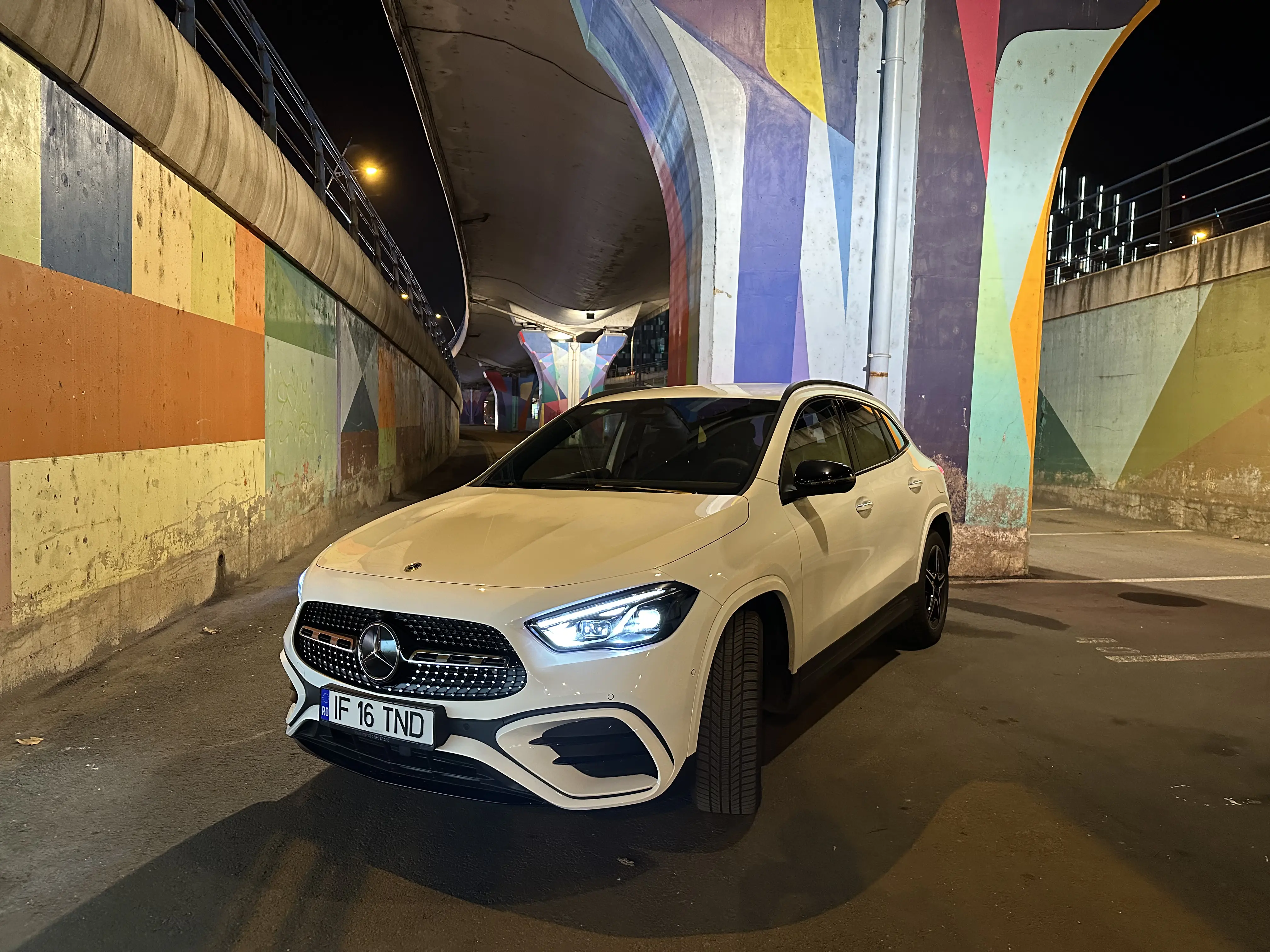
The Mercedes-Benz GLA 250e impresses at first sight with elegant, modern design that successfully blends the athletic lines of a compact SUV with the refinement typical of the German brand. Compared with the previous generation, the new GLA presents a more imposing, muscular stance, emphasising its premium crossover character.
The distinctive front grille, with the prominent Mercedes emblem, dominates the face of the vehicle, flanked by expressive LED headlights that incorporate the light signature characteristic of recent models from the brand. The side profile highlights flowing, well-proportioned body lines, with pronounced wheel arches that add robustness to the overall look.
The rear continues the elegant theme, with slim LED tail lights and an integrated diffuser that hints at performance. Chrome details and alloy wheels with hybrid-specific design complete the premium appearance of the GLA 250e.
A distinctive element of the plug-in hybrid version is the discreet presence of the charging port, elegantly integrated into the body without compromising the vehicle’s overall aesthetics. This subtle detail indicates the dual nature of the GLA 250e, combining Mercedes-Benz tradition with future technology.
The colour palette available for the GLA 250e offers options both for those who prefer a sober, elegant look and for those who want to stand out. From classic shades such as obsidian black or iridium silver to bolder colours such as jupiter red or denim blue, there is a variant for every preference.
Overall, the exterior design of the Mercedes GLA 250e succeeds in conveying luxury and sophistication while maintaining a modern, dynamic appearance. It is a vehicle that will stand out both in a corporate car park and in front of a fine restaurant, reflecting the owner’s status and refined taste.
The interior of the Mercedes GLA 250e is an impressive demonstration of the German manufacturer’s ability to create luxurious, functional spaces in the compact SUV segment. The cabin reflects the brand’s contemporary design philosophy, blending premium materials with state-of-the-art technology in a harmonious, ergonomic whole.
At first glance, the dashboard captivates with two high-resolution digital screens that dominate the centre console. The MBUX (Mercedes-Benz User Experience) infotainment system offers an intuitive, fast interface controllable via touchscreen, voice commands or the touchpad on the centre console. The graphics are impeccable and response times are prompt, making navigation through menus and settings a pleasant, effortless experience.
The quality of materials used inside meets expectations for a Mercedes-Benz model. Fine leather upholstery, wood or aluminium inserts (depending on the chosen pack) and chrome elements create a premium atmosphere. Attention to detail is evident in flawless finishes and the pleasant texture of surfaces to the touch.
The front seats offer excellent lumbar and lateral support, with multiple adjustment possibilities. Space for rear passengers is generous, representing a significant improvement over the previous GLA generation. That makes the vehicle suitable for young families too, offering enough room to install child seats comfortably.
The two-zone climate system ensures optimal thermal comfort for all occupants, and ambient lighting with multiple colour options allows personalisation of the interior atmosphere according to preference or mood.
A hybrid-specific aspect is the discreet integration of indicators and controls related to the electric propulsion system. The digital instrument panel offers clear information on battery state, remaining electric range and energy flow between engine and battery without excessively loading the interface.
The boot, although slightly reduced in capacity compared with conventional versions because of the battery, remains practical and well organised. The 40/20/40 rear seat folding system offers flexibility in configuring load space.
Overall, the interior of the Mercedes GLA 250e succeeds in offering a level of refinement and comfort worthy of the premium class, combining functionality with luxury in a compact, well thought-out package. It is a space in which both driver and passengers will feel pampered, regardless of journey length.
The Mercedes GLA 250e stands out for its advanced level of technology and connectivity, offering an impressive suite of functions and systems designed to improve the driving experience and passenger comfort. At the centre of this technological experience is the MBUX (Mercedes-Benz User Experience) infotainment system, which represents the cutting edge of digital innovation in the automotive industry.
MBUX distinguishes itself through its intuitive interface and learning capabilities based on artificial intelligence. The high-resolution touchscreen, with a generous diagonal, offers quick access to all vehicle functions, from navigation and climate settings to personalisation of driving modes. The advanced voice command function, activated by the phrase “Hey Mercedes”, allows control of many car functions through natural commands, thus reducing driver distraction.
Smartphone integration is seamless, with support for Apple CarPlay and Android Auto, allowing easy access to favourite apps directly on the car’s central screen. In addition, the Mercedes me connect app offers the possibility to control and monitor various vehicle functions remotely, such as battery charge status, interior pre-climatisation or locating the car.
A distinctive element of the hybrid version is the energy management system, which offers detailed information on energy flow between the electric motor and the combustion engine, battery charge state and remaining range. This data is presented clearly and is easy to understand, helping the driver optimise the vehicle’s energy efficiency.
The integrated navigation system includes functions specific to electrified vehicles, such as locating charging stations and planning routes according to available electric range. It can suggest charging stops and estimate time needed to reach the destination, taking into account both electric range and that offered by the combustion engine.
Regarding driver-assistance systems, the GLA 250e is equipped with a wide range of active and passive safety technologies. These include automatic emergency braking, lane-keeping assistant, blind-spot monitoring and parking assistance with 360-degree sensors. Optionally, a semi-autonomous driving system is available, which can take partial control of the vehicle under certain traffic conditions.
Another important technological aspect is the premium sound system, which offers a high-quality audio experience. Optionally, customers can choose the Burmester surround sound system, which raises the audio experience to a higher level.
Overall, the technological package of the Mercedes GLA 250e is impressive, offering a level of connectivity and driving assistance that meets and even exceeds expectations for a vehicle in this class. The fluid integration of these technologies into the driving experience demonstrates Mercedes-Benz’s commitment to innovation and comfort, making the GLA 250e an attractive choice for technology enthusiasts.
The Mercedes GLA 250e impresses with its plug-in hybrid propulsion system, which combines the efficiency of an electric motor with the versatility of a petrol engine. This configuration offers a unique driving experience, blending performance with energy efficiency in a way that suits the modern urban lifestyle perfectly.
At the base of the propulsion system is a 1.3-litre turbocharged petrol engine that works in tandem with an electric motor. Together they generate a combined output of 160 kW (218 hp) and an impressive 450 Nm of torque. This combination allows the GLA 250e to accelerate from 0 to 100 km/h in approximately 7.1 seconds—a remarkable performance for a compact hybrid SUV.
A notable aspect is the vehicle’s ability to run exclusively in electric mode for short distances. With a declared electric range of up to 61 km (WLTP cycle), the GLA 250e can easily cover most daily urban trips without consuming fuel. That makes it an ideal option for the daily commute or short city trips.
The eight-speed automatic transmission stands out for smooth, quick shifts, contributing to a fluid, comfortable driving experience. The front-wheel-drive system is well calibrated, offering good grip in most road conditions.
Regarding driving dynamics, the GLA 250e offers a good balance between comfort and manoeuvrability. Adaptive suspension, available optionally, allows adjustment of ride characteristics according to driver preference and road conditions. In Comfort mode, the vehicle offers a smooth, relaxing ride, absorbing road irregularities effectively. Switching to Sport mode firms the suspension and makes steering more precise, offering a more engaging driving experience.
A hybrid-specific aspect is the regenerative braking system, which recovers energy during deceleration and stores it in the battery. This system is well integrated and offers a natural feel at the brake pedal, without abrupt transitions between regenerative and conventional braking.
Cornering behaviour is predictable and safe, with well-controlled body roll for an SUV. Steering offers decent feedback, although some drivers might want a more direct feel in Sport mode.
A strength of the GLA 250e is its versatility. Different driving modes (Electric, Hybrid, Sport) allow the driver to adapt vehicle behaviour to traffic conditions and personal preferences. Electric mode is ideal for silent, zero-emission urban trips, while Hybrid mode optimises efficiency for longer journeys.
Regarding efficiency, the GLA 250e impresses with a declared average consumption of only 1.3–1.7 l/100 km on the mixed WLTP cycle. Of course, these figures can vary significantly depending on driving style and how often the battery is charged.
In conclusion, the Mercedes GLA 250e offers a driving experience that successfully combines comfort, efficiency and performance. It is a versatile vehicle, capable of satisfying both daily urban mobility requirements and longer journeys, making it an attractive choice for those seeking a premium compact SUV with hybrid capabilities.
One of the most attractive aspects of the Mercedes GLA 250e is its remarkable efficiency, resulting from the intelligent combination of electric propulsion and the combustion engine. This plug-in hybrid system was designed to offer an optimal solution for urban and peri-urban driving, significantly reducing fuel consumption and CO2 emissions.
The 15.6 kWh lithium-ion battery allows the GLA 250e to achieve an impressive electric range of up to 61 km according to the WLTP cycle. In practice, this range can vary depending on several factors, such as driving style, traffic conditions and outside temperature, but it remains sufficient to cover most daily urban trips without consuming fuel.
The battery can be charged in several ways. Using a DC fast-charging station, the battery can be charged from 10% to 80% in approximately 25 minutes. On a domestic alternating-current socket, a full charge takes around 5 hours and 30 minutes. For those who want a faster home solution, Mercedes offers a wallbox option that reduces charging time to approximately 1 hour and 45 minutes.
The hybrid propulsion system is designed to operate intelligently, optimising use of electric energy and fossil fuel. In Hybrid mode, the vehicle automatically chooses the most efficient energy source according to driving conditions. The driver can also manually select Electric mode for zero-emission urban trips or Battery Hold mode to conserve electric energy for later use.
An important aspect of GLA 250e efficiency is the regenerative braking system. It recovers kinetic energy during deceleration and braking, converting it into electrical energy stored in the battery. The driver can adjust regenerative braking intensity via paddles on the steering wheel, allowing one-pedal driving in certain conditions.
Regarding fuel consumption, Mercedes declares impressive figures. On the mixed WLTP cycle, average consumption is only 1.3–1.7 l/100 km, with CO2 emissions of 31–38 g/km. These values make the GLA 250e one of the most efficient options in its segment, especially for drivers who can charge the vehicle regularly and who mainly make urban trips.
To maximise efficiency, the GLA 250e is equipped with advanced energy management functions. The navigation system can be used to plan routes that optimise use of electric energy, taking into account topography, speed limits and charging station locations. Pre-climatisation also allows heating or cooling the cabin while the vehicle is still connected to the power source, thus saving battery energy for driving.
In conclusion, the efficiency and electric range of the Mercedes GLA 250e represent a strong argument in its favour, especially for urban users and those who can charge the vehicle regularly. The combination of compact SUV versatility and plug-in hybrid efficiency makes the GLA 250e an attractive option for those who want to reduce operating costs and environmental impact without compromising comfort and performance.
Mercedes-Benz has integrated into the GLA 250e an impressive suite of safety and driving-assistance systems, reflecting the brand’s commitment to innovation and occupant protection. These advanced technologies not only enhance passive and active vehicle safety but also contribute to a more relaxed, safer driving experience.
Automatic emergency braking is one of the key active safety elements. It uses sensors and cameras to detect potential collisions with vehicles, pedestrians or cyclists, warning the driver and applying the brakes automatically if necessary. Complementing this, the lane-keeping assistant helps prevent unintentional lane departures by intervening subtly on steering.
Blind-spot monitoring is another important safety function, alerting the driver when a vehicle is in the blind spot of the mirrors. This system is particularly useful in congested urban traffic or when changing lanes on the motorway.
For low-speed manoeuvres, the GLA 250e is equipped with parking sensors and a reversing camera. Optionally, a 360-degree camera system is available, offering a panoramic view of the vehicle’s surroundings, facilitating parking and manoeuvres in tight spaces.
A safety element specific to the hybrid version is the acoustic pedestrian alert system. It generates a subtle sound when the vehicle runs in electric mode at low speeds, alerting pedestrians and cyclists to the car’s presence.
The semi-autonomous driving assistance system, available optionally, represents the pinnacle of safety technology offered on the GLA 250e. It combines intelligent adaptive cruise control with centred lane keeping, offering assistance in traffic and on the motorway. Although not a fully autonomous system, it significantly reduces driver stress on long journeys or in heavy traffic.
Regarding passive safety, the GLA 250e benefits from a rigid body structure designed to absorb and distribute impact energy in the event of a collision. The vehicle is equipped with multiple airbags, including front, side and curtain airbags, as well as seatbelt pre-tensioner systems.
The eCall automatic emergency call system is fitted as standard, ensuring rapid intervention in the event of an accident. It can automatically transmit information about the vehicle’s location and impact severity to emergency services.
For child safety, the GLA 250e offers ISOFIX anchors for child seats, as well as the possibility to deactivate the front passenger airbag when using a rear-facing child seat.
An important point to mention is that many of these safety and assistance systems can be personalised via the MBUX infotainment system, allowing the driver to adjust sensitivity and intervention mode according to personal preference.
In conclusion, the Mercedes GLA 250e offers a top-level safety and driving-assistance package, combining traditional technologies with cutting-edge innovations. These systems not only significantly enhance safety for occupants and other road users but also contribute to a more relaxed, comfortable driving experience, making the GLA 250e an attractive option for those who emphasise safety and advanced technology when choosing a vehicle.
One of the most attractive aspects of the Mercedes GLA 250e is its potential to offer reduced operating costs, especially for users who can make the most of its hybrid capabilities. Evaluating operating and maintenance costs is essential for potential buyers, especially in the current context of fluctuating fuel prices and growing awareness of environmental impact.
First, the GLA 250e’s low fuel consumption represents a major advantage. With a declared average consumption of 1.3–1.7 l/100 km on the mixed WLTP cycle, fuel costs can be significantly lower compared with conventional SUVs in the same class. Of course, these figures can vary depending on driving style and how often the battery is charged, but the savings potential remains substantial.
Electricity costs for charging the battery are generally lower than those associated with fossil fuel. In Romania, where the average price of electricity is relatively low compared with other European countries, the cost for a full charge of the 15.6 kWh battery can be estimated at approximately €10–15, depending on local tariffs and time of day when charging takes place.
From the perspective of taxes and duties, the GLA 250e benefits from significant advantages thanks to its low CO2 emissions. In many European countries, including Romania, plug-in hybrid vehicles benefit from tax reductions or exemptions, which can represent substantial savings for owners.
Regarding maintenance, the GLA 250e requires regular services similar to conventional models. However, due to reduced use of the internal combustion engine, certain components such as engine oil, filters and brake pads may have a longer service life. On the other hand, the electric system and battery require specific checks and maintenance that can only be carried out at authorised Mercedes-Benz service centres.
An important aspect to consider is the warranty offered for hybrid components. Mercedes-Benz offers an extended warranty for the high-voltage battery, usually six years or 100,000 km, which provides additional protection against potential costs associated with this key component.
Resale value is another important factor in evaluating total cost of ownership. Although the plug-in hybrid vehicle market is still evolving, the general trend suggests that models with low emissions and high efficiency maintain their value well over the medium and long term.
For corporate users, the GLA 250e can offer significant tax advantages. In many countries, low-emission vehicles benefit from greater tax deductions and more advantageous leasing costs, which can make this model an attractive option for company fleets.
In conclusion, the Mercedes GLA 250e has the potential to offer competitive operating costs, especially for users who can maximise use of electric propulsion and who benefit from the infrastructure needed for regular charging. Although the initial purchase cost may be higher compared with conventional models, long-term savings regarding fuel consumption, taxes and maintenance can make the GLA 250e a smart investment for many buyers.
In the premium compact SUV segment with plug-in hybrid propulsion, the Mercedes GLA 250e faces strong competition. To better understand its market positioning, it is useful to compare it with its main rivals, highlighting strengths and areas where it could be improved.
One of the main competitors is the BMW X1 xDrive25e. The BMW model offers similar combined power and comparable electric range. The X1 stands out for sportier dynamic behaviour and all-wheel drive, which can be an advantage for some buyers. However, the GLA 250e tends to offer a more luxurious interior and a more advanced infotainment system.
The Audi Q3 45 TFSI e is another direct competitor. The Audi model impresses with build quality and high-class interior finishes. The Q3 also offers generous interior space and a larger boot than the GLA 250e. However, the Audi’s electric range is slightly lower, and the infotainment system may seem less intuitive compared with Mercedes MBUX.
The Volvo XC40 Recharge T5 is another attractive option in this segment. The Swedish model distinguishes itself through elegant Scandinavian design and emphasis on safety. The XC40 offers a spacious, well thought-out interior, although its electric range is slightly lower than that of the GLA 250e. Volvo tends to have a more competitive starting price, which can be a decisive factor for some buyers.
Regarding prices, the GLA 250e generally sits in the upper part of the segment. In Romania, the starting price for the GLA 250e is approximately €46,000, similar to the BMW X1 xDrive25e, but slightly higher than the Audi Q3 45 TFSI e and Volvo XC40 Recharge T5.
It is important to mention that personal preferences play a crucial role in choosing between these models. Factors such as brand loyalty, desired driving experience and individual priorities (for example, emphasis on luxury, performance or efficiency) will influence the buyer’s final decision.