While SUVs dominate today’s market, the Toyota Camry Hybrid 2024 stands out for buyers who still value the elegance and comfort of a classic saloon. This iteration is more than a facelift—it redefines what a mid-size sedan should be in the modern era.
Many assume saloons are a dying breed. The Camry Hybrid 2024 suggests otherwise: evolved design, up-to-date technology and strong efficiency show that four-door cars can still matter.
The Camry may not carry the heritage of some European brands, but it has earned loyalty through reliability, comfort and value. This generation raises the bar further.
This review covers exterior design, powertrain performance and the driving experience, how it compares with rivals and whether it deserves the “best saloon right now” praise some enthusiasts already give it.
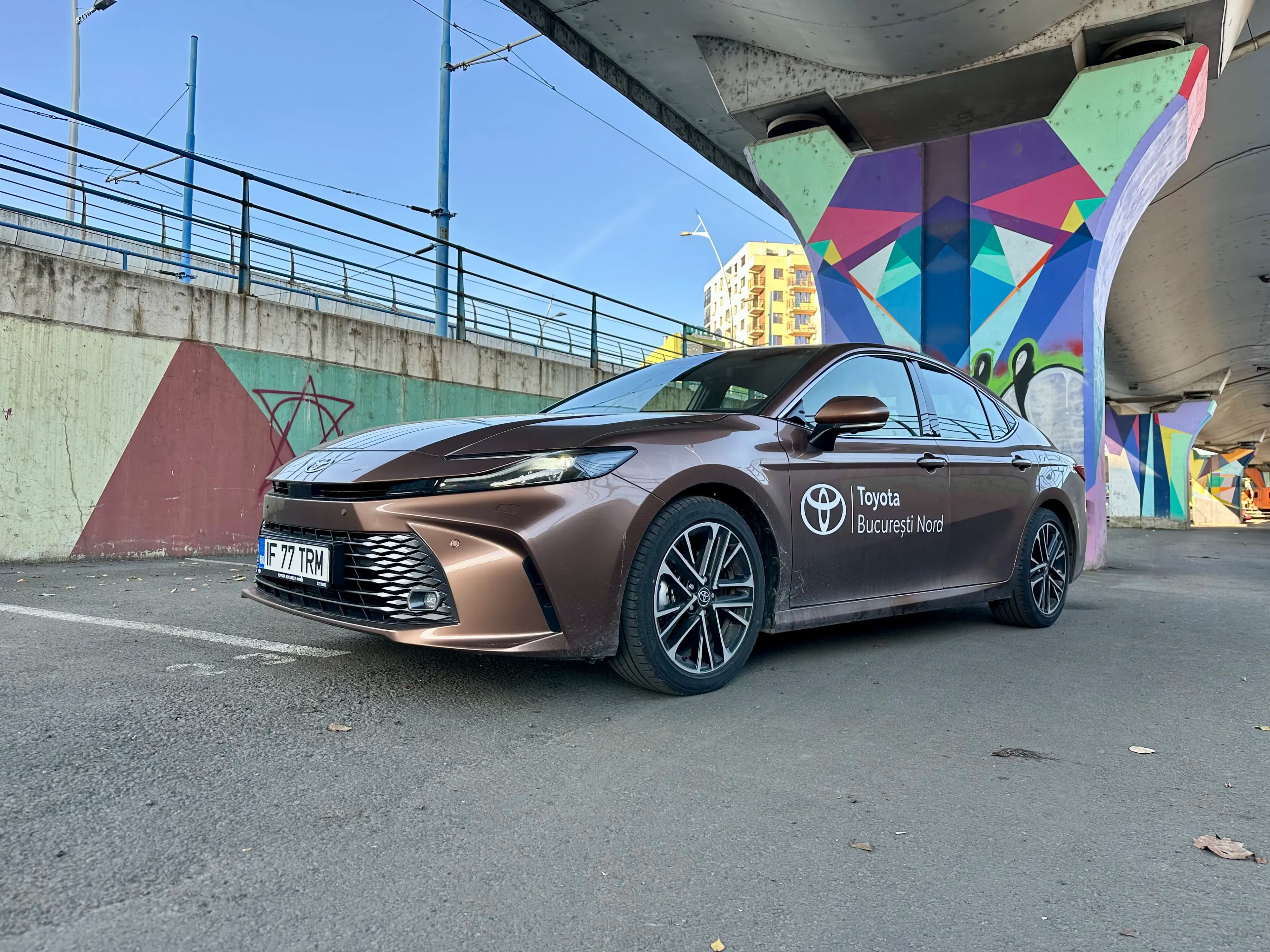
Exterior changes are subtle but meaningful. Toyota’s aim was a more contemporary look without losing Camry elegance.
The front sees the biggest change. A more prominent grille adopts the “hammerhead” theme also seen on the latest Prius and C-HR, adding road presence and aiding aerodynamics.
Headlights are redesigned with advanced LED technology. Top grades get twin rectangular LED projectors for stronger night visibility.
Side profile lines are largely familiar, but the roofline sits slightly lower at the rear for a more dynamic silhouette. The front overhang grows by about 30 mm, contributing to a more athletic stance.
At the rear, new lamp units and subtle hammerhead cues on the tailgate modernise the look and widen the boot opening.
Colour choice is broad: classic white (040), metallics such as silver (1F7), attitude black (218), dark blue (8X8) or grey metallic (1L5), plus pearls including platinum white (089), emotional red (3U9) or bronze (4Y6).
Overall, the exterior blends traditional Camry elegance with modern cues that should appeal to loyal buyers and newcomers alike.
The interior is a major leap from the previous generation, with refinement and technology that challenge some larger segments. The cabin is rethought around ergonomics, material quality and seamless tech integration.
The dashboard transformation centres on a new 12.3-inch multimedia screen, larger and better integrated than before, with a more intuitive interface.
Soft-touch surfaces dominate; wood or aluminium inserts (by trim) add elegance. Contrast stitching highlights detail.
Seats are redesigned for long-distance comfort. Top versions offer ventilation, heating and multiple electric adjustments. Rear space is generous for leg and head room, even for tall adults.
A multifunction panel in the rear armrest on upper trims lets rear passengers adjust climate and audio.
Climate control improves too: three-zone automatic air conditioning on top grades, plus Toyota’s Nanoe-X air purifier for cleaner cabin air.
Technology includes the central 12.3-inch display and a digital instrument panel replacing analogue dials, configurable from speed and fuel use to hybrid data.
Wireless Apple CarPlay and wired Android Auto are standard. Upper trims get a nine-speaker JBL premium audio system.
The cabin mixes familiar Camry comfort with modern tech—it feels both known and advanced.
Power comes from Toyota’s fifth-generation hybrid system, with gains in performance, efficiency and drivability. A 2.5-litre petrol engine works with a strong electric motor for combined power and economy.
The naturally aspirated 2.5-litre petrol produces 186 hp and 221 Nm. An electric motor adds 136 hp and 208 Nm integrated into the eCVT transmission. Total system output is 230 hp—a notable rise over the previous car.
Toyota quotes 0–100 km/h in 7.2 seconds and an electronically limited 180 km/h top speed.
Efficiency is a highlight: combined WLTP consumption of 4.8–5.1 l/100 km depending on trim. In urban driving, where the hybrid shines most, consumption can even fall below 6 l/100 km (manufacturer context in source).
CO₂ emissions are 109–114 g/km WLTP combined—attractive for buyers not ready for a full EV.
A lithium-ion battery replaces the previous nickel-metal hydride unit for higher energy density and better efficiency, enabling more electric running at low speeds and in traffic.
The eCVT has been refined for smoother, more natural acceleration, with less of the traditional rubber-band effect.
Toyota states the Camry can run electrically up to 60% of the time in urban use, cutting fuel use and cabin noise in town.
The hybrid system is a mature, balanced package that keeps the Camry competitive in its class.
On the road, the Camry balances comfort and dynamism. It feels as suited to long motorway miles as to winding roads.
MacPherson struts front and a double-wishbone multi-link rear offer good bump absorption while keeping body control in corners. Ride is slightly firmer than before but still comfortable.
Steering offers better feedback and precision—light at parking speeds, appropriately weighted at pace.
NVH is improved: the cabin stays quiet even at motorway speeds. Normal conversation is easy up to about 140 km/h; the audio system works well at moderate volume.
The hybrid often runs on electric power alone at low speeds; transitions between EV and hybrid modes are barely noticeable.
For its size, handling is surprisingly secure. A lower centre of gravity—partly thanks to battery placement—helps stability. It is not a sports saloon, but it feels predictable when driven briskly.
Braking blends regeneration with conventional discs naturally, with smooth pedal feel and strong stopping power.
New for this generation is proactive driving assist (PDA), including obstacle anticipation, deceleration support and steering assistance—useful in dense urban traffic.
Overall, the Camry delivers comfort and refinement rivalling some larger cars while remaining engaging enough for keen drivers. It works for daily commutes and long trips alike.
Technology and connectivity take a big step forward, with modern features for driver and passengers.
Toyota Smart Connect runs through the 12.3-inch touchscreen with sharp graphics and quick responses. Cloud navigation updates live traffic and road events.
Wireless Apple CarPlay and wired Android Auto bring apps for navigation, music and messaging to the screen.
An onboard intelligent voice agent can set navigation destinations, adjust climate or control audio—helpful to keep eyes on the road.
Audio ranges from a six-speaker standard system to a nine-speaker JBL setup on top grades with strong bass and clear treble.
Five USB ports are spread through the cabin; wireless phone charging is standard.
An optional 12.3-inch digital instrument cluster replaces analogue dials with configurable layouts.
A digital smart key lets compatible smartphones lock, start and drive the car without the physical key.
Three-zone climate on upper trims can be pre-set remotely via a smartphone app.
Safety uses the latest Toyota Safety Sense, including collision prevention, adaptive cruise, lane keeping and traffic-sign recognition. New features include intersection collision assist and front cross-traffic alert.
A panoramic view monitor (PVM) on top grades gives a 360° view for parking and tight spaces.
The tech package feels modern and well equipped for the digital age.
Safety has always been a Toyota priority. The Camry Hybrid 2024 carries an extensive active and passive suite, much of it standard across the range.
Toyota Safety Sense sits at the core, with a broad set of assistance and prevention functions.
New for this generation is a driver-monitoring camera within the pre-collision system, detecting fatigue or distraction and issuing warnings or intervening if needed.
Passive protection includes front, side, curtain and driver knee airbags, plus a new front-centre airbag to limit occupant contact in side impacts.
Body structure uses high-strength steel in key areas; crash energy management is optimised for better force distribution.
ISOFIX anchors are on the outer rear seats; an optional KIDFIX I-SIZE child seat suits ages 3.5–12 years.
Tyre-pressure monitoring is standard on all grades.
Advanced LED headlights improve night vision; top trims add twin rectangular projectors.
Euro NCAP awarded five stars, underlining occupant and pedestrian protection.
In the mid-size saloon class the Camry Hybrid 2024 faces strong competition, especially from European brands. Here is how it lines up against key rivals:
Overall, the Camry Hybrid 2024 is a balanced, rational choice: technology, comfort and efficiency at a competitive price—a reliable, well-equipped saloon without major compromises on performance or luxury.
Long-term running costs are among its strengths. A higher purchase price can be offset by lower day-to-day costs and strong resale value.
Lifecycle costs—purchase price, fuel, maintenance, insurance and depreciation—make the Camry Hybrid very competitive. Savings in use can outweigh a higher list price versus non-hybrid rivals.
In Romania, list prices start around €40,700 including VAT for the base Comfort grade; top Luxury reaches about €46,700. Generous standard equipment and hybrid benefits should be weighed against those figures.
For buyers focused on total cost of ownership, the Camry Hybrid 2024 is a sound investment: high efficiency, lower maintenance costs and strong residual values make a compelling case.