Volkswagen Group expects its 2026 operating return on sales to reach no more than 1%, down from the previous 4–5.5% forecast. The company still expects automotive net cash flow of €3–6 billion and automotive net liquidity of €32–34 billion, but says the operating result is being squeezed by China, special effects and a faster shift in demand towards battery-electric vehicles.
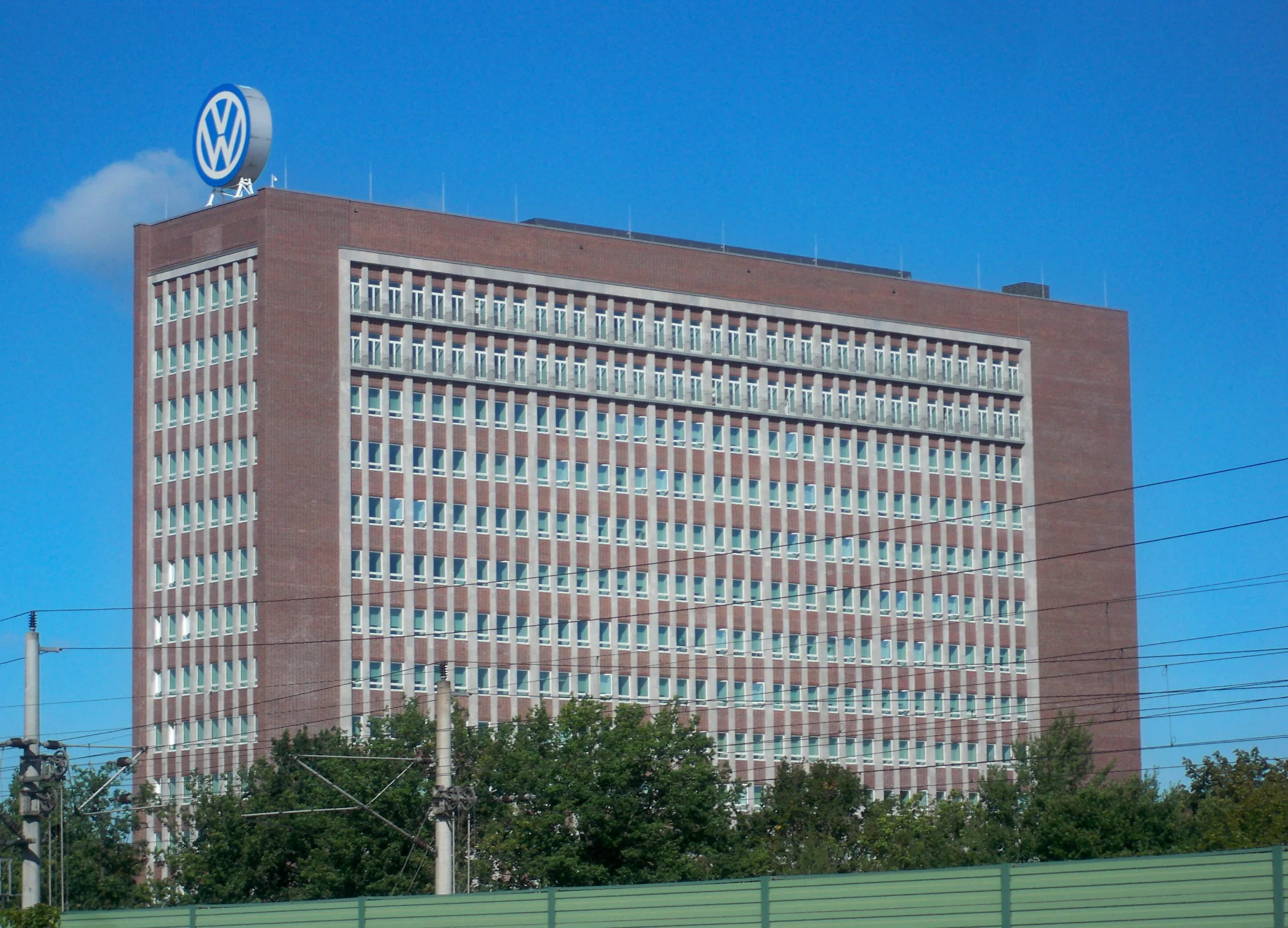
Sediul Volkswagen din Wolfsburg. Fotografie: Vanellus/Wikimedia Commons, CC BY-SA 4.0.
The revised number is mainly about profit
Volkswagen’s ad hoc announcement on 18 September puts group sales revenue at around €315 billion for 2026. That figure is broadly consistent with the middle of the previous forecast range, which called for a year-on-year change between –3% and 0%. In 2025, the group reported revenue of €321.9 billion.
The sharper change concerns profitability. Volkswagen reported a 2.8% operating return on sales for 2025 and still expected 4–5.5% for 2026 after the first-half update. The new ceiling of 1% shows how much the combination of market pressure and non-recurring accounting effects can change the headline result within a few months.
The company estimates total special effects of about €10 billion in the 2026 financial year. Around €0.9 billion had already been reported in the first half. The announcement says the updated planning for Porsche AG is one of the reasons for the revision. Volkswagen also expects an impairment of roughly €6 billion on goodwill allocated to the Porsche business segment.
That impairment is a non-cash accounting charge. It reduces reported operating profit, but it is not the same as a €6 billion payment leaving the company on the day of the announcement. The distinction matters when comparing the headline margin with the underlying cash position. Volkswagen’s own adjusted view puts the 2026 operating return on sales at about 4% after excluding the special effects.
China is the immediate commercial problem
Arno Antlitz, Volkswagen Group’s chief financial and operating officer, said the global market environment had deteriorated further, particularly in China. He described the Chinese market as having fallen by 20% and said that the group could not escape the decline. Volkswagen’s first-half reporting had already shown a 31.6% contraction in the relevant Chinese market and a 25.9% drop in Volkswagen Group deliveries in China.
Those numbers need to be read within the group’s accounting structure. Volkswagen’s joint ventures and equity-accounted companies in China do not enter consolidated revenue in the same way as fully consolidated operations. Deliveries, revenue and operating profit therefore describe different parts of the business. A delivery decline is still commercially relevant, but it should not be read as a one-to-one change in group revenue.
The pressure in China is also changing the product equation. Domestic manufacturers compete on price, software and the speed of local product development. Volkswagen says Chinese carmakers are also exporting additional capacity to Europe, adding pressure to a market where established manufacturers are already dealing with slower demand and expensive electrification programmes.
Volkswagen’s answer is its “In China for China” strategy. At Auto China 2026, the group announced more than 20 electrified vehicles for the Chinese market during 2026 and a plan to reach 50 models by 2030. These are corporate product plans, not confirmed sales volumes. Antlitz also said the local strategy would not pay off fully until the coming years.
The electric transition is affecting margins
The group links the revised forecast to an accelerated shift in demand towards battery-electric vehicles. Volkswagen says electric demand has been supported by geopolitical developments and sharply higher petrol prices, while also acknowledging that it currently earns considerably less on battery-electric vehicles than on combustion-engine cars.
That statement does not represent a change of direction away from electric cars. In Europe, Volkswagen reported that the order backlog for fully electric vehicles had risen by more than 50% in the first half of 2026. The Electric Urban Car Family, spanning Volkswagen, Škoda and CUPRA products, had collected more than 54,000 orders by early July, when only three of the four models were available.
The financial challenge is the speed of the change. A battery-electric car combines a different bill of materials with battery procurement, power electronics, software and charging-related development. A manufacturer can lose margin when it cuts prices to match competitors before production volumes and purchasing costs have reached the intended level. That is a general business effect; it does not prove that every Volkswagen electric model is loss-making.
Volkswagen’s announcement also names Audi and Volkswagen Passenger Cars as brands whose operating development is falling short of original expectations. It does not provide a model-by-model breakdown, a list of affected factories or a detailed regional allocation of the revised margin.
Simplification is the central response
The company connects the new outlook with its “Group Target Picture 2030” plan. The publicly described levers are reduced complexity, a clearer product portfolio, simpler processes and leaner structures. For a group operating multiple brands and platforms, complexity can increase development work, purchasing variations, software integration and production planning.
Volkswagen says its performance programmes are already delivering measurable progress. Overhead costs and capital expenditure have been reduced, while the group continues to invest in new products. Earlier in 2026, it said overhead costs had fallen by nearly €1 billion in the first quarter. The same communication also warned that the existing cost reductions were not enough to create structural and sustainable improvements.
The trade-off is visible in the financial targets. Volkswagen still wants to preserve a solid cash and liquidity position, but it also needs to fund electric vehicles, software and regional product development. A high liquidity number can provide room to invest; it does not remove the need to make each programme profitable over its life cycle.
The updated outlook therefore combines two messages that are easy to confuse. The group is under pressure and expects a very low reported margin in 2026. At the same time, Volkswagen says the result adjusted for the major special effects would be around 4%, while the automotive division should remain cash-generative. The two figures answer different questions.
What the announcement does not confirm
Volkswagen has not announced the immediate withdrawal of a named model from Romania, a specific factory closure or a new local price list. The forecast also does not establish that the group will cut a particular number of jobs in a particular country. It provides the financial framework and points to the strategic response; implementation details will have to come through later company decisions.
For Romanian buyers, the practical effects are indirect. Model availability, delivery times and prices depend on European production allocation and the local importer, not on the group margin alone. A revised corporate forecast can influence investment and product priorities, but it is not itself a retail announcement.
The next useful checkpoints are Volkswagen’s third-quarter results, the treatment of the Porsche impairment in the accounts and the concrete measures attached to the 2030 plan. Until those details are published, the confirmed facts are the new financial range, the stated China and electric-vehicle pressures and the group’s commitment to simplify its operations.