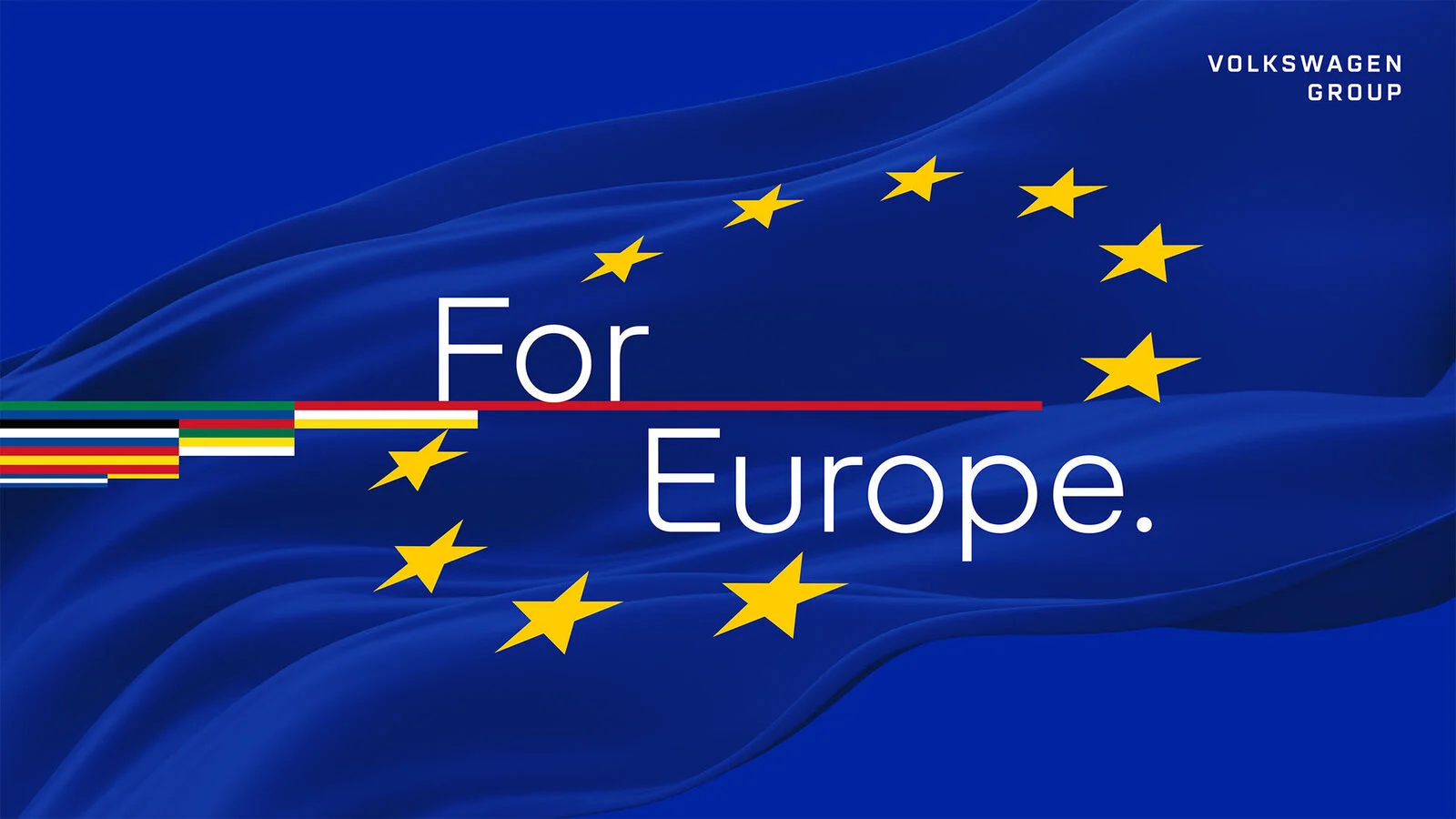
Image: Volkswagen Group. The For Europe event in Paris, 11 October 2026.
Volkswagen, Renault and Stellantis form a European ‘Big 3’ for Made in Europe rules
Volkswagen Group, Renault Group and Stellantis are presenting a common position on the future of Europe’s automotive industry. The three volume manufacturers want European institutions to create a framework that rewards local value creation, strengthens supply chains and gives carmakers more room to manage the transition to electric vehicles while they compete with Chinese manufacturers.
Automotive News describes the cooperation as a European version of Detroit’s Big 3. The phrase does not describe a merger, a new company or a commercial alliance between the brands. It refers to a joint industrial-policy position. The manufacturers are asking for European-content rules and for a regulatory approach that makes the electrification timetable more predictable for factories, suppliers and customers.
What the three groups are asking for
In the joint statement published by Volkswagen Group, the three companies say they account for more than 60% of EU vehicle production. They support a simple “Made in Europe” framework that could be applied consistently across the European Union’s 27 member states.
Their proposal says that 70% of the vehicles sold in Europe should meet a European-content requirement. Under the mechanism described by the groups, if 70% of a manufacturer’s fleet met the condition, the full fleet could automatically qualify as “Made in Europe”. That is an industry proposal, not an EU rule already in force.
The manufacturers also want the definition to cover more than final assembly. Research and development, engineering, manufacturing and the wider supply chain should count when European value is measured. That distinction matters because a vehicle assembled in Europe can still depend on battery cells, electronic components, software or raw materials sourced elsewhere.
Why the proposal has appeared now
Europe’s car industry is dealing with several changes at the same time: the move to electric power, restructuring at some plants and stronger competition from Chinese electric-car companies. The cost of a modern car is shaped not only by the assembly line. Battery materials, cells, power electronics, software, energy and supplier capacity all affect the final economics.
A local-content requirement could therefore have two different effects. It could encourage investment in European factories and make access to public incentives or procurement programmes more predictable. But if the thresholds were introduced too quickly, they could also raise the cost of electric cars at a time when manufacturers are trying to bring more affordable models to market.
That is why Volkswagen, Renault and Stellantis are asking for a “realistic” framework. Their argument is that industrial protection, competitiveness and decarbonisation have to be designed together. The request is not simply to stop electrification; it is to make the investment conditions less volatile while factories and suppliers adapt.
How the proposal connects with EU emissions rules
The European Commission continues to keep a strong signal toward electrification. Its official page on cars and vans says that Regulation (EU) 2019/631 sets CO2 performance standards and that the current 2035 objective corresponds to a 100% reduction in average emissions from new cars and vans. At the same time, the Commission’s 2025 Automotive Package proposes additional flexibility.
According to the Commission’s description, the proposal would require a 90% reduction in tailpipe emissions from 2035, with the remaining 10% compensated through low-carbon steel produced in the Union, e-fuels or biofuels. In that proposed framework, plug-in hybrids, range extenders, mild hybrids and internal-combustion vehicles could retain a role alongside battery-electric and hydrogen vehicles.
There is also a temporary compliance flexibility for 2025–2027. Manufacturers can be assessed on the average of the three-year period rather than against a separate annual result. That does not remove the targets; it changes how compliance is calculated. For factories and suppliers, the distinction is significant because a short-term shortfall can be balanced by stronger performance elsewhere in the period.
What it could mean for car buyers in Europe
An eventual Made in Europe framework would not automatically change a car’s price overnight. The result would depend on the final criteria, the incentives attached to them and the cost of European components compared with imported alternatives.
For customers, the effect could appear in the products offered: more small electric cars built in Europe, public support linked to origin, or a different mix of imported and locally produced versions. The policy could also influence where suppliers invest. The joint statement does not, however, announce a new plant, a specific model for Romania or a confirmed production allocation.
The practical buying criteria remain the same. Customers should compare the actual price, battery capacity, WLTP range, warranty, charging performance, service network and total cost of ownership. “Made in Europe” could become relevant to a future incentive or procurement rule, but it cannot replace a technical specification or a written dealer offer.
A common position, not a merger
The significant development is the public coordination of the three groups. Volkswagen Group held its “For Europe” event in Paris before the motor show, while the common Made in Europe statement brings Renault Group and Stellantis into the same policy message. Each group remains a separate competitor, with its own brands, platforms, factories and financial decisions.
The next step belongs to European institutions. The industry proposal has to be weighed against emissions targets, trade rules, competition law and the capacity of European suppliers. Until the institutions adopt a binding act, the 70% threshold remains a joint request from Volkswagen Group, Renault Group and Stellantis, not a requirement for manufacturers or customers.