
The European Union and China have reached a preliminary understanding that could reduce Chinese exports of electric and plug-in hybrid passenger cars to the EU by up to 50%. European Trade Commissioner Maroš Šefčovič announced the possibility after talks in Beijing. The arrangement is not yet a final customs rule: its technical details have not been published in full and it still requires approval through the EU’s political process.
A possible cap, not a rule already in force
The wording matters. The reported figure describes a potential reduction in expected shipments, not a quota that is already being enforced at European ports. There is no public final document setting the number of vehicles, the calculation period, the allocation between manufacturers or the penalties for exceeding the limit.
The proposed measure concerns electric and plug-in hybrid cars made in China and exported to the European Union. It should not be confused with the countervailing duties introduced for certain battery-electric vehicles from China. The European Commission has previously said that its completed anti-subsidy case concerned BEVs, while there was no equivalent investigation into Chinese hybrid imports at that stage. Plug-in hybrids therefore do not automatically receive the same treatment as battery-electric cars.
That distinction is relevant for brands whose European line-ups contain both powertrain types. A plug-in hybrid can be charged externally but also retains a combustion engine. A battery-electric vehicle relies on its battery for propulsion. Trade policy can classify these products differently even when both are marketed as electrified vehicles.
Why plug-in hybrids are part of the dispute
Chinese manufacturers have expanded their exports while Europe’s car market has moved towards electrified powertrains. ACEA reported 758,082 plug-in-hybrid registrations in the EU during the first eight months of 2026. Battery-electric cars held a 21.7% share in the same period. Those figures describe the whole market and do not show how many vehicles were imported from China, but they illustrate the commercial space in which Chinese brands are competing.
Plug-in hybrids have a different customer proposition from BEVs. They can cover short journeys using electric energy when charged regularly, while the combustion engine provides another operating mode on longer trips. Their demand can therefore grow even where charging access is uneven. For European manufacturers, Chinese PHEVs add competition in a segment that combines an established engine architecture with newer battery and software systems.
For policymakers, the issue is also linked to market access and industrial capacity. The EU’s measures on Chinese BEVs were justified through an anti-subsidy investigation. The new discussion about hybrids is presented as part of broader negotiations over trade balances rather than as a completed anti-subsidy case. Those are different legal and political routes, and the final arrangement will determine what happens next.
The automotive measure is part of a wider package
The talks covered more than vehicles. Reports about the preliminary understanding also mention better access for European products in China, rare-earth supply chains and the wider EU-China trade imbalance. Šefčovič said the package could benefit almost every EU member state, but no country-by-country impact table has been released.
Rare earths and permanent magnets matter to vehicle production because they are used in electric motors, electronics and other components. An agreement on export licensing would not mean that every shipment is automatically approved. Companies would still depend on the final procedures, documentation and decisions of the relevant authorities in China and Europe.
The trade negotiations also show why the vehicle figure should not be interpreted as a simple ban. The reported aim is to manage the volume of Chinese vehicles entering the EU while keeping the wider market open. A quota by manufacturer would have a different effect from a system based on vehicle origin, price or a total annual number. None of those mechanisms has been confirmed in the public material available so far.
What it could mean for Romania
Romania is part of the EU single market, so an EU-wide customs or quota measure would also affect vehicles imported into the Romanian market. The practical result would depend on the final design. A limit could influence model availability, delivery schedules or manufacturers’ allocation decisions, but there is not enough information to predict a Romanian price increase or a withdrawal of Chinese brands.
The origin of a vehicle may also matter. A European brand assembled in China, a Chinese brand using a European plant and a car produced entirely inside the EU could fall under different definitions. The final text would need to specify how assembly, components, ownership and the exporting company are treated. Until that happens, statements about individual brands remain assumptions.
Romanian buyers should also separate the trade question from the technology question. The possible agreement concerns imports and market access, not whether a particular hybrid or electric drivetrain is technically suitable. A model’s real-world usefulness still depends on its range, charging routine, fuel use, warranty and service network. The announced figure alone says nothing about those factors.
Approval is the next step
The announcement does not establish an implementation date. EU governments and institutions must approve the agreed elements, and customs authorities will need a monitoring method. Until a legal text is published, the 50% figure should be described as a possible reduction in future shipments rather than a measured cut that has already occurred.
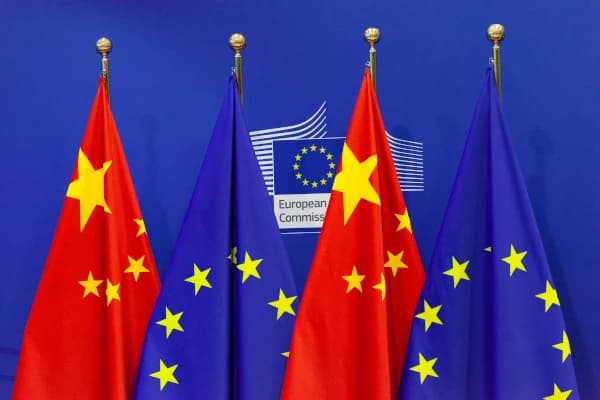
The image shows EU and Chinese flags in a diplomatic setting and comes from an official Austrian Federal Chancellery page. It was converted locally to WebP for publication. Image rights remain with the original rights holder.


