Dacia Bigster positions itself as an exceptional value proposition in the family SUV segment, with a starting price of just €24,400, in a market where similar models can frequently reach double that amount. As an automotive journalist with experience testing vehicles across price categories, I was curious to discover whether this new Romanian model manages to offer a complete experience without major compromises.
After an intensive week of testing on varied road types in Romania, I can say that Bigster impresses beyond its accessible price. This 4.6-metre hybrid SUV comes equipped with a 667-litre boot, a hybrid system developing 155 hp and a suite of modern technologies that would easily place it in the premium zone if we judged by specifications alone.
Real consumption recorded during my test varied between 4.5–6 l/100 km depending on road conditions and driving style—remarkable values for an SUV of these dimensions. The quality of materials used, although it does not reach the refinement of premium brands, offers a sense of durability and a pleasant appearance, demonstrating that Dacia has evolved significantly in recent years.
In the sections that follow, I will share my impressions of Dacia’s newest and most ambitious model, analysing in detail on-road behaviour, the hybrid system, technological equipment and the value-for-money ratio that could redefine expectations in this vehicle category.
Dacia Bigster 2025: first impression at the wheel
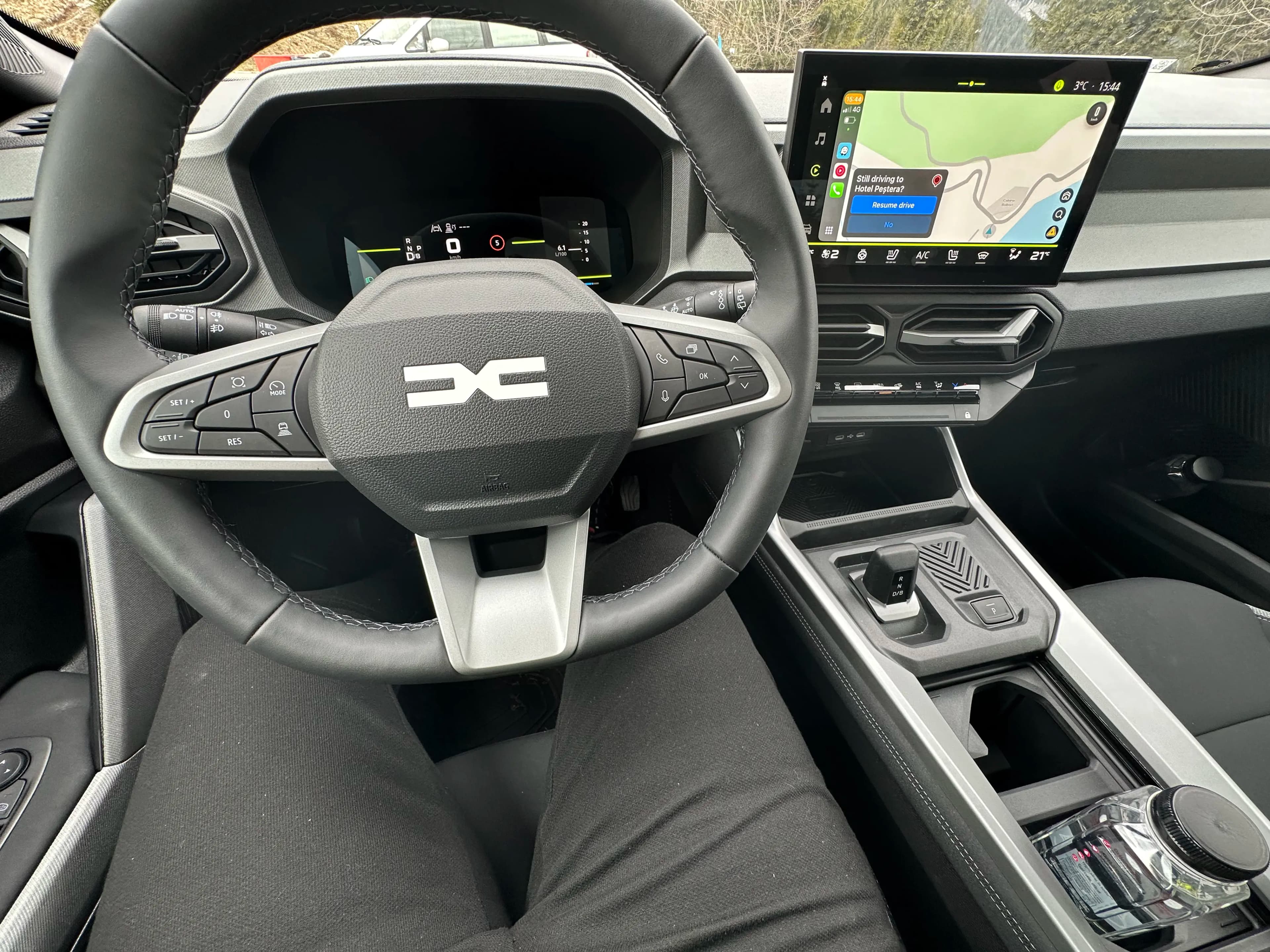
My first meeting with the Dacia Bigster generated an unexpected sensation. Getting behind the wheel, I was surprised by the perception of a higher-class vehicle, although the Dacia badge was clearly visible on the steering wheel. This impression is not accidental—the brand representatives confirmed to me that this was exactly the objective they pursued in developing the new model.
Exterior design: robust but refined
Bigster stands out immediately through its imposing dimensions, being the largest model Dacia has ever produced. Compared with its smaller sibling, the Duster, the differences are significant: 4.57 metres length (23 cm more), 1.81 metres width, 1.71 metres height (+5 cm) and a wheelbase of 2.70 metres (4 cm more generous). Generous ground clearance of 22 centimetres gives it credible off-road capability.
Exterior design keeps the essence of the concept presented three years ago, although engineers made necessary adjustments for compliance with safety regulations. The design language relies on robustness and geometric clarity. The vertical front, with a strongly sculpted bonnet and headlights positioned towards the extremities, creates a distinctive presence in traffic. The Y-shaped light signature, together with the wide gloss-black grille and the new “Dacia Link” emblem, defines the brand’s visual identity.
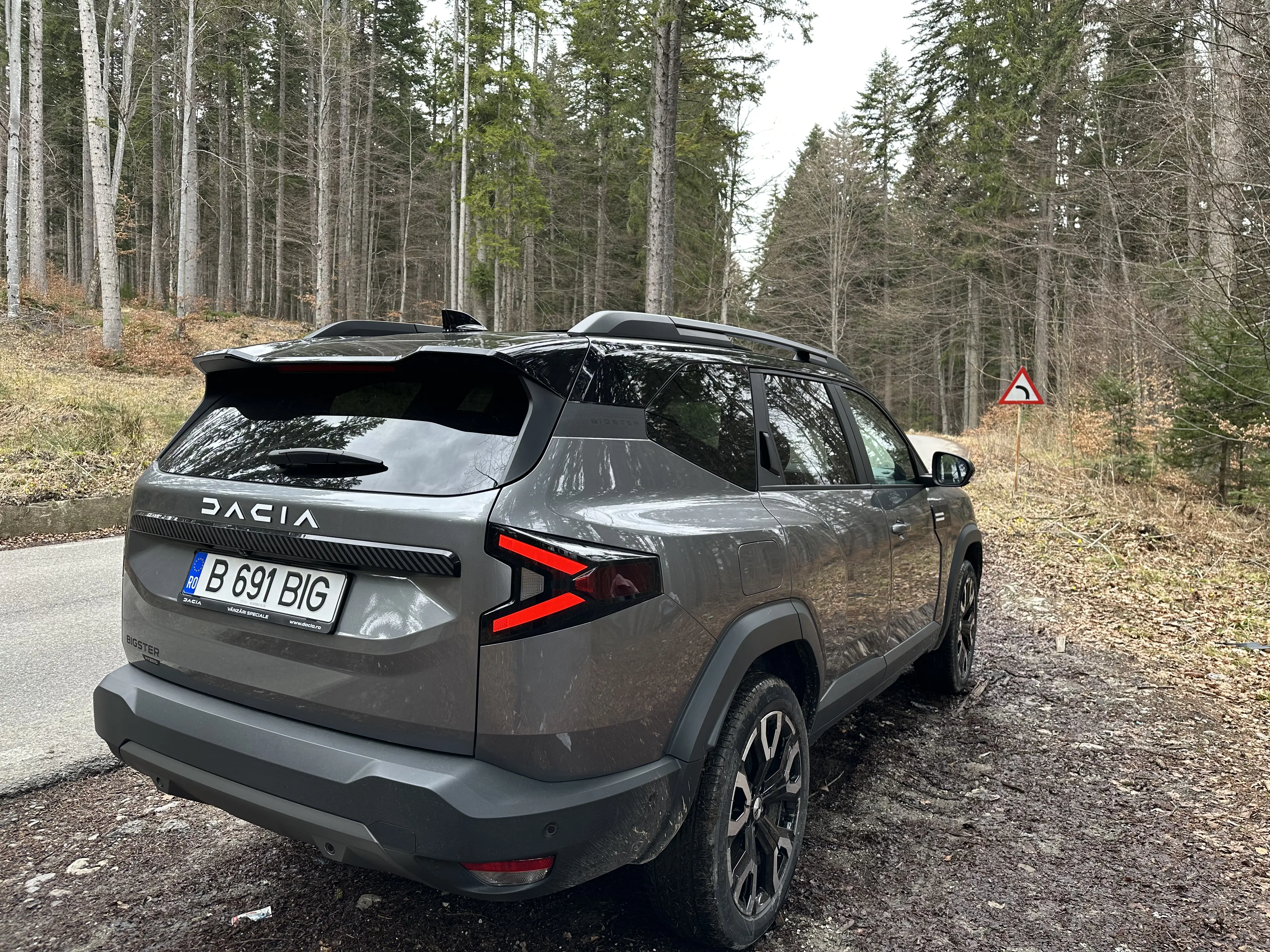
The Journey version I tested came equipped with 19-inch alloy wheels, which add a touch of refinement to the silhouette. A particularly practical element is the modular roof bars, which can be quickly converted into cross bars—standard on the Extreme version and optional on Journey.
A remarkable step forward compared with the Duster is significantly improved visibility. While the smaller model has relatively narrow glass areas, Bigster offers a much better field of view. The correctly sized side mirrors integrate a blind-spot assistant, and visibility through the tailgate is excellent. The video camera system also offers a side view, although image quality could benefit from improvements.
Interior: impressive space and good ergonomics
Interior space is perhaps Bigster’s greatest asset. The 667-litre boot (with the bench in normal position) is the most generous in the segment. With the bench fully folded, available volume rises to an impressive 2,002 litres. The “Easy Fold” function simplifies the process—a simple pull of the handle in the boot causes the seats to fold automatically, creating a flat platform 2.7 metres long.
For organising personal items, Bigster offers numerous practical compartments. Phone, keys and a water bottle quickly find their place in the cabin. An intelligent detail taken from the Duster is the YouClip system, which allows attaching various accessories for more efficient organisation.
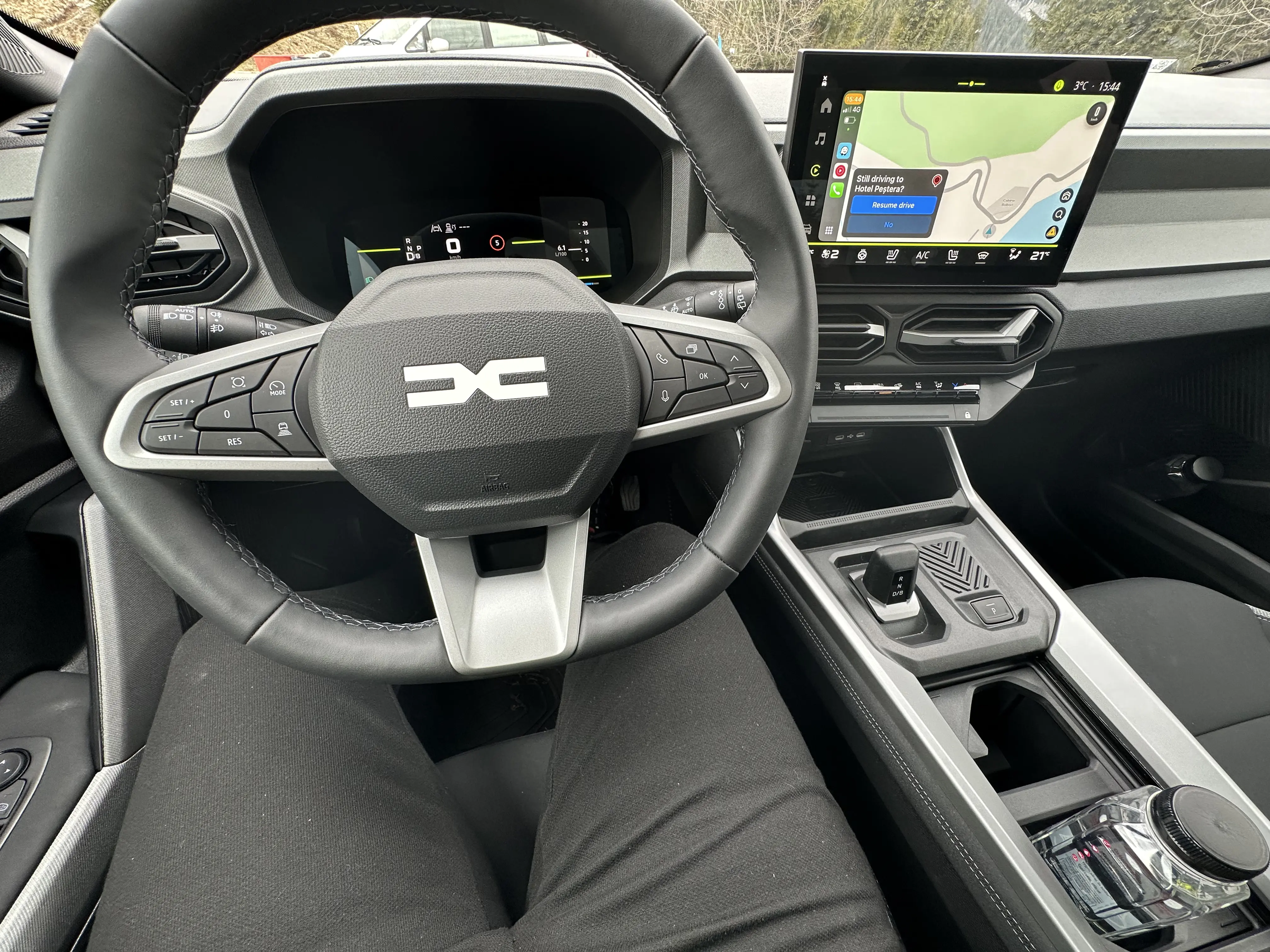
The driving position is dominated by two digital screens: the instrument cluster (7 or 10.1 inches, depending on equipment level) and the central 10.1-inch display for the multimedia system. On the Journey version tested, I benefited from the large digital instrument cluster, with simple but very readable graphics. The multimedia system has a modern, intuitive interface, although I occasionally noticed small response delays and stuttering of the navigation.
The driving position is clearly superior to the Duster’s, with the driver’s seat electrically adjustable for height on Journey equipment. Seat shape and manually adjustable lumbar support contributed to comfort felt even after a route of over 120 km. Space for rear passengers is generous both for head room and knee room, easily accommodating tall adults.
Regarding materials, Dacia maintains the brand’s pragmatic philosophy: surfaces predominantly hard plastic, visually pleasant but less satisfying to the touch. Even so, assembly is correct and precise, with no visible quality problems. This approach reflects the brand’s priority of offering space and functionality rather than expensive materials that would inevitably raise the final price.
155 hp hybrid system: performance and efficiency
The new hybrid system of the Dacia Bigster marks an important moment for the Romanian manufacturer—it is the most powerful powertrain ever installed in a model of the brand. With combined power of 155 hp, this propulsion unit transforms Bigster into a particularly attractive proposition from a performance–efficiency perspective, an aspect I analysed closely during my extended test.
The technology behind the power
At the centre of the hybrid system is a 1.8-litre naturally aspirated petrol engine developed specifically for this model. The combustion unit, benefiting from a high compression ratio of 14:1, develops 109 hp and 172 Nm of torque. It is complemented by two electric motors—a main propulsion motor adding 49 hp and 205 Nm, and a starter-generator. The battery with usable capacity of just 1.4 kWh is sufficient for self-charging hybrid operation.
The multi-mode transmission, with 4 ratios for the combustion engine and 2 for the electric motor, directs all power to the front wheels. During tests, I timed 0–100 km/h acceleration in approximately 9.7 seconds—a competitive value for an SUV in this category and with these dimensions.
In urban traffic and at low speeds (below 50–60 km/h), I observed that Bigster runs predominantly on electric power. This behaviour was especially evident in rural areas along the route. According to information from Dacia engineers, in urban environments the system operates electrically approximately 80% of the time—a claim supported by the low consumption recorded in my tests.
Although overall performance is satisfactory, I also identified a few aspects that could be improved. Transition from electric to combustion propulsion is not always smooth, the transmission benefiting from calibration that could be refined. I also noted that after placing the selector in P and releasing the brake pedal, the car tends to lurch forward briefly for a fraction of a second before stabilising completely.
Real-world consumption experience
To evaluate hybrid efficiency in real conditions, I covered a route of approximately 120 km between Marseille airport and the hotel, combining motorway segments (110–120 km/h), national roads (80 km/h) and localities (30–50 km/h).
The results were remarkable: outbound, on a profile with slight ascent, the trip computer indicated consumption of 6 l/100 km. The next day, on exactly the same route but in the opposite direction (predominantly descent), the value dropped to 4.5 l/100 km. The real average recorded of approximately 5.3 l/100 km is very close to the theoretical value of 4.6–4.7 l/100 km officially announced by Dacia.
An interesting aspect observed in a separate test: out of a total of 178 km covered, no less than 85 km were covered exclusively in electric mode. This impressive efficiency is due mainly to the system’s ability to switch intelligently between the two propulsion sources, optimising consumption according to specific road conditions.
Range and practical versatility
With a 50-litre tank and average consumption of 5.3 l/100 km obtained in my tests, the Bigster hybrid can theoretically cover up to 940 km on a single fill—excellent range that removes the frequent anxiety of stops for fuel on long trips.
Besides fuel economy, the hybrid system brings other significant practical advantages. Thanks to the new 1.8-litre engine, towing capacity increased considerably, reaching 1,250 kg, versus only 750 kg offered by the Duster Hybrid—an important argument for those who need greater versatility.
In direct comparison with segment competitors, Bigster Hybrid 155 positions itself excellently on efficiency. Ford Kuga Hybrid (180 hp) has declared consumption of 5.3 l/100 km, Nissan Qashqai E-Power (188 hp) officially consumes 5.1 l/100 km, and Renault Symbioz (145 hp) has consumption of 4.7 l/100 km—all values similar to what Bigster offers, but at significantly higher prices.
Another advantage for users who do not have electric charging infrastructure is battery self-recharging while driving, completely eliminating the need to visit charging stations. In addition, CO₂ emissions are substantially reduced, Dacia reporting up to 40% lower fuel consumption compared with conventional powertrains.
Comfort and technology at an accessible price
After evaluating engine performance and efficiency, I paid special attention to comfort and technological equipment on the Dacia Bigster. Here I discovered perhaps the most pleasant surprise of my test—a level of refinement and equipment that contradicts traditional perceptions about this price segment.
Suspension with impressive behaviour
The first aspect that impressed me during the test was suspension quality. Bigster handles road imperfections with remarkable competence, offering a comfort level superior to many models in the same price class. This behaviour is all the more notable given that the test car was equipped with 19-inch wheels, which usually compromise comfort in favour of aesthetic appearance.
In tight corners, I observed slight body roll, and moderate pitch appears when crossing speed bumps, but these characteristics are perfectly normal for an SUV in this category and do not affect the overall driving experience. Steering is calibrated for ease of manoeuvre, ideal for navigating urban environments and tight spaces, although on open roads feedback transmitted to the driver could be improved.
An aspect especially appreciated during longer trips was excellent acoustic insulation. Up to speeds of 120 km/h, noise level in the cabin remains surprisingly low, both regarding rolling noise and aerodynamic noise. This detail transforms Bigster into an ideal companion for long-distance travel, a segment in which many similarly priced models disappoint.
Technological equipment beyond expectations
Bigster’s technological equipment far exceeds what we could have anticipated at a starting price of €24,400. The digital instrument cluster comes in two variants: 7 inches for base versions and 10.1 inches for Journey and Extreme equipment. During the test, I appreciated the excellent readability of the large version, with information clear and easy to consult in any lighting conditions.
The central 10.1-inch touchscreen is standard on all versions, whether you choose the Media Display or Media Nav system. The interface is intuitive and modern, and the graphics are visually pleasing. I did note, however, that occasionally the system responds with slight delay to commands, and navigation can show small stutters in certain situations—aspects that could be improved through future software updates.
A functionality that caught my attention is display of maps from popular apps such as Waze, Google Maps or Apple Maps directly on the digital instrument cluster, depending on which app you use on the connected phone. This detail significantly increases safety, allowing the driver to consult navigation instructions without taking eyes off the road.
Premium equipment at an accessible price
Dacia managed to integrate into Bigster a series of features that, traditionally, are found only on considerably more expensive models. The panoramic roof with electric opening and generous length of 120 cm (standard on Extreme and optional on Journey) completely transforms the interior ambience, offering amplified space sensation and access to natural light.
The power tailgate, including operation via the card key, simplifies access to the generous boot—a feature rarely found in this price class. Two-zone automatic climate control (humorously called “bizonic climate” by brand representatives) completes the comfort elements list.
Safety systems were not neglected; Bigster comes equipped with adaptive cruise control and automatic high-beam switching—technologies that until recently were exclusive to premium models. For interior organisation, the YouClip system taken from Duster proves ingenious and practical, allowing attachment of various useful accessories in the cabin.
Although materials used in the interior do not reach the refinement of premium brands, the entire technological and comfort package delivers an experience that far exceeds expectations created by the purchase price. This balance between cost and equipment demonstrates Dacia’s pragmatic philosophy, which prefers to offer relevant functionality and technology rather than expensive materials with limited impact on daily experience.
Dacia Bigster vs Duster: what you gain extra
After intensive testing of Bigster, a natural question arises for potential buyers: is the price difference versus Duster worth it? Having experience with both models, I can offer a detailed comparative perspective that clarifies what the larger sibling brings beyond the obvious dimensions.
Significant differences in space and comfort
Exterior dimensions are the first indicator of differences. At 4.57 metres length, Bigster exceeds the Duster by 23 cm, and this plus translates directly into a significantly more generous cabin. The 667-litre boot (considered best in class in the segment) offers approximately 20% more loading space than the Duster—a decisive advantage for active families or long trips with bulky luggage.
During the test, I paid special attention to rear passenger comfort, where differences become even more evident. Bigster offers remarkable head room and an impressive knee zone. I practically verified this claim by positioning two tall adults one behind the other, finding that both benefit from sufficient space to travel comfortably even on long distances.
Visibility is another aspect where Bigster brings substantial improvements. While the Duster is characterised by relatively narrow glass areas, Bigster benefits from more generous windows, better proportioned side mirrors and a blind-spot assistant that significantly increases safety. During motorway testing, I especially appreciated superior acoustic comfort—sound insulation being excellent up to 120 km/h, reducing fatigue on long trips.
Performance and refinement: Bigster Hybrid 155 vs Duster Hybrid 140
Although both models offer hybrid variants, Bigster introduces a new 1.8-litre powertrain that replaces the 1.6-litre unit on the Duster. The new engine, although following the same philosophy (naturally aspirated), offers 15 hp extra (155 vs 140) and 20 Nm more torque. In real traffic conditions, this power difference is perceptible especially in situations such as overtaking or climbing gradients with load.
From a practical perspective, the most important advantage of the new propulsion is significantly improved towing capacity—1,250 kg versus only 750 kg on Duster Hybrid. For users who frequently tow trailers or caravans, this aspect can be decisive in choosing between the two models.
Another subtle but notable benefit of the 1.8-litre engine is superior acoustic refinement at low and medium speeds. During city driving, perceived noise level in the cabin is lower compared with the Duster, contributing to a more pleasant and relaxing driving experience.
However, it should be mentioned that Bigster also shows some “hitches” when switching from electric to combustion propulsion, similar to those observed on Duster Hybrid. Also, steering characteristics are close on both models—light and optimised for urban manoeuvrability, but with reduced feedback on open roads. This calibration reflects the brand’s priority for comfort and ease of daily use rather than sporty sensations.
Following this direct comparison, it becomes evident that Bigster is not simply a larger Duster, but brings substantial improvements in space, comfort, performance and versatility. For large families or those who frequently travel with bulky luggage, the price difference is justified by the tangible benefits offered by the larger model.
Prices and equipment: from €24,400 to €29,500
Dacia Bigster’s price structure is probably its strongest argument in an extremely competitive market. With a starting price of just €24,400, the Romanian model directly challenges segment conventions, where similar competitors rarely drop below the €30,000 threshold. After detailed evaluation of the vehicle, I can state that the value proposition becomes even more convincing when we analyse the equipment level and capabilities offered at these accessible prices.
Expression version: solid foundation at €24,400
The Bigster range debuts with Expression equipment, available from €24,400. Although it represents the access variant, it already includes an impressive list of essential features. The 7-inch digital instrument cluster, central 10.1-inch multimedia screen (compatible with Apple CarPlay and Android Auto), automatic climate control and the driver assistance systems pack would be considered mid or upper-level equipment at many competitors.
I especially appreciated that Dacia did not compromise on safety even for the base version. Expression comes equipped with automatic emergency braking, road sign recognition, lane departure warning and driver attention monitoring—elements that are becoming mandatory for modern safety, but which at some brands remain costly options.
Journey and Extreme: additional refinement at €26,000
For a reasonable supplement of €1,600, customers have access to Journey and Extreme versions, both starting from €26,000. These equipment levels add elements that significantly improve the on-board experience: enlarged 10.1-inch digital instrument cluster, driver’s seat with electric height adjustment and two-zone automatic climate control (the so-called “bizonic climate”).
During my test with the Journey version, I observed that it focuses on comfort and technology, probably representing the optimal choice for most customers. The Extreme version, at the same base price, bets on a more adventurous character, offering modular roof bars as standard (optional on Journey) and a few distinctive styling elements that give it a more robust appearance.
An element that deserves special mention is the panoramic roof with electric opening and generous 120 cm length—standard on Extreme and optional on Journey. During testing, I found that this feature completely transforms the interior ambience, bringing extra natural light and an amplified space sensation that would be difficult to obtain otherwise.
Analysis of the tested hybrid version: €29,500
The test car was a Bigster Hybrid 155 in Journey equipment, with a starting price of €29,500. At this amount, the car included 19-inch alloy wheels, Media Nav system with connected navigation and Arkamys 3D audio with 6 speakers, power tailgate and adaptive cruise control—an impressive package for this price category.
The figures speak for themselves: Bigster Hybrid offers savings of over €3,000 versus the most accessible competitor and a staggering €13,000 versus the segment’s premium model. It is important to mention that the version I tested in France benefited from a few optional features that raised the final price to €32,734—even so, this amount remains below the base price level of most direct competitors.
Following analysis of the ratio between price, equipment and capabilities, I can conclude that Dacia Bigster sets a new standard in its segment. The brand’s strategy of offering a complete, well-balanced package at a significantly more accessible price than direct competitors is, without doubt, its main asset in a market increasingly polarised between volume vehicles and those with premium pretensions.
Conclusion
After an intensive week of testing with the Dacia Bigster, the overall impression is surprisingly positive, exceeding initial expectations for a model carrying this badge. This family SUV manages to offer a convincing combination of space, efficiency and modern equipment, at a price that defies segment logic.
The 667-litre boot—class leader—is only one of the model’s practical arguments. The 155 hp hybrid system proves not only powerful for daily needs, but also remarkably efficient in real use conditions. Consumption between 4.5–6 l/100 km recorded in my test translates into impressive range of up to 940 kilometres, removing anxiety about frequent fuel stops on long trips.
What truly impressed me is how Dacia managed to offer upper-level equipment—such as the panoramic roof, electric tailgate or 10.1-inch digital instrument cluster—while maintaining a starting price of just €24,400. At this amount, direct competitors offer base models, with significantly poorer equipment and without hybrid propulsion.
Of course, Bigster is not perfect. Transition between electric and combustion propulsion could benefit from finer calibration, and interior materials, although well assembled, do not reach the refinement of premium brands. However, these are acceptable compromises given the price advantage of at least €3,000 versus the most accessible hybrid rival.
Generous interior space, suspension comfort and excellent acoustic insulation up to 120 km/h transform this SUV into a very tempting alternative for families who value practical aspects more than the badge on the bonnet. Bigster achieves the rare performance of offering a premium experience from the perspective of space and technology, without the premium price usually associated with these characteristics.
Dacia Bigster is, without doubt, the most interesting proposition in the family SUV segment at this moment. For pragmatic buyers seeking maximum value for their investment, this model deserves serious attention and an extended test drive before turning towards more expensive and possibly less practical alternatives.