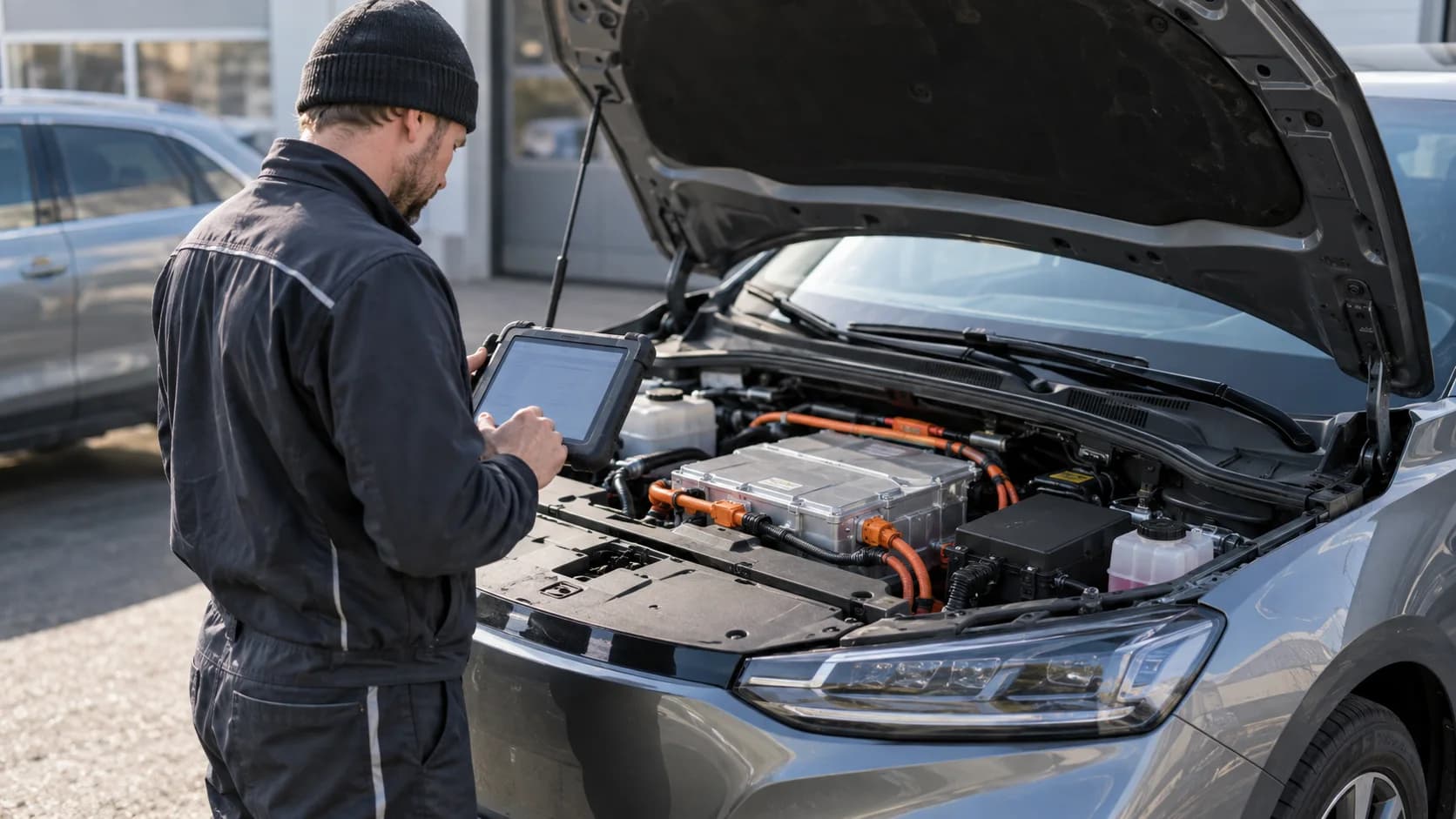
Assessing the health of a used electric vehicle (EV) battery primarily involves reviewing the vehicle's State of Health (SoH) display, if available, and examining service records for any battery-related interventions. These methods provide an initial indication of the battery's remaining capacity relative to its original design.
Understanding Battery Degradation
EV batteries, typically lithium-ion, degrade over time and use. This degradation manifests as a reduction in the battery's total energy storage capacity and, potentially, its ability to deliver peak power. Factors influencing degradation include the number of charge/discharge cycles, depth of discharge, exposure to extreme temperatures, and charging habits, particularly frequent use of high-power DC fast charging. While some degradation is inevitable, its rate varies significantly between vehicles and usage patterns.
The EU Batteries Regulation (Regulation (EU) 2023/1542) addresses battery durability, requiring manufacturers to provide information on expected battery lifespan and performance. For traction batteries in light means of transport, the regulation specifies that a battery's SoH should be available to the end-user. This information is crucial for evaluating a used EV.
Accessing Battery State of Health (SoH)
Many modern EVs display the battery's SoH directly within the infotainment system or instrument cluster. This figure is usually presented as a percentage, indicating the current usable capacity relative to the battery's original factory capacity. For example, an SoH of 90% means the battery can store 90% of the energy it could when new. This is the most direct and convenient method for a prospective buyer to gauge battery health.
If the SoH is not directly displayed, it may be accessible via a diagnostic tool connected to the vehicle's On-Board Diagnostics (OBD-II) port. Independent workshops specialising in EVs often possess such tools. While this requires a professional, it can provide a more detailed report, including individual cell voltages and temperature data, which can reveal imbalances or specific issues not evident from a simple SoH percentage.
Service records are another vital source of information. Look for any battery-related warranty claims, software updates, or diagnostic reports. A history of consistent servicing at an authorised dealer can also indicate better overall vehicle care, which often correlates with better battery health.
Real-World Range and Charging Performance
While SoH provides a numerical value, real-world driving experience offers practical insights. A test drive is essential. Pay attention to the indicated range after a full charge. Compare this to the vehicle's original WLTP (Worldwide Harmonised Light Vehicle Test Procedure) range, adjusted for the observed SoH. For instance, if a vehicle originally had a 400 km WLTP range and now shows 80% SoH, an expected real-world range closer to 320 km (400 km * 0.8) would be reasonable under similar driving conditions. However, real-world range is always influenced by driving style, ambient temperature, terrain, and auxiliary use (heating/air conditioning). The WLTP procedure (as per Regulation (EU) 2025/1706) provides a standardised comparison, but individual results will vary.
During the test drive, observe charging performance if possible. While a full charge cycle is impractical, even a brief connection to a DC fast charger can reveal issues. Monitor the charging rate displayed on the vehicle or charger. A significantly slower-than-expected charging rate, especially at lower battery percentages, could indicate battery degradation or a fault. However, charging rates are also influenced by the charger's power output, ambient temperature, and the battery's internal temperature and SoH. The EU Alternative Fuels Infrastructure Regulation (Regulation (EU) 2023/1804) mandates certain information be displayed at charging points, which can help in this assessment.
Impact of Temperature and Usage Patterns
Battery performance is sensitive to temperature. Cold temperatures reduce both available capacity and power output, while very high temperatures can accelerate degradation. Consider the climate in which the vehicle has primarily operated. A vehicle used predominantly in a mild climate might exhibit less degradation than one from an area with extreme hot or cold seasons, assuming similar usage.
The UNECE Global Technical Regulation No. 22 (UN GTR No. 22) outlines durability requirements for EV batteries, acknowledging the influence of usage patterns. Vehicles frequently subjected to deep discharges (regularly running the battery down to very low percentages) or consistently charged to 100% and left for extended periods may show higher degradation. Conversely, vehicles primarily charged to 80% and kept within a moderate charge window tend to exhibit slower degradation. Inquire about the previous owner's charging habits if possible, though this information is often difficult to verify.
Long-Term Considerations and Warranty
For a used EV, understanding the remaining battery warranty is crucial. Most manufacturers offer a separate, longer warranty for the high-voltage battery, often eight years or a specific mileage, whichever comes first. This warranty typically guarantees a minimum SoH (e.g., 70% or 75%) by the end of the warranty period. Verify the vehicle's original in-service date and mileage to determine the remaining warranty coverage. A battery still under warranty provides a degree of protection against unforeseen degradation.
When considering a representative cross-border European journey, such as from Brussels to Berlin, a degraded battery will necessitate more frequent charging stops. For example, a vehicle with a new WLTP range of 450 km might complete the 770 km journey with one or two charging stops. If the battery's SoH has dropped to 70%, its effective range is reduced to approximately 315 km, potentially requiring an additional charging stop or longer charging durations to complete the same journey. This highlights how battery health directly impacts the practicality and convenience of long-distance travel.
Ultimately, a combination of displayed SoH, service history, and a thorough test drive provides the most comprehensive assessment of a used EV battery's health. While no method can predict future degradation with absolute certainty, these steps offer a robust framework for an informed purchasing decision.