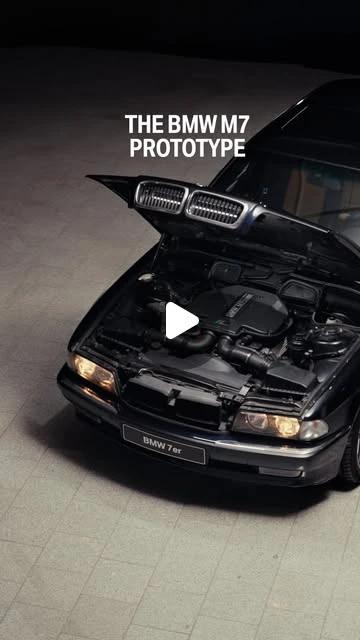
BMW Classic has publicly identified an E38 7 Series development car as the BMW M7 prototype. The project uses a 1997 BMW 740i as its base, but replaces the standard drivetrain with the naturally aspirated S62 V8 and six-speed manual gearbox from the E39 M5. It produces 294 kW or 400 PS, weighs 1,875 kg and is limited to 250 km/h. BMW never offered this specification as a production model.
A 1997 740i, but not necessarily a 1997 conversion
BMW Classic describes the car as a 1997 740i powered by the V8 from the E39 M5. That wording establishes the donor shell and the internal M7 name. It does not establish when engineers completed the conversion, how long it was tested or how close it came to a production decision.
The chronology needs care. BMW Group Classic lists E39 M5 production from October 1998 to June 2003. The S62 installation therefore cannot represent the 740i's original 1997 configuration. The project may have used a development version of the engine before the M5 launch or may have been assembled later, but BMW has not provided a build date for the completed prototype.
Calling it a hidden 1997 production-ready M7 would go beyond the evidence. What BMW has now confirmed is a factory prototype based on a car built in that year, subsequently equipped with M5 hardware.
The S62 makes the technical case
The S62B50 displaces 4,941 cc and uses an aluminium block and cylinder heads, four valves per cylinder, eight electronically controlled individual throttle butterflies and Double VANOS camshaft adjustment. BMW M rates it at 294 kW or 400 PS at 6,600 rpm, with 500 Nm of torque.
Unlike modern M V8s, it is naturally aspirated. In the E39 M5, it drives the rear wheels through a six-speed manual gearbox, and the prototype adopts that transmission as well. The standard 1997 740i used a 4.4-litre M62 V8 with 210 kW or 286 PS and an automatic gearbox in its mainstream configuration. The M engine adds 84 kW and changes the driver's involvement more dramatically than the discreet body suggests.
The E39 M5 completed 0–100 km/h in an official 5.3 seconds. BMW has not published a corresponding M7 figure, so the M5 number cannot simply be transferred to a 1,875 kg luxury saloon. Gear ratios, tyres, final drive and mass all affect acceleration, and BMW Classic has not detailed every one of those components.
A stated 250 km/h maximum, with many gaps
The prototype's listed top speed is 250 km/h, matching the electronic limit applied to the E39 M5. There is no official claim for unrestricted maximum speed, 0–100 km/h acceleration, braking distance or a track time. Presenting estimates as test results would turn an archive reveal into a performance claim BMW has not made.
Its 1,875 kg weight is substantial beside the M5, but consistent with an extensively equipped E38. BMW has not specified whether the prototype received M5 suspension geometry, brakes, steering hardware or limited-slip differential. An engine and gearbox transplant does not prove that every chassis component came from the same donor.
Nor has BMW said whether the car currently runs or is approved for road use. The Classic presentation shows it as a preserved exhibit, with the bonnet open and the key visual details filmed in a controlled indoor space.
The exterior conceals most of the project
The E38 body does without prominent M7 badges, widened wheelarches or an aggressive aerodynamic package. Its grille, lamps, bumpers and basic stance remain close to the production 7 Series. Dark cross-spoke BBS wheels are the clearest clue from the side.
At the rear, four exhaust outlets are arranged as a pair on each side. That layout became a recognisable M signature through cars such as the E39 M5. Here, it is one of very few external signals that the car carries a different drivetrain.
The display plate still reads “BMW 7er”. With the bonnet shut and the exhaust out of view, an observer could mistake it for a lightly modified 740i. BMW has not said whether the restrained exterior was an intentional production proposal or simply unfinished prototype bodywork.
Manual transmission meets rear-seat luxury
The cabin mixes M equipment with late-1990s flagship details. A three-spoke M steering wheel faces the driver, while the six-speed manual lever rises from a wood-trimmed centre console. Black leather covers the upper dashboard, door tops and seat bolsters; beige leather appears on the seat centres and door inserts.
The rear console retains a telephone handset on a coiled cable. It is a particularly clear illustration of the M7 concept: a chauffeur-oriented executive saloon fitted with the controls and drivetrain of BMW's flagship sports sedan.
BMW has not released a full equipment specification. There is no official explanation of revised instruments, seat frames, driving modes or unique electronic calibration. The visible details prove a carefully assembled development car, not a final retail specification.
BMW does not explain why it stopped
The official material does not state why the prototype remained a one-off. It is possible to construct plausible business arguments involving the V12 750i, the smaller E39 M5 or buyer preference for automatic transmissions, but none is presented by BMW as the reason. Without project records or testimony from the engineers, those explanations remain speculation.
BMW later sold increasingly powerful 7 Series variants and several M Performance flagships, yet no full M7 reached showrooms. The distinction matters. Names such as M760i, M760e and i7 M70 identify M Performance derivatives; they are not a production BMW M7 equivalent to the M3 or M5.
The prototype therefore does not rewrite the E38 catalogue. There was no customer price, homologated production run or public order book. It demonstrates that BMW explored the mechanical concept within the company.
What the archive reveal proves
S62-swapped E38s have existed for years as private conversions. BMW Classic's car is different because it confirms that the manufacturer created its own version and referred to it internally as M7. The restrained BBS-and-quad-exhaust appearance also shows how close the concept remained to an ordinary 740i visually.
It is still an archive object, not a preview of a modern M7 or a newly announced continuation model. BMW has not offered it for sale, announced a recreation or linked it to a future product. The verifiable story is narrower and more interesting: a 1997 E38 740i became a factory M7 prototype with the E39 M5's 400 PS S62 and manual gearbox, then remained largely unknown for almost three decades.