
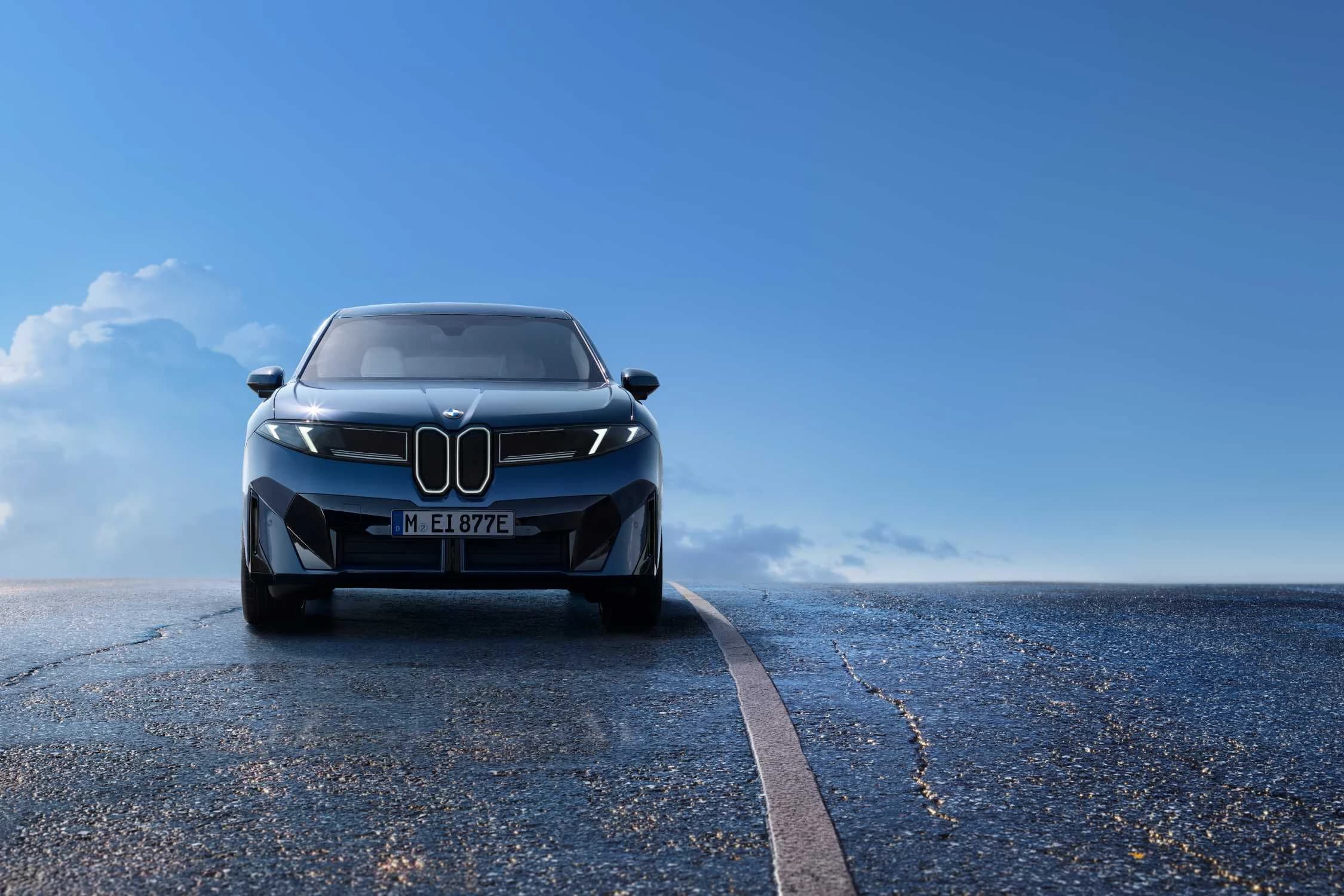
Americans say they usually need a relatively small amount of driving range each day, yet many still want a battery-electric vehicle to cover almost 500 kilometres before they would seriously consider buying one. That is the central finding of BMW Group’s 2026 U.S. consumer survey, which describes a gap between practical daily use and the reserve range people want for less predictable trips.
The survey was conducted by Big Village from September 11 to 13, 2026, among 1,005 U.S. adults aged 18 and over. BMW says the sample was weighted to represent the U.S. adult population. It is therefore a study of American attitudes, not a global measure of EV demand and not evidence about the Romanian or wider European market.
The range gap is larger than the daily routine
Seventy-three percent of respondents selected 25, 50 or 75 miles when asked how much range would be enough to cover their daily driving routine. The upper end of that group, 75 miles, is about 121 kilometres. At the same time, 72% said minimum driving range would be a deciding factor when considering an EV, and 42% said they would want at least 300 miles before considering one. That threshold is approximately 483 kilometres. Eighteen percent wanted more than 400 miles, or over 644 kilometres.
Those answers do not mean that 42% of respondents drive 483 kilometres every day. They show that total range has a psychological and practical role beyond the average commute. A driver may use only 50 miles on a normal weekday but still want enough reserve for a long weekend trip, an unexpected change of plans or a route where public charging is uncertain.
The survey does not record odometer data or compare the answers with real journeys. It measures stated needs and purchase considerations. That distinction matters because a stated range requirement can include a safety margin, a fear of inconvenient charging, or a preference for avoiding stops rather than a genuine daily energy requirement.
Faster charging could narrow the gap
Fifty-three percent of those surveyed said they would be more likely to consider an EV if it could add approximately 150 miles of range during a 10-minute fast-charging stop. That is about 241 kilometres. The answer was particularly common among younger respondents: 70% of Gen Z and 65% of Millennials selected the option, compared with 52% of Gen X and 30% of Baby Boomers.
Acceptable charging times also moved from the previous year. Fifty-five percent now consider 30 minutes or less acceptable, compared with 48% in BMW’s 2025 survey. Seventy-six percent consider an hour or less acceptable, up from 71% in 2025. These are expectations, not guarantees. A charging session depends on the car’s maximum input, the charger’s available power, the battery’s temperature and state of charge, and the site’s electrical capacity.
BMW points to the new iX3 as an example of the technology it believes can answer that demand. The company says the model can add an estimated 185 miles of range in 10 minutes at an 800-volt DC fast-charging station. That is a BMW figure for a particular vehicle and charging scenario. It should not be treated as a universal result for every EV or every stop.
Price remains the biggest barrier
Sixty-eight percent of respondents say they would consider an EV. The reasons include lower ownership or operating costs, cited by 27%, better performance or driving characteristics, cited by 19%, newer technology at 19%, and environmental benefits, also at 19%.
Consideration is not the same as readiness to buy. Purchase price is the leading barrier, mentioned by 51% of respondents. Battery longevity or replacement cost follows at 31%. Charging time is cited by 26%, while driving range and public charging availability each receive 24%. Convenient home charging is another concern at 23%.
The used market may broaden the audience if the price difference is large enough. Fifty-five percent say they would consider a certified pre-owned or used EV if it provided sufficient savings. The survey does not define “sufficient” savings, does not compare specific models, and does not measure the cost of battery replacement. It does show that buyers are assessing an EV as a total ownership decision rather than only as a powertrain choice.
Backup power is part of the appeal
Fifty-seven percent say they would be more likely to consider an EV if it could provide backup electricity to their home during a power outage. BMW connects that answer with Vehicle-to-Home functionality introduced with the new iX3. Bidirectional charging requires more than a large battery: the vehicle, charger and home electrical system all need to support the function, and local rules may affect how it can be used.
The survey also asked what people might do during a hypothetical 20- to 30-minute public charging stop. Forty-three percent would call or text friends and family, 41% would get coffee or food, and 36% would relax or read. Streaming entertainment or gaming attracted 29%, running an errand 26%, and walking or exercising 25%.
Those answers make the location and quality of charging sites relevant. A predictable stop with food, toilets or safe walking space may feel different from an isolated charger beside a closed business. BMW’s survey did not audit charging locations or test how respondents behave during real sessions, so the result should be read as a preference rather than an infrastructure scorecard.
EV perception is changing, but access is uneven
Forty-five percent of respondents say their opinion of EVs changed during the past year. Thirty-four percent report a more positive view and 11% a more negative one. Only 56% now describe EV buyers as early adopters, down from 62% in 2025.
Performance is one reason attitudes may be shifting. Thirty-eight percent believe EVs accelerate faster than a comparable petrol-powered vehicle. The figure rises to 49% among Millennials and 47% among Gen Z, compared with 33% among Gen X and 25% among Baby Boomers.
Awareness of local charging remains limited. Just 47% say they know where the nearest public charger is located near their home or workplace, unchanged from 2025. That helps explain why buyers can express interest in EVs while still demanding a large range buffer. When charging is not visible or predictable, a larger battery becomes an easier way to manage uncertainty.
The survey also reports a gender difference in range and performance views. Men were more likely than women to say range would be a deciding factor, 80% versus 64%, and to prefer at least 300 miles, 50% versus 35%. Men were also more likely to believe an EV accelerates faster than a comparable petrol vehicle, 52% versus 25%. These are group-level answers and do not predict how an individual customer will shop.
What the survey does and does not prove
BMW’s results do not prove that every EV needs a 500-kilometre battery or that range is the only issue holding back sales. They show that a large share of U.S. consumers wants a substantial reserve, even when the stated daily routine is much shorter. Faster charging appears to be one possible way to reduce the need for that reserve, while purchase price, battery confidence and home charging remain practical barriers.
For buyers, the useful lesson is to separate a vehicle’s official range from the distance they actually drive and the stops they are willing to make. For manufacturers and charging operators, the responses point to several demands at once: lower entry prices, clear battery warranties, reliable public charging and shorter, more predictable stops. The study is a snapshot of American opinion in September 2026, not a forecast for every market.
Sources
- BMW Group PressClub USA – 2026 survey results and methodology
- BMW Group PressClub USA – 2025 comparison survey
Image: BMW Group PressClub, official BMW iX3 press photograph. Reused from BMW’s media material; copyright remains with BMW Group.


