
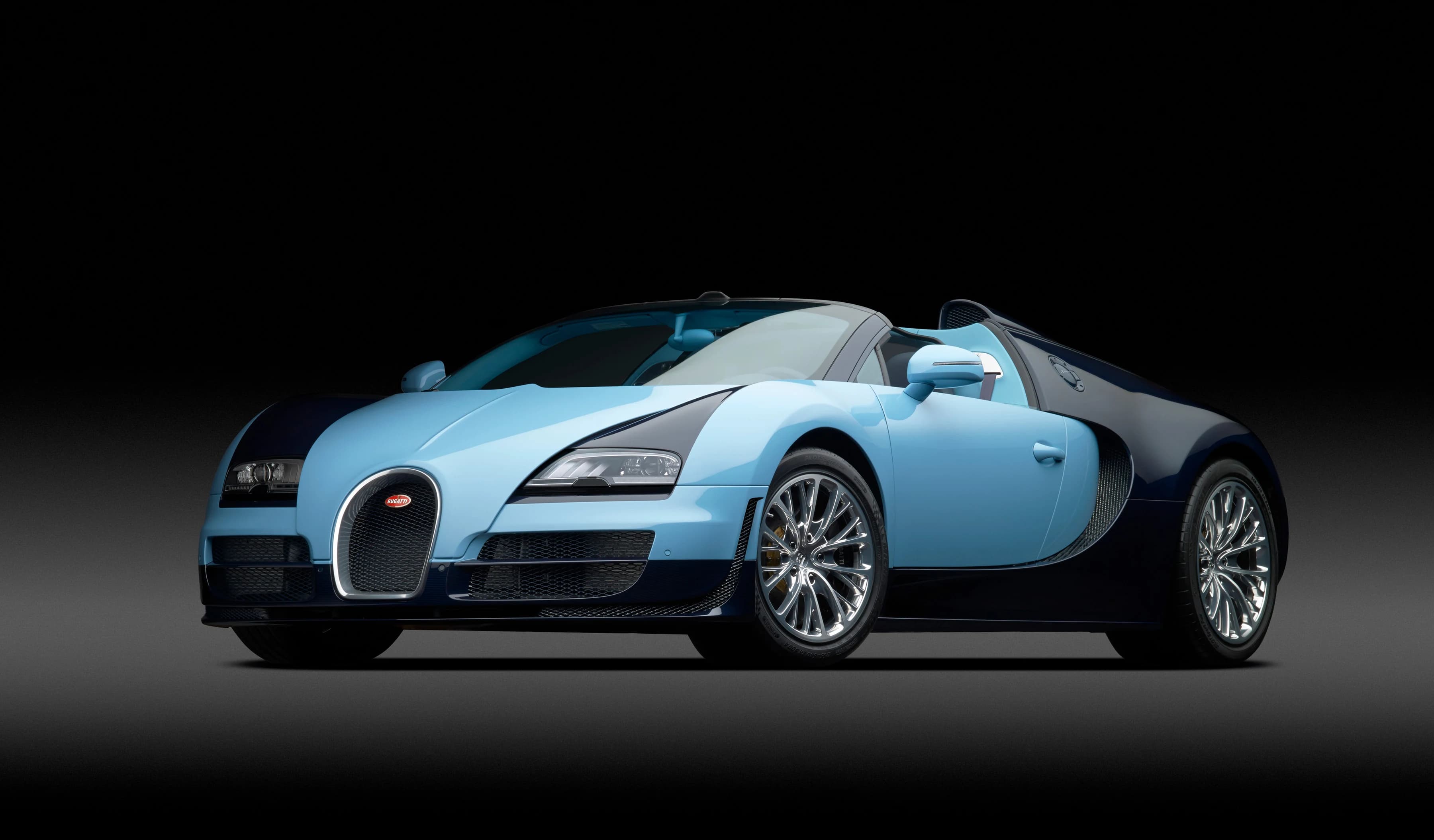
A Bugatti Veyron 16.4 Grand Sport Vitesse Jean-Pierre Wimille sold for CHF 4,505,000 at RM Sotheby’s Zurich auction on September 26, 2026. The result is the highest public auction price recorded for a Bugatti Veyron, according to post-auction reporting and collector-car market databases.
The car is one of three examples built for the first entry in Bugatti’s “Les Légendes de Bugatti” series. It was delivered in 2014 and had covered 3,766 kilometres. Its final result was about 61 per cent above RM Sotheby’s top estimate of CHF 2.8 million. The figure reflects the car’s specification and performance, but also its limited production, historical subject and documented condition.
A result well above the estimate
RM Sotheby’s estimated the car at CHF 2.4 million to CHF 2.8 million. The CHF 4.505 million result cleared the top of that range by CHF 1.705 million. Converting the sale into euros or dollars depends on the exchange rate used; the Swiss-franc result is the useful reference for the auction itself.
An auction result is not a factory price and it is not a universal valuation for every Veyron. Collector-car prices can vary significantly between versions. Production numbers, mileage, service records, ownership history and the quality of the sale all matter. In Zurich, the Jean-Pierre Wimille specification added a documented story to the mechanical base of a Grand Sport Vitesse.
The three-car Wimille edition
Bugatti introduced the first “Les Légendes de Bugatti” model at Pebble Beach in August 2013. The series honoured people and themes from the company’s history, with each edition limited to three cars. Jean-Pierre Wimille was a Bugatti works driver who won the 24 Hours of Le Mans twice for the marque.
Wimille’s 1937 victory with Robert Benoist in a Bugatti Type 57G Tank provided the main theme for the edition. He won again in 1939, this time sharing a Type 57C Tank with Pierre Veyron. Bugatti translated that connection into the car’s light-blue and dark-blue colour scheme, references to the Le Mans circuit and details bearing Wimille’s signature.
The auction car is not a replica of the historic racer. It is a production Veyron Grand Sport Vitesse finished by Bugatti as a limited Legend edition. Its carbon-fibre body uses the specially developed “Bleu Wimille” paint with exposed dark-blue carbon. The cabin follows the same two-tone approach, with blue upholstery, French-colour stitching, the driver’s signature and “Les Légendes de Bugatti” details.
What the Vitesse brought mechanically
The Veyron 16.4 Grand Sport Vitesse uses an 8.0-litre W16 engine with four turbochargers. Bugatti quoted 1,200 PS and 1,500 Nm of torque between 3,000 and 5,000 rpm. The manufacturer’s figure for 0–100 km/h acceleration is 2.6 seconds.
With its roof removed, the Vitesse reached 408.84 km/h in a Bugatti test in April 2013. The company described it at the time as the fastest production roadster. That figure belongs to the model’s development history and does not describe normal road use. For collectors, it helps define the engineering story, but the top speed alone does not explain the Zurich price.
The Veyron’s hardware was already unusual when the Grand Sport Vitesse arrived. An 8.0-litre W16, four turbochargers, all-wheel drive and a road-going open body required a complex cooling and control system. The Vitesse also had to combine high-speed stability with a cabin and trim level expected from a Bugatti road car. None of those parts makes the Wimille edition one of a kind by itself, but they form the technical base on which the historical specification sits.
Why the history adds value
Bugatti limited the full Veyron production run to 450 cars. A three-car edition is therefore much rarer than a standard Veyron, particularly when its theme is tied to the first Bugatti victories at Le Mans. Rarity does not guarantee a fixed value: auction prices depend on the bidders present, the timing of the sale and the documentation supplied with the car.
The 3,766-kilometre odometer reading helps position this example, but collectors also examine its maintenance history. A W16 with four turbochargers, complex cooling circuits, a sophisticated transmission and hydraulic systems requires specialist care. Service invoices, delivery documents and any work carried out after delivery are part of the car’s commercial identity.
That is why the record should not be applied to every Veyron. A standard Grand Sport Vitesse, a different body style or a car with less complete provenance can produce a very different result. The sale demonstrates what a rare combination of model, historical connection and condition can achieve, rather than setting a universal price for Veyron ownership.
What the sale says about modern collectibles
The Zurich result confirms that the Veyron remains relevant in the modern collector-car market more than a decade after production ended. One sale is not enough to establish an annual trend, however. A meaningful comparison would require several results, a common currency, consistent treatment of fees and a clear separation between Veyron versions.
For the Jean-Pierre Wimille car, the case rests on four specific points: a three-car production run, an extreme technical specification for its period, a direct link to Bugatti’s Le Mans history and low mileage. Together they produced a record auction result. The story is therefore as much about provenance and scarcity as it is about the W16 engine.


