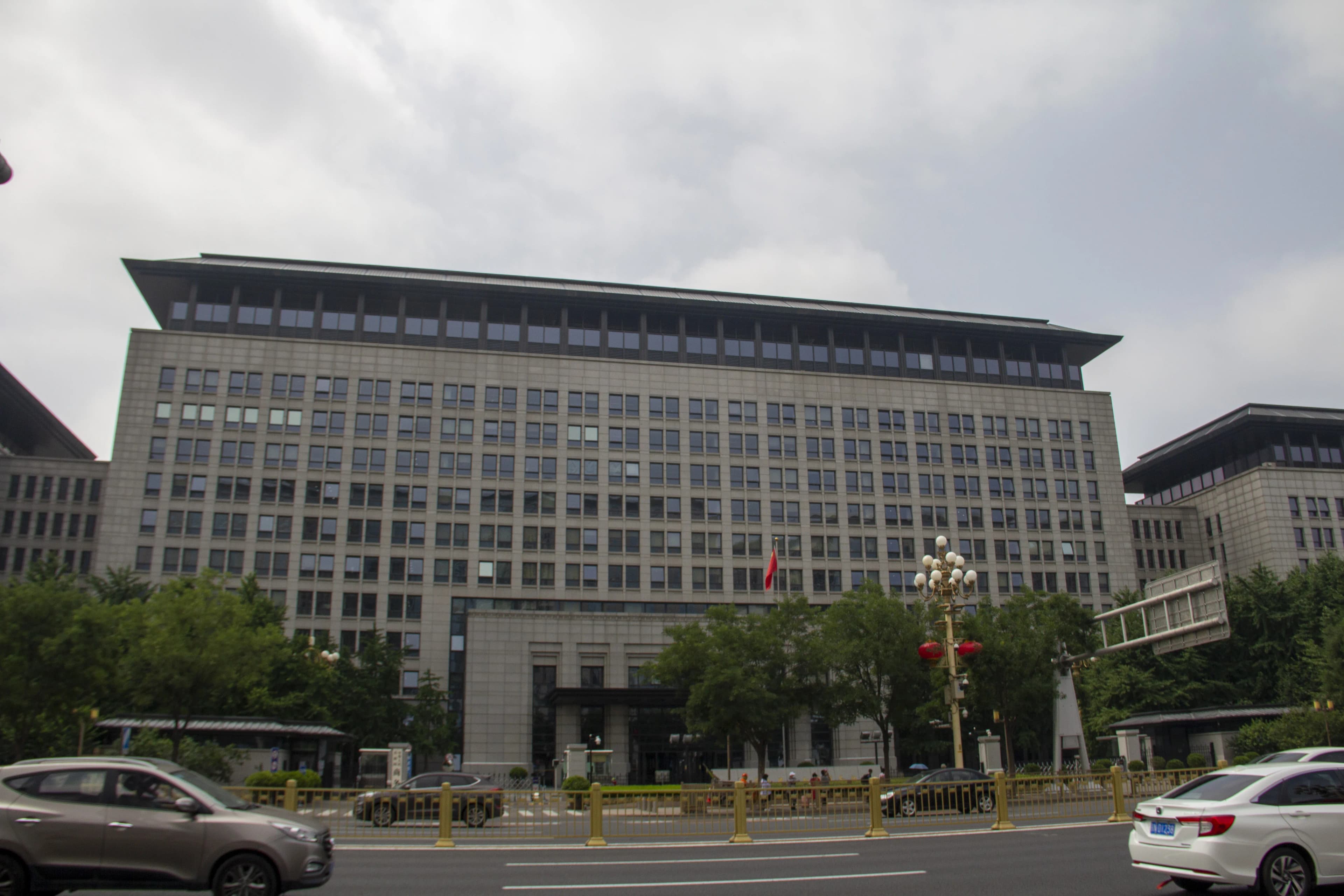
China's Ministry of Commerce headquarters in Beijing. Photo: 維基小霸王/Wikimedia Commons, CC BY-SA 4.0.
China warns the UK over possible restrictions on Chinese EVs
China has warned that it will take “firm countermeasures” if the United Kingdom restricts Chinese electric vehicles. The statement, issued by the Ministry of Commerce on 19 October, followed remarks from UK Trade Minister Anas Sarwar that Britain and the European Union should work together on the challenge posed by China’s growing position in the car industry.
The important qualification is that Britain has not introduced a new EV tariff. London is discussing its options with European partners, but there is no published UK duty matching the European Union’s additional charges on battery-electric vehicles made in China. Beijing’s statement is therefore a conditional warning about a possible future measure, not an announcement of a Chinese response to a tariff already in force.
What Beijing actually said
The Chinese ministry was responding to reports about Sarwar’s comments. It described China–UK automotive cooperation as complementary, equal and mutually beneficial. It also urged the British government to follow World Trade Organization rules, think carefully before acting and avoid simply following the EU’s approach.
The ministry said it would watch the UK’s next steps closely. If Britain insisted on restrictive measures against Chinese electric vehicles, it would respond to protect the legitimate interests of Chinese industry. No product category, British company, tariff rate or investigation was named. That leaves the possible shape of any response unknown.
That wording matters for manufacturers and importers. A ministry warning can affect expectations and negotiations, but it does not alter customs declarations by itself. A UK importer still needs to work with the tariff schedule and origin rules currently in force until the British government publishes a legally effective change.
Why Britain is considering alignment with the EU
The European Union imposed definitive countervailing duties on Chinese battery-electric cars from 30 October 2024, after an anti-subsidy investigation. The rates vary by company: 17% for BYD, 18.8% for Geely, 35.3% for SAIC, 7.8% for Tesla Shanghai, 20.7% for other cooperating companies and 35.3% for non-cooperating companies. The normal 10% customs duty is separate, so the highest combined rate can reach 45.3% for a vehicle covered by the relevant rules.
The UK did not adopt the EU’s additional countervailing duties in 2024. Chinese-built electric cars can therefore enter Britain under the ordinary tariff regime, subject to the applicable customs rules. That difference helped make the UK an attractive market for brands such as BYD, MG, Chery, Omoda, Jaecoo and other manufacturers with Chinese production.
The political discussion is connected to the EU’s proposed Industrial Accelerator Act. Presented by the European Commission in March 2026, the proposal would create “Made in EU” and low-carbon preferences in some public procurement and support schemes, including measures covering cars and net-zero technologies. It is still a legislative proposal that must be negotiated by the European Parliament and the Council. It is not itself a tariff on Chinese cars.
For Britain, the question is partly about access for companies that sell into European supply chains. The UK wants its businesses to be treated fairly under future industrial rules, while some EU governments have argued that closer alignment of trade policy should be part of that relationship. The exact link between EV tariffs and participation in the final act remains a matter for negotiation.
The UK position is not settled
Sarwar’s comments indicate that talks are continuing, but they do not set a rate or a date. The UK minister responsible for trade is Lord Sarwar, appointed to the role in July 2026. The government has also said that it continues to engage with industry and that its tariff policy must reflect the UK’s national interests.
That leaves several routes open. Britain could maintain the current system. It could start its own trade-remedy process. It could introduce a quota or another form of restriction. It could negotiate a form of alignment with EU measures. Each route would have different legal steps and different effects on import costs.
An independent UK investigation would not automatically produce the same result as the European Commission’s case. The investigations could use different evidence, product definitions and findings. A political agreement to mirror EU duties would be faster, but it would raise questions about how much of Britain’s trade policy was being set through decisions made outside the UK.
What a tariff could mean for buyers
An additional duty would increase the landed cost of a vehicle made in China, although the final effect would depend on how manufacturers and distributors share the burden. Some of the cost could be absorbed through lower margins or removed discounts; some could reach the customer through a higher list price. Models made outside China would not necessarily receive the same treatment, even if the brand is Chinese-owned.
The European example shows why the details matter. BYD, Geely, SAIC and Tesla Shanghai face different additional rates under the EU regulation. A UK system could use the origin of the vehicle, the exporter, the result of a new investigation or a volume threshold. No British method has been announced.
The decision would also sit alongside the UK’s zero-emission vehicle policy. Higher prices on some electric cars could make market growth more difficult for buyers who are comparing battery vehicles with petrol or hybrid alternatives. On the other hand, supporters of restrictions argue that trade measures could give domestic manufacturers more room to compete. The current public record does not establish how a UK tariff would affect registrations, factory investment or consumer prices.
For British carmakers, China is also an export market and a source of components. That is why the possibility of retaliation is part of the government’s calculation. Beijing has not said what it would target, so any discussion of specific British brands or products would be speculation.
The next concrete signals
The next meaningful step would be a UK consultation, investigation notice, tariff instrument or formal agreement with the EU. Until one of those appears, the position remains political rather than operational. Importers should watch customs guidance and official trade-remedy announcements, not only statements made at business events.
The Industrial Accelerator Act is another key reference point. The Commission’s proposal includes requirements for selected strategic sectors and conditions for some large foreign investments, but its final text and treatment of the UK are not yet known. The UK–EU rules of origin for electric vehicles are also due to change after the extension that kept the existing arrangements in place through the end of 2026.
The narrow conclusion is the most accurate one: China has warned Britain against restricting Chinese EVs, and Britain is discussing coordination with the EU. Neither a new UK tariff nor a Chinese retaliation measure has been announced. The commercial impact will become clearer only when London publishes an actual policy and Beijing identifies any response.
Sources
- China Ministry of Commerce: response on UK statements about the auto industry
- European Commission: definitive countervailing duties on Chinese battery-electric vehicles
- European Commission: Industrial Accelerator Act proposal
- UK Government: electric-vehicle rules of origin under the Trade and Cooperation Agreement
- CnEVPost: China warns the UK against following the EU on EV restrictions