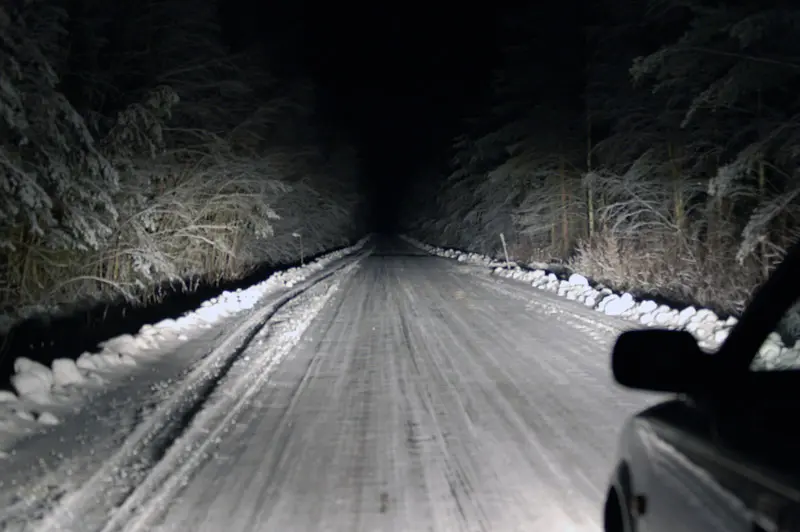
A Toyota Corolla photographed on a dark winter road in Finland. Photo: Scoo/Wikimedia Commons, CC BY-SA 2.5.
AA sees 8% rise in crash-assistance claims after clock change
AA says claims handled by its Accident Assist service rose by about 8% in the two weeks after last autumn's clock change. The number is a service-activity measure, not a national count of police-reported crashes, injuries or deaths. It also does not show that every driver became 8% more likely to crash.
The United Kingdom moves from British Summer Time to Greenwich Mean Time on the last Sunday of October. Turning the clocks back shifts an hour of daylight from the evening to the morning. Drivers leaving work at the same clock time can therefore meet darker roads, lower contrast and more glare from wet surfaces.
What the AA number does and does not say
Accident Assist is an assistance service. A claim can follow a collision or another incident for which a driver needs support, but the published summary does not provide the total number of claims, the geographic split, the share involving injury or the full comparison period. It also does not establish whether darkness, rain, fatigue, traffic volume or another factor caused any individual incident.
That matters because the word “crashes” can make a service dataset sound like an official accident census. The AA figure is useful as a warning about a seasonal change in demand, but it should not be substituted for the Department for Transport's STATS19 collision data. A call to an assistance provider and a police-recorded casualty are different observations.
The same caution applies when the British result is discussed in other countries. Romania has different traffic patterns, lighting standards, weather and work schedules. A percentage observed in an AA service cannot be copied into a Romanian road-safety forecast without a local dataset and the same definitions.
The evidence from British road data
A BMJ Open study examined road traffic casualties in Great Britain around the seasonal clock changes using STATS19 records from 2005 to 2018. The researchers used a causal regression-discontinuity design and looked at the immediate periods around the spring and autumn transitions. Their conclusion was not a simple crash surge after the clocks went back. Effects were small, varied by time of day and place, and the aggregate autumn result did not show a statistically significant nationwide increase.
The paper found reductions in some morning periods after the autumn transition, when the extra hour of sleep and earlier morning light could work in the same direction. It also stresses that the data come from police reports and that under-reporting is possible. The study is an analysis of casualties, not a test of the AA service, so its result cannot confirm or disprove the AA's 8% claim directly.
Other work asks a broader question: when is daylight available to the people who travel? Research published in the Review of Economics and Statistics estimated the long-run road-safety cost associated with darkness in Great Britain and modelled alternative time regimes. That approach considers the distribution of light across a whole year rather than the short disruption immediately after one clock change.
Why the evening can feel different
After the autumn change, sunset arrives an hour earlier by the clock. The evening traffic peak can then overlap with darkness. Pedestrians and cyclists are harder to see when they wear dark clothing, while wet asphalt can reflect headlights and street lighting. A dirty windscreen can create additional glare, and a worn wiper can leave a thin film across the driver's field of view.
Those conditions do not act alone. Rain changes braking distance and road grip; leaves can cover lane markings or become slippery; and drivers may be adapting to a new schedule. The AA figure cannot separate these effects. The research literature likewise warns that traffic volume, time of day, weather and sleep changes can overlap at the transition.
Practical checks for drivers
The Royal Society for the Prevention of Accidents advises extra care as autumn evenings become darker. The practical response is straightforward: choose a speed that matches the visible road, leave more space on wet surfaces and keep the windscreen clean inside and out. Use dipped beam when appropriate and avoid dazzling other road users with badly adjusted or unnecessary main-beam lights.
Tyre pressure should be checked when the tyres are cold and set against the vehicle manufacturer's figures. Tread depth and condition matter more when water is present, but good tyres do not remove the need for a longer following distance. A legal speed limit is a maximum, not a target for a road that cannot be seen clearly.
The same principle applies near crossings, bus stops and schools. A driver should be able to stop within the distance illuminated and visible ahead. If a cyclist, pedestrian or animal appears late in the beam, the problem is not solved by reacting faster after the fact; lower speed and more observation create the time needed before the hazard becomes immediate.
How to read the headline
The most accurate summary is narrow. The AA reports an increase of about 8% in Accident Assist claims during the two weeks after last autumn's clock change. Independent research using British casualty records does not support a universal rule that the autumn clock transition produces an 8% rise in all crashes. The mechanisms remain plausible, but the size and direction of the effect depend on the dataset and time window.
For drivers, the useful response is not to treat the percentage as a personal prediction. It is to recognise that darkness arrives earlier and to adjust speed, visibility checks and following distance accordingly. The AA result is a service signal; STATS19 and academic studies provide a different, more limited view of road casualties.