Alfa Romeo is questioning the idea that a modern car needs an ever-larger screen in the middle of the dashboard. The Cuorerosso concept, unveiled at the 2026 Paris Motor Show, keeps digital technology but makes it less visually dominant. Its central display can disappear when it is not needed, while physical controls remain available for the functions the driver is expected to find quickly.
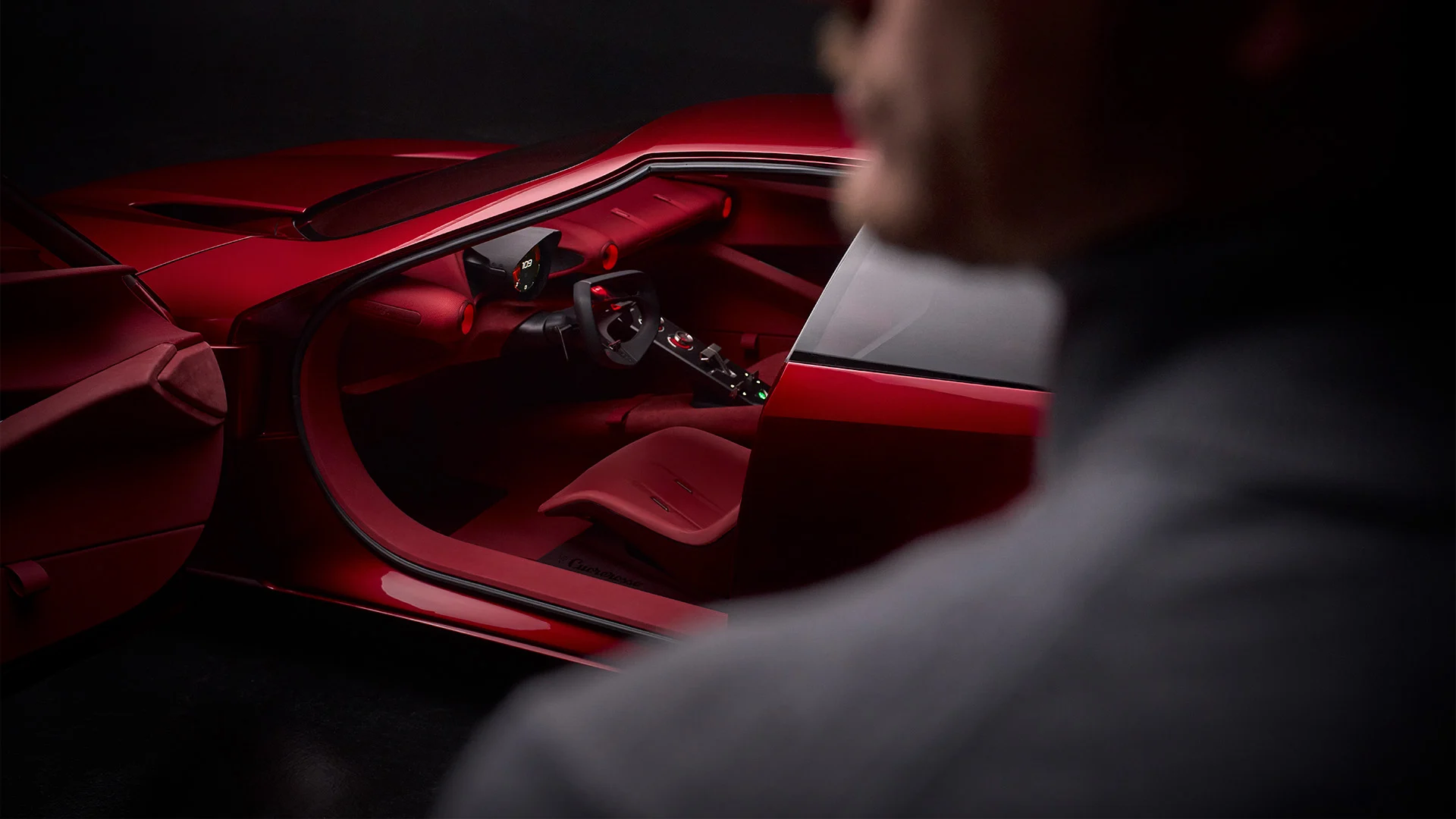
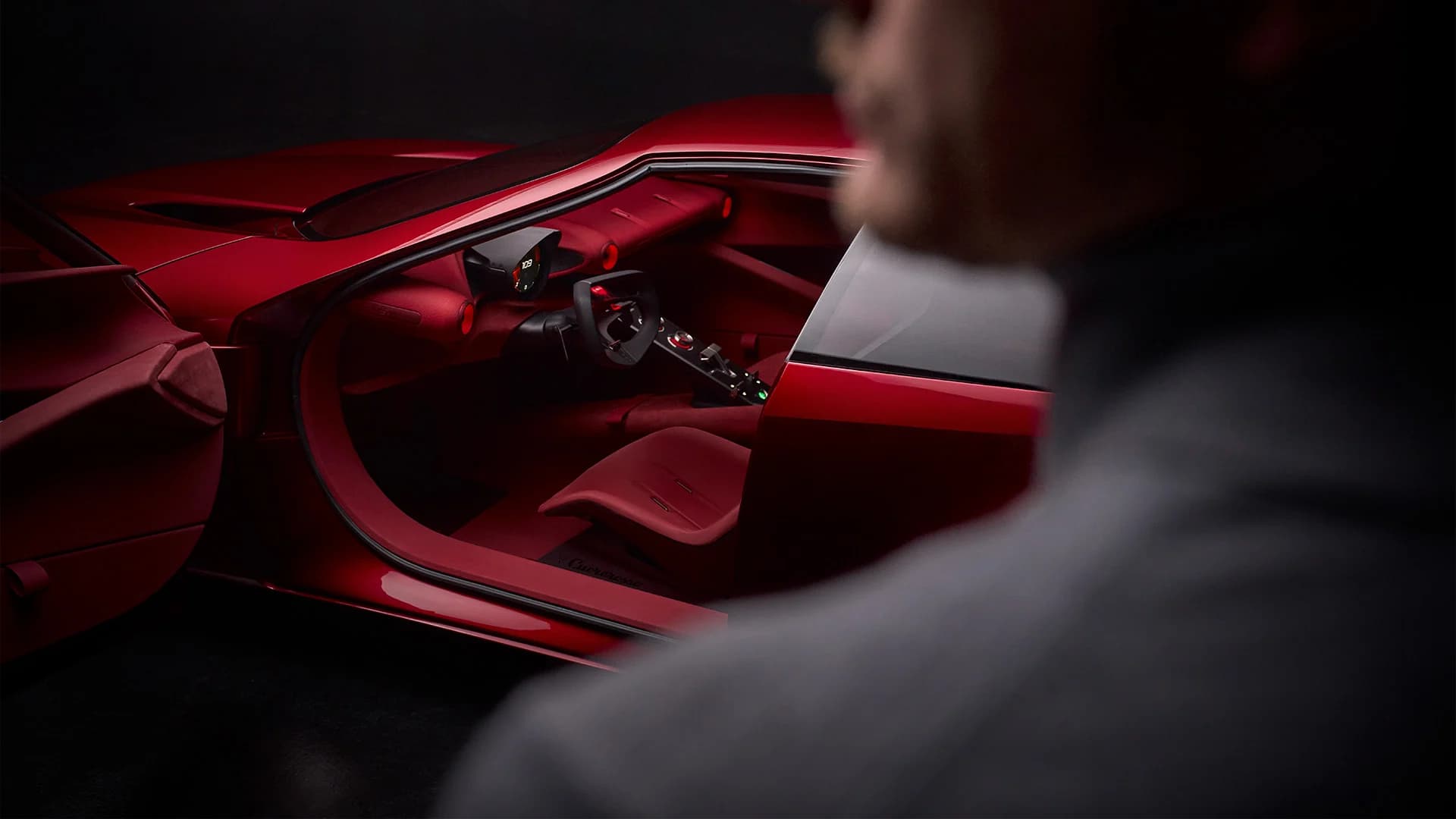
Official Alfa Romeo Cuorerosso concept interior. Image: Alfa Romeo/Stellantis Media.
A design statement, not a production car
Stellantis describes Cuorerosso as a concept and a manifesto for Alfa Romeo’s next design direction. It is not a confirmed production model, and its technology should not be read as a final equipment list for a future car. The official Alfa Romeo page says the brand’s “Bellezza Necessaria” language will shape new Alfa Romeo models from 2028, but it does not specify which production model will receive each Cuorerosso feature.
The principle is straightforward: every line and surface should have a reason. That leads to an interior with fewer permanent visual elements and a clearer division between information that is always needed and information that should appear only on demand. Alejandro Mesonero-Romanos, Alfa Romeo’s design chief, told Autocar that the industry has entered a “war of centimetres” over screen size and said the brand would rather get rid of screens where they are not useful.
That does not mean Alfa Romeo is proposing a completely screen-free cabin. Cuorerosso still uses digital displays. The difference is that they are integrated into a moving instrument cluster and a console that can hide its interface, instead of remaining as a large, permanently visible tablet.
Magma Display mixes physical and digital controls
The centrepiece of the concept is the Magma Display. Alfa Romeo describes it as a “phygital” console, combining digital surfaces with physical controls. When it is resting, the console is meant to look clean, with no visible screen clutter. When the driver needs a function, the relevant control rises into the expected hand position and then retreats again.
The official description refers to a digital touch surface, a rotary dial, a drive-mode selector and toggle controls. The idea is therefore not a return to a fully analogue dashboard. Instead, Alfa Romeo is trying to give different functions the type of input that suits them best: touch for flexible information, and physical movement for controls that need to be found without searching through a menu.
That approach also creates a practical question. A hidden interface can make a cabin calmer, but only if it appears quickly, is easy to understand and gives the driver clear feedback. A concept can demonstrate the mechanism; only a production car can show whether the solution works in traffic, at night and while wearing gloves. Alfa has not published a production timetable for the Magma Display.
The Cannocchiale changes with the driving mode
Behind the steering wheel is the Cannocchiale Vivente, a moving interpretation of Alfa Romeo’s traditional instrument binnacle. In “Cruising” mode, the two round elements open into two screens. In “Focused” mode, they fold back into a single Cannocchiale, reducing the visual field to the information Alfa Romeo considers most relevant to concentrated driving.
The system is intended to change the character of the cabin rather than simply add another display. During normal travel, the driver can use the wider layout. When the focus is on the road and the car’s responses, the interface becomes more compact. The screens are still there, but the concept avoids showing everything at once.
The interior also features the Con-tatto steering wheel, linked to a steer-by-wire concept. As with the Cannocchiale and Magma Display, this is a technology presented as part of a design study. Alfa Romeo has not confirmed the exact production vehicle, hardware specification or final interface that may result.
What could reach future Alfa Romeo models?
Alfa Romeo says its new design language will influence the brand’s future range from 2028. Daniele Chiari, Alfa Romeo’s head of product, also told Autoblog that some of the Cuorerosso technology will appear on a production car. The interview did not identify a model or provide a date for the individual interior systems, so the likely path remains open.
The direction is nevertheless significant. Many new cars now use screen size as a visible shorthand for technology. Alfa Romeo is trying to distinguish itself through the opposite message: technology should support the driver without becoming the cabin’s main decoration. For a brand that continues to use driving enjoyment as part of its identity, a compact instrument display and tangible controls could become as recognisable as a grille or a steering-wheel badge.
Cuorerosso is also a large concept, measuring 4.70 metres in length, 1.98 metres in width and 2.93 metres between the axles. Alfa Romeo presents it as a multi-energy vision. The official concept page mentions a 565-hp V6 biturbo working with lithium-ion batteries delivering around 350 kW, plus air suspension and carbon-ceramic brakes. Those figures belong to the concept and are not confirmed specifications for a future production model.
The real test will be everyday usability
For drivers, the proposal promises less visual noise and more direct access to important functions. For Alfa Romeo, the challenge will be to preserve connectivity without turning the cabin into a collection of menus. That will depend on details: how quickly a control appears, whether the physical feedback is consistent, and whether the driver can use it without taking attention away from the road.
Cuorerosso offers a coherent answer to the giant-screen trend. Displays do not disappear, but they stop being the permanent background of the dashboard. The idea will only be fully tested when Alfa Romeo has to adapt it to production costs, safety requirements, durability and different customers. For now, the concept is a clear indication that the brand wants a quieter cabin and technology that knows when to step back.