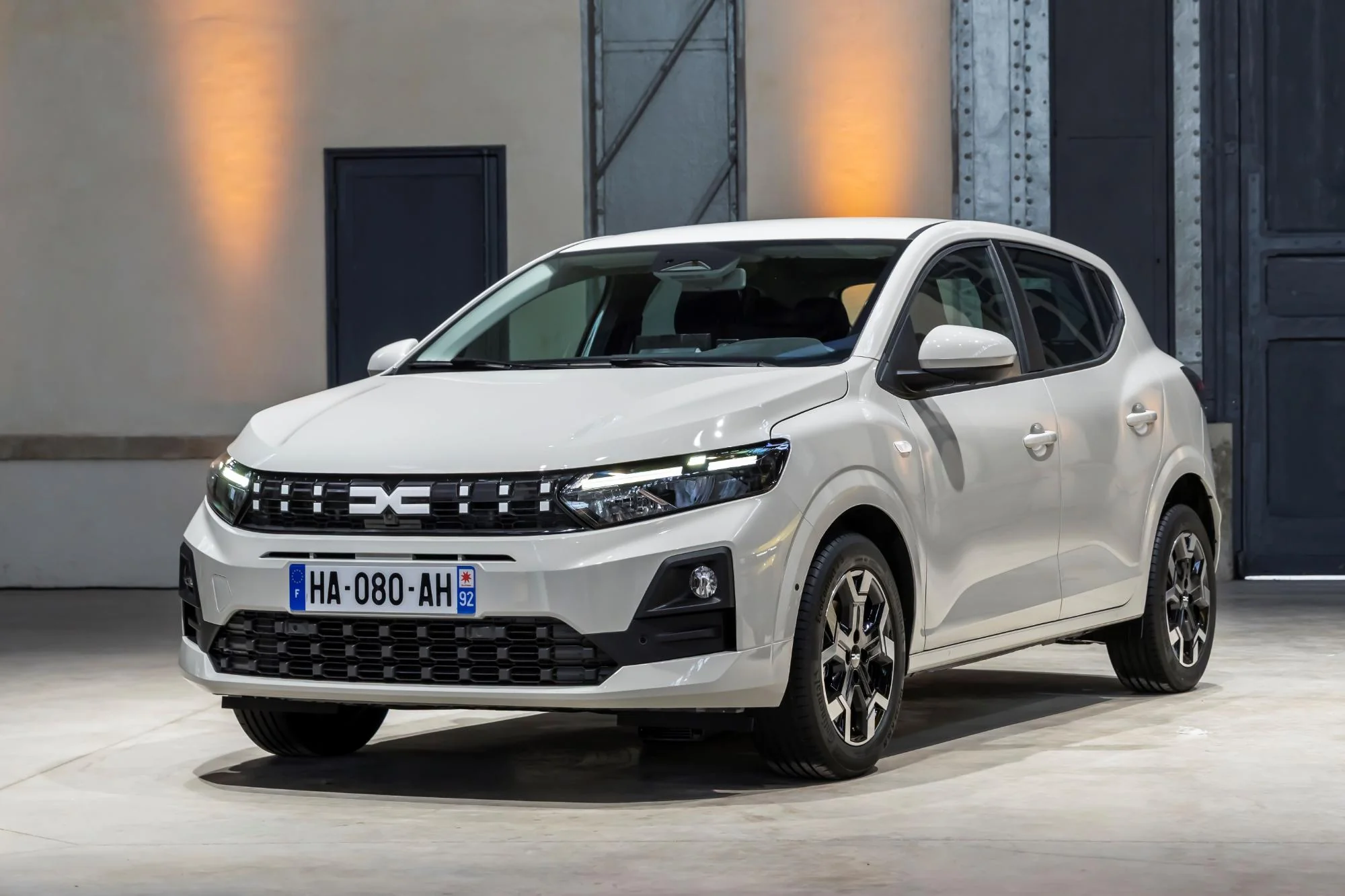
The Dacia Sandero kept first place in Europe both in July and after the first seven months of 2026. Image: Dacia.
Dacia Sandero remains Europe’s best-selling car in 2026. Golf and T-Roc complete the podium
The Dacia Sandero was the most registered new car in Europe in the first seven months of 2026. The Romanian brand’s model reached 132,998 units, enough to stay ahead of the Volkswagen Golf and Volkswagen T-Roc, even though its volume fell 10.8% compared with the same period of 2025.
The preliminary ranking compiled by Dataforce covers 30 European markets and includes all sales channels: private customers, companies, rental firms and dealer or manufacturer registrations. For that reason, the figures should not be confused with a ranking exclusively of private buyers or with ACEA data limited to the European Union.
In July, the Sandero also occupied first place, with 19,709 examples, almost at the same level as in July 2025. The monthly result allowed it to keep a lead of almost 12,000 units over the Golf in the cumulative ranking.
Europe’s ten best-selling cars in 2026
| Rank | Model | January–July 2026 | Year-on-year change |
|---|---|---|---|
| 1 | Dacia Sandero | 132,998 | -10.8% |
| 2 | Volkswagen Golf | 121,272 | +1.2% |
| 3 | Volkswagen T-Roc | 120,247 | -5.4% |
| 4 | Renault Clio | 119,287 | -12.9% |
| 5 | Tesla Model Y | 115,957 | +55.2% |
| 6 | Peugeot 208 | 112,528 | -7.0% |
| 7 | Toyota Yaris Cross | 112,204 | -0.3% |
| 8 | Volkswagen Tiguan | 109,923 | -7.8% |
| 9 | Peugeot 2008 | 101,363 | -7.3% |
| 10 | Opel Corsa | 99,953 | -5.5% |
The gaps are small behind the leader. Between the Golf, in second place, and the Renault Clio in fourth there are fewer than 2,000 units. A single strong month can change the order of this group.
The Tesla Model Y is the only fully electric car in the top ten. The 115,957 examples represent growth of 55.2% and bring the model to fifth place, after range changes and temporary production stops had affected deliveries in 2025.
Sandero leads, but no longer at the 2025 pace
First place does not hide the drop in volume. The Sandero lost 16,027 registrations compared with January–July 2025. The Renault Clio, the main rival in the segment and the model with which the Sandero shares part of its technical base, fell even more sharply in percentage terms, by 12.9%.
The Golf took advantage of this context. The Volkswagen model advanced 1.2%, to 121,272 units, and moved into second place. In July it recorded 17,655 examples, 14.1% more than in the same month of 2025.
The Sandero remains competitive through price, the LPG range available in several markets and running costs. These advantages help it especially in sales to private individuals, but the Dataforce report also includes fleets. The position in the overall ranking does not say how many cars actually reached private customers.
Dacia Duster loses ground, Bigster doubles its sales
Dacia has three models in the top 50. Their trajectories are very different, however:
- the Duster occupies 18th place, with 84,992 units, down 24.8%;
- the Bigster reaches 46th place, with 52,430 units, up 100.6%;
- the Sandero leads the ranking, with 132,998 units, but loses 10.8%.
The Bigster’s growth must be read in the context of its launch. In the first seven months of 2025, the model was still at the beginning of commercialisation and had accumulated only 26,136 registrations. Doubling the volume in 2026 therefore compares a fully available range with a launch period.
For the Mioveni plant, the Duster and Bigster positions are more important than the first place occupied by the Sandero. The two SUVs are produced in Romania and use an extensive local supplier network. The Sandero sold in Europe is manufactured mainly at Renault Group plants in Morocco.
SUVs occupy half of the top ten places
The T-Roc, Yaris Cross, Model Y, Tiguan and Peugeot 2008 show how important the SUV or crossover format has become. Still, the Sandero, Golf, Clio, Peugeot 208 and Corsa confirm that compact and small cars have not disappeared from Europeans’ preferences.
The report also shows a market more fragmented than the podium suggests. The Nissan Qashqai is in 16th place, the Kia Sportage 12th, the Hyundai Tucson 14th, and the Škoda Kodiaq 22nd. None dominates the SUV segment alone, but together these models add up to significant volumes.
The Mercedes GLC has one of the largest increases among established models: 78,452 units and a gain of 25.7%, enough for 20th place. In July, the GLC was Europe’s seventh model and overtook the Peugeot 208, Toyota Yaris and Kia Sportage.
BYD enters the ranking with two models
The July ranking includes two BYD models. The Seal U reached 21st place in the month and 39th after seven months, with 58,074 units and growth of 48.4%. The Atto 2 occupied 40th position in July, with 7,679 examples.
The Seal U result is also relevant for Romania, where the model entered the overall ranking of July registrations. The European range includes both fully electric versions and the plug-in hybrid DM-i, so the model total cannot be attributed to a single technology.
MG has two models in the cumulative ranking: the ZS in 23rd place and the HS in 50th. Their presence, alongside BYD, shows that Chinese brands are no longer competing only in the electric segment, but also through hybrid SUVs or those with combustion engines.
Electrics that entered the top 50
Besides the Tesla Model Y, the list includes the Škoda Elroq in 27th place, the Tesla Model 3 in 40th and the Renault 5 E-Tech in 43rd. In July the Volkswagen ID.4, BMW iX1, Škoda Enyaq and the new BMW iX3 also entered.
The Elroq rose 59.2%, to 67,760 units, and the Renault 5 E-Tech 36.7%, to 54,257 units. The Tesla Model 3 advanced 30.9%. These results complement ACEA data according to which electric cars accounted for 20.7% of the European Union market in the first half of 2026.
Still, the model ranking and the share by powertrain type do not measure the same thing. Models such as the Peugeot 208, Opel Corsa, Hyundai Kona or BMW X1 exist with several powertrains, and Dataforce sums all versions under the same name.
How the Romanian market differs
In Romania, the July podium was occupied entirely by Dacia, according to the APIA analysis based on DGPCI data. The Logan had 1,260 registrations, the Sandero 896, and the Duster 725. At European level, the Logan does not appear in the top 50, because it is sold in a smaller number of markets.
The Bigster was Romania’s sixth model in July, with 289 units, and the Toyota Yaris Cross, BYD Seal U and Hyundai Tucson are among the models that appear both in local preferences and in the European ranking.
The major difference is Dacia’s share. The brand had 3,286 passenger cars registered in Romania in July, in a market of 11,633 units calculated by APIA. In Europe, no manufacturer can dominate so clearly a set of 30 markets with very different tax systems, incomes and preferences.
What the ranking shows after seven months
The Sandero has a sufficient lead to remain favourite for the annual first place, but the contest is tighter than in 2025. The Golf, T-Roc and Clio are separated by small volumes, and the Tesla Model Y’s recovery changes the balance in the upper part of the ranking.
For Romania’s car industry, the picture is mixed. The Sandero keeps its European title, the Bigster doubles its registrations, but the Duster loses almost a quarter of its volume. The coming months will show whether Dacia’s launches and updates can stop that decline without slowing the Bigster SUV’s growth.