
Women can face a higher risk of injury than men in some types of car crashes, according to a new analysis by the US National Highway Traffic Safety Administration. The finding needs careful wording. NHTSA does not conclude that every car is more dangerous for women, or that women face the same difference in every collision. Its results vary by crash direction, injury severity, seating position, vehicle age and the safety systems fitted to the car.
That distinction matters to drivers and car buyers. Occupant protection is not determined by body size alone or by the number of airbags listed in a brochure. Seat-belt geometry, seat design, the structure around the passenger cell, airbag deployment and the age of the vehicle all affect what happens in a crash.
What the NHTSA study found
NHTSA examined six crash situations: frontal, near-side, far-side, rear, combined crashes and rollovers. Across 150 statistical injury models, women had a statistically significant higher risk in 26% of the models. The agency says the differences appeared more often for moderate or serious injuries. They did not appear in every crash category or for every body region.
Some of the reported differences are substantial. In selected models, women had a 46% higher injury risk in frontal crashes and a 55% higher risk in rollovers. For lower-limb injuries in frontal crashes, the estimated difference was 62%. For foot and ankle injuries in frontal crashes, the difference reached 128%. These figures describe particular injury categories in the study; they are not a universal percentage for every female occupant.
The data came from US police-reported passenger-vehicle crashes. NASS-CDS covered 2000 to 2015, while CISS covered 2017 to 2022. The databases are designed to represent national crash patterns, but they do not automatically describe crash conditions in Europe or Romania. They are nevertheless valuable because they show where vehicle testing and restraint design may still leave gaps.
Newer vehicles have narrowed the fatality gap
The latest result should be read alongside an earlier NHTSA report on vehicle age. In vehicles built from 1960 through 2009, the relative female fatality risk was about 18.3% higher than the male risk. The estimate fell to 6.3% for vehicles from 2010 to 2020 and to 2.9% for vehicles from 2015 to 2020.
NHTSA associates the improvement with better seat belts, airbags and occupant compartments. In the 2015–2020 group, the estimated difference for female drivers compared with male drivers was close to zero, about 0.5%, although the uncertainty interval was wide. That does not prove that every modern model protects everyone equally. It does show that the gap seen in older vehicles has been greatly reduced by successive safety improvements.
Vehicle age is therefore a practical issue. A large older vehicle may not provide the same restraint performance as a newer, smaller vehicle with improved crash structure and belt load management. Conversely, a modern vehicle’s safety rating must still be read in context: different tests cover different impacts, and a good overall result does not mean that every injury mechanism has disappeared.
Why crash-test dummies matter
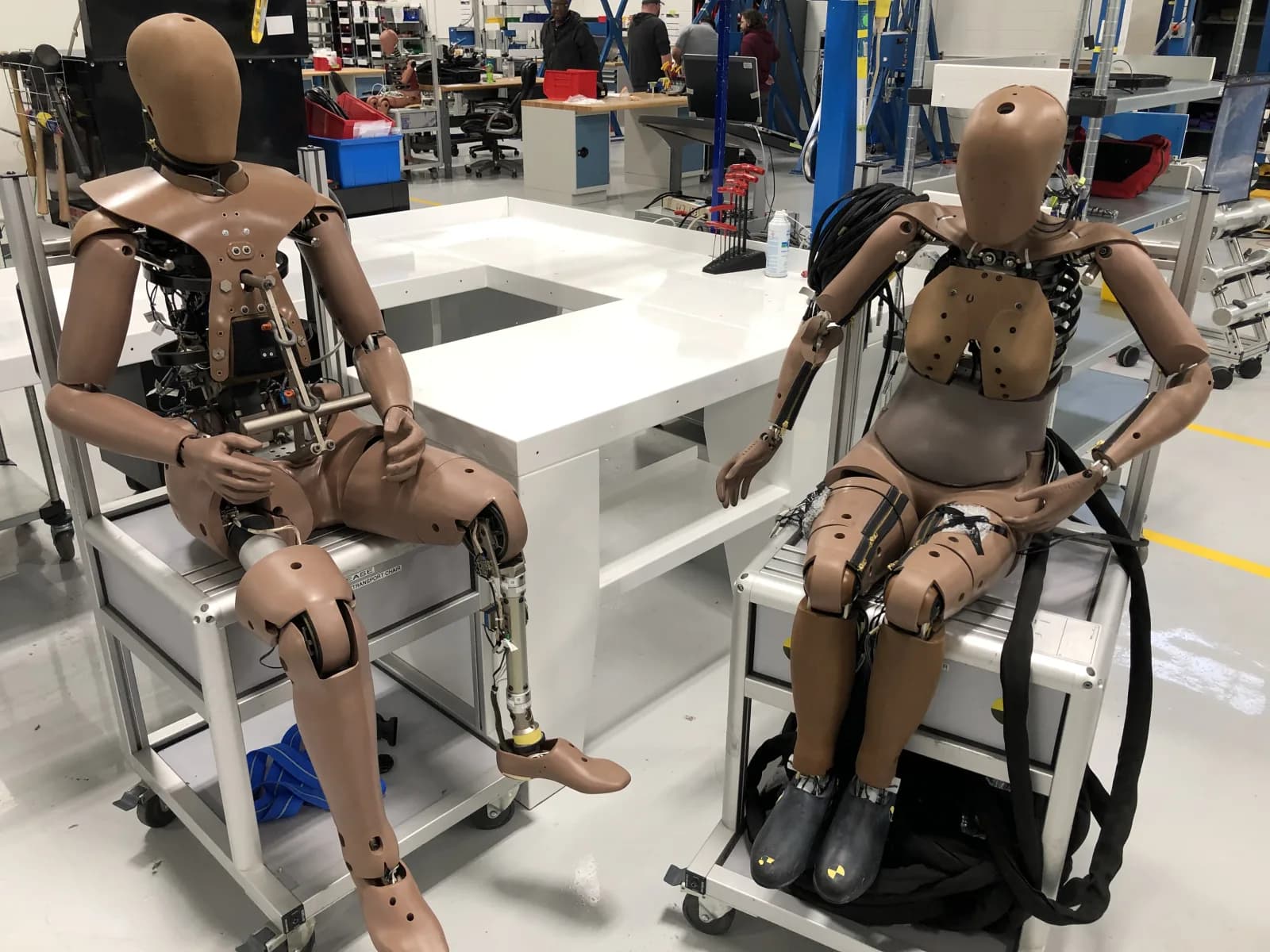
A crash-test dummy is a measuring instrument. Its body shape, joints and sensor locations determine which loads can be recorded. NHTSA has pointed to the need for advanced female dummies, including THOR-05F and WorldSID-05F, to better represent differences in the neck, chest, pelvis and lower limbs.
Volvo’s E.V.A. initiative is another example of the issue. Volvo says it has studied more than 40,000 cars and 70,000 occupants from real-world crashes since 1970. The company says women can have a greater risk of some chest and neck injuries and that its WHIPS whiplash protection system reduced the difference seen in its own data. Those are Volvo’s claims about its research and products, not an independent certification covering every car or every seating position.
The debate also has a direct everyday consequence: belt fit. The shoulder belt should pass across the collarbone rather than the neck, while the lap belt should sit low across the pelvis. The seat should be adjusted so the driver can reach the controls without compromising distance from the steering wheel. Correct adjustment cannot remove every biomechanical difference, but it gives the restraint system a better chance to work as engineered.
Why simple comparisons can mislead
The Insurance Institute for Highway Safety has shown that vehicle choice and crash circumstances can influence comparisons between male and female drivers. In its research, women were more often driving cars, SUVs and minivans, while men were more often driving pickups. In two-vehicle crashes, the median vehicle curb weight for the female driver was about 104 kg lower. Female drivers were also more likely to be struck from the side or rear in the analysed set.
IIHS estimated that vehicle differences explained a large part of the increased relative fatality odds seen in head-to-head crashes. The finding should not be copied directly to every country or road environment. Its broader lesson is methodological: sex, by itself, is not enough to explain injury outcomes. Crash direction, vehicle mass, body style, model year, occupant age and restraint use must be considered together.
For European buyers, sensible safety checks include the vehicle generation, independent crash-test coverage, the availability of modern belt and airbag systems, and the ability to find a comfortable, correct driving position. A heavier car is not automatically safer, and a long list of airbags cannot compensate for outdated structural protection.
The practical conclusion
The NHTSA results confirm a real difference in selected injury models, but the complete story is more nuanced than the statement that cars are simply more dangerous for women. The difference changes with the crash and the injury. Modern vehicles have narrowed the fatality gap, and more representative dummies could help manufacturers improve the next generation of belts, seats and airbags.
There is no NHTSA figure in the reviewed material that can be applied directly to Romanian crashes. The evidence comes mainly from US crash databases and Volvo’s own research. It is still useful as a reminder that safety engineering should account for a wider range of occupants, not only the average body represented by older test procedures.
Sources
- NHTSA – Female crash-test dummy study
- NHTSA – Newer cars and gender disparities
- NHTSA Technical Report 813358
- Volvo – E.V.A. Initiative
- IIHS research bibliography
Image: Human Crash Safety, Wikimedia Commons, CC BY-SA 4.0.


