Jaguar’s decision to stop selling new cars from its previous range was not a group-wide ban on petrol engines. JLR has kept combustion, hybrid and plug-in hybrid options for Range Rover, Defender and Discovery. Jaguar is the exception: the brand is being rebuilt as an electric-only luxury marque, with a four-door GT as its first new production model.
The old Jaguar range had reached its limit
Jaguar’s Reimagine strategy, announced by JLR in 2021, set out an all-electric future for the brand. Jaguar’s own ownership FAQ says that new-car sales from the current generation ended in November 2024, ahead of a new brand reveal and product launch. Existing owners were not abandoned: authorised retailers were expected to continue servicing current cars, honouring warranty claims and providing software support.
The outgoing range covered very different jobs. The XE and XF were executive cars, the F-Type was a sports car, the E-Pace and F-Pace were SUVs, and the I-Pace was already a battery-electric model. Ending the range was therefore more than replacing an engine family. Jaguar removed a complete product portfolio and chose to restart with a different technical and commercial proposition.
JLR had also acknowledged that several outgoing models generated little profit. A smaller future range can reduce the number of engines, transmissions, platforms and trim combinations that require engineering, certification and supply-chain support. The trade-off is a long gap between the last old-generation car and the first new one. Jaguar accepted that gap while it developed a new platform and a new identity.
Jaguar is not the same decision as JLR
JLR’s June 2026 investor update makes the split explicit. Range Rover, Defender and Discovery will use a mixture of mild-hybrid, full-hybrid, plug-in hybrid and battery-electric powertrains, depending on product and market. Jaguar will be JLR’s uniquely electric brand and will be manufactured at Solihull in the United Kingdom.
That difference is reflected in the hardware. The flexible MLA architecture used for Range Rover and Range Rover Sport can support combustion engines, plug-in hybrids and battery-electric versions. JLR is also developing the EMA architecture for future products and plans to add more propulsion flexibility there. Jaguar’s future cars, by contrast, are being developed around a dedicated electric architecture rather than adapted from an existing combustion platform.
This approach gives JLR a portfolio-level answer to different markets. A large SUV may need a choice of fuel, charging and hybrid systems because customers travel long distances, tow, or live where public charging is less predictable. A low-volume luxury GT can be used to make a sharper statement about design and technology. Choosing Jaguar as the electric-only brand does not prove that one powertrain suits every vehicle; it shows where JLR wants to place its clearest electric identity.
Why the first new car is a four-door GT
Jaguar says its engineers drove historic models including the XK120, E-Type, XJ Coupé V12, XJS and first-generation XJ before defining the new GT. The company says the exercise was intended to recover a combination of power in reserve, comfort, stability and refinement. The brief was not simply to create the quickest possible electric car.
In an interview with ABC News, vehicle engineering leader Dave Doody said the four-door GT was selected because Jaguar’s history is strongly associated with sports cars and fast luxury saloons. An SUV may be considered later, but the launch product is meant to explain what the revived brand is supposed to be. The decision also avoids starting with the same body style that dominates many luxury EV launches.
An electric architecture gives the designers more freedom around the floor and front end. There is no large engine, gearbox or exhaust system to package in the same way, so the battery can sit low between the axles and the cabin can be shaped around a different set of proportions. Jaguar has used that freedom for a long bonnet, a low roof and a large four-door body. That does not automatically make an EV lighter or more practical, but it changes the available design and packaging choices.
What Jaguar has confirmed about the GT
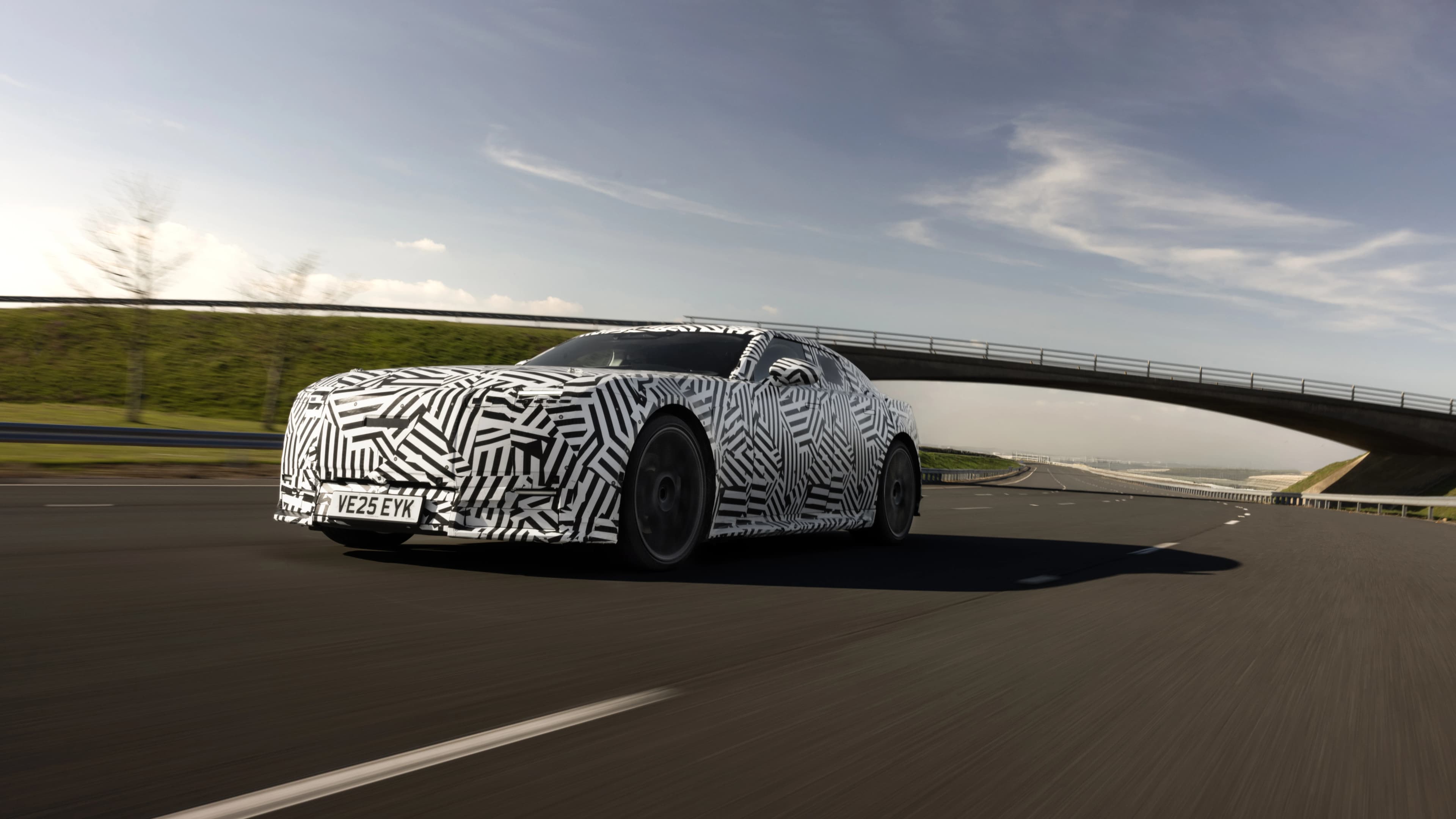
JLR’s March 2026 engineering release says the GT will use three electric motors, intelligent torque vectoring, air suspension and twin-valve active dampers. The manufacturer quotes more than 1,000 PS and more than 1,300 Nm. Those are official claims, not Carboratory test results.
The ABC News interview refers to a 120 kWh battery and roughly 400 miles of range, or about 640 km after conversion. The final European WLTP result may differ once the production car is homologated. Battery capacity alone also does not determine motorway range: wheel size, temperature, speed, software calibration and body configuration all matter.
Jaguar says the car will offer several drive modes and that its engineers tuned the power delivery to feel progressive rather than violent. That is a meaningful design choice for a luxury GT. Instant torque is available in an EV, but the way it reaches the driver is controlled by software, traction management, motor calibration and suspension tuning. Jaguar’s stated aim is a car that can accelerate strongly without making every journey feel like a launch test.
The vehicle is identified as Type 01 in JLR’s June strategy update and is due to be revealed in 2026. The official material consulted does not settle the European price, the final WLTP range, charging time or Romanian delivery schedule. Those details should not be filled in with estimates presented as specifications.
The business risk is deliberate
An electric-only Jaguar is easier to describe than a mixed range: the brand has one clear technical direction, and the new cars can share a dedicated development programme. It also removes a safety valve. If demand for luxury EVs weakens in a particular region, Jaguar cannot respond with a petrol or plug-in hybrid derivative of the same launch car without changing the programme.
JLR is containing that risk by keeping propulsion flexibility elsewhere in the portfolio. Range Rover, Defender and Discovery can address customers who still want a combustion engine or who are not ready to rely on charging. Jaguar is being asked to win on identity, design, refinement and the experience of driving an electric grand tourer.
For buyers, the familiar questions also change. A new Jaguar will be judged by charging speed, motorway range, cold-weather efficiency, software stability, ride comfort and the availability of reliable public chargers. Engine displacement, exhaust character and conventional gear changes will no longer define the product. Jaguar says the car will have a distinctive cabin sound because regulations require an acoustic signal, but it has not described this as a V8 or V12 imitation.
The conclusion is narrower than “JLR has killed petrol cars”. Jaguar has ended its old range to rebuild one brand around electric luxury. The wider group still plans several propulsion types. Whether the decision works will depend on the GT’s production quality, real-world usability and ability to justify a premium price once customers can finally order it.