Kia announced in Frankfurt am Main on 24 September 2026 a new 71.2 kWh extended-range battery option for the PV5 Chassis Cab. The pack sits alongside the existing 51.5 kWh medium-range battery and is aimed at companies and fleets that need longer intervals between charging stops, without giving up the conversion versatility that defines the Chassis Cab.
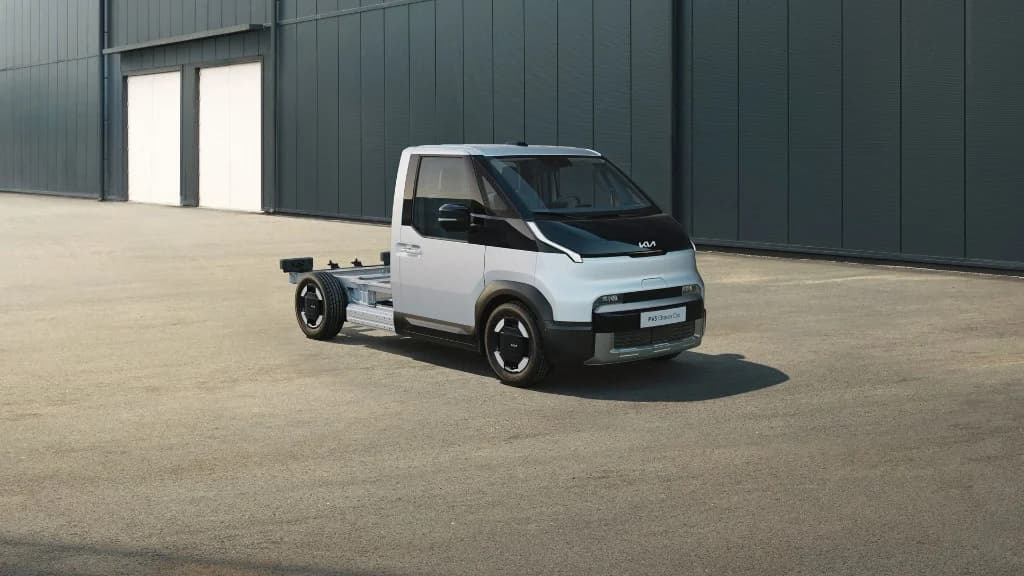
The announcement sits inside Kia’s PBV (Platform Beyond Vehicle) commercial strategy. The PV5 family already covers Cargo, Passenger and Chassis Cab. Kia describes the Chassis Cab as its first dedicated, fully electric chassis-cab platform, built for professional bodywork rather than as a shortened passenger van.
Why a larger battery matters on a chassis cab
For a conversion chassis, battery size is not only about marketing range. Bodybuilders add tippers, refrigerated boxes, parcel vans or service modules. Each kilogram of body and equipment changes real-world energy use, and operators often work routes that mix dense city streets with longer suburban or regional legs.
Kia’s position is that the 71.2 kWh option responds to customers who could not comfortably plan those routes on the medium pack. The Chassis Cab keeps an exposed rear chassis for professional bodies, so the battery choice is framed as an operating decision rather than a change of vehicle architecture.
Erhan Eren, Director PBV at Kia Europe, put the commercial logic in those terms. According to the manufacturer’s statement, commercial customers need solutions that match how they work. The 71.2 kWh battery, he said, increases versatility by balancing range, charging access and conversion requirements on a compact electric platform.
That quote belongs to Kia Europe’s PBV leadership and should be read as the manufacturer’s view of the product brief, not as an independent fleet study.
Charging figures published with the option
For the extended battery option, Kia quotes 120 kW DC charging. From 10% to 80%, the company says the process takes about 30 minutes under the conditions it uses for the claim. On AC at 11 kW, a charge from 10% to 100% is stated at roughly six hours and 30 minutes.
Those times are manufacturer figures. Actual results depend on charger output, battery temperature, state of charge at the start of the session and the power available at the site. The September 2026 release uses 120 kW DC for this extended battery option; it does not republish older higher figures from earlier commercial-vehicle events.
Kia also underlines that final range and payload depend on the conversion, the vehicle specification, equipment, load, route and operating conditions. That caveat is especially relevant for a Chassis Cab, because two vehicles leaving the factory with the same battery can leave a bodybuilder with very different masses and aerodynamic profiles.
Range reference: L2H1 Cargo, not the Chassis Cab itself
Kia does not present a WLTP range figure for a finished Chassis Cab conversion in this announcement. Instead it points to a reference from the same battery in another PV5 body style: the L2H1 Cargo, launched in 2025, is quoted at up to 416 km WLTP with the 71.2 kWh extended battery.
That number is useful context for the energy pack. It is not a WLTP homologation claim for tippers, refrigerated bodies, High Box conversions or other Chassis Cab builds. Range on a converted vehicle will vary with the body, equipment and how the vehicle is used.
Compact dimensions and urban manoeuvrability
The PV5 Chassis Cab is described as under five metres in overall length, with an emphasis on urban manoeuvrability. Kia quotes a turning radius of 5.5 metres and presents that figure as best in class. The “best in class” wording is a manufacturer claim from the press material and should be treated as such unless an independent comparison is cited separately.
For municipal fleets, construction suppliers and last-mile operators, a short overall length and a tight turning circle matter as much as battery capacity. The Chassis Cab is meant to keep that compact footprint while leaving the rear structure open for specialised bodies.
E-GMP.S and European conversion partners
The vehicle is based on E-GMP.S (Electric-Global Modular Platform for Service), Kia’s modular architecture developed for commercial electric applications. The Chassis Cab programme has been developed with European conversion partners covering several body families:
- drop-side and tipper bodies for construction, agriculture and municipal work
- three van-body variants aimed at e-commerce and parcel delivery
- refrigerated bodies for food and other temperature-controlled transport
- utility, maintenance and field-service modules
Kia also cites a High Box conversion of up to 8 m³ as an illustration of how far the platform can be pushed on volume. That example shows flexibility; it is not presented as a single standard factory offer. Final body type, equipment, certification and availability depend on the conversion partner and on local requirements in each market.
Sales context in the first half of 2026
Kia places the Chassis Cab battery news against the broader PV5 sales picture in Europe. In the first half of 2026, the PV5 recorded 13,116 registrations and accounted for 37% of C-segment electric van sales in Europe, making it the best-selling model in that segment according to the figures Kia cites.
The source chain given with those statistics is ACEA data covering the EU, EFTA and the United Kingdom, compiled via national associations, ACEA members and S&P Global Mobility. Methodology matters here: the 37% share and best-seller ranking describe the PV5 family in the C-segment electric van market as defined in that dataset, not a separate Chassis Cab-only ranking published in the same release.
European launch, warranty and market differences
Kia says the European market launch takes place during 2026, with timing, specifications and body solutions varying by country. Buyers should therefore treat the Frankfurt announcement as a product and battery brief, not as a guarantee that every conversion type or battery option is orderable immediately in every market.
Warranty cover is quoted as seven years or 150,000 km for the vehicle, plus a separate battery warranty of eight years. Kia notes that terms may vary by market. In Romania, Kia Romauto has been the official distributor since 2004; local availability, homologation of converted bodies and warranty wording should be confirmed through that network rather than assumed from the pan-European release alone.
The practical reading of the announcement is straightforward. Kia is not changing the Chassis Cab’s role as a conversion base. It is adding a larger energy option so fleets that already accept the compact electric platform can stretch the distance between charges, while still matching body choice to the job. The 71.2 kWh pack, the 120 kW DC charging claim and the 416 km Cargo reference are the concrete numbers in the brief; everything else about payload and finished range remains conversion-specific.
Photo: Kia / Kia Romauto press material.
Sources
- Official Kia / Kia Romauto press release, Frankfurt am Main, 24 September 2026
- Kia Romania
- Kia News Center
- ACEA