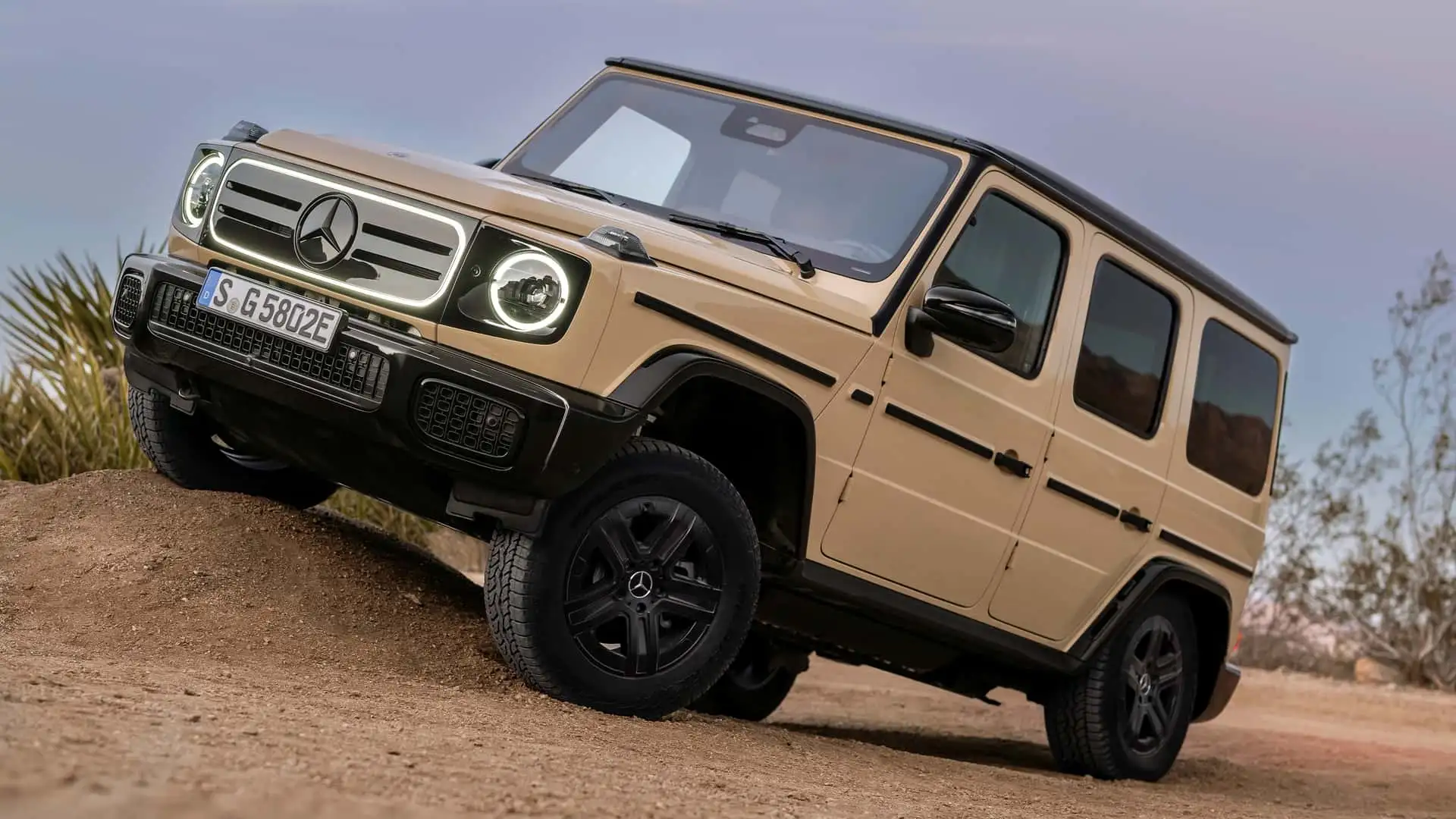
Official Mercedes-Benz photograph of an electric G 580. The image does not show the Little G prototype.
Mercedes-Benz says Little G will target a different buyer
Mercedes-Benz is developing a smaller off-road vehicle related to the G-Class. It is widely known as the “Little G”, although the name has not been confirmed as the final production badge. The important point in the latest executive comments is not only that the vehicle will be smaller. Mercedes-AMG executive Stefan Weckbach says it will target a different segment and will not be aimed at the same customer as the full-size G-Class.
The project is confirmed, the timetable is not
Mercedes-Benz has publicly confirmed that the G-Class family will be expanded with a smaller model. Chief executive Ola Källenius has also repeated that the vehicle should arrive within less than 24 months from the point of his comments. That wording gives an indication of a launch window around 2028 when interpreted against the current timeline, but it is not an official reveal date or a confirmed start of sales.
Mercedes has not published a production name, price, dimensions or final technical sheet. “Little G” and “Baby G” remain informal descriptions used by media and enthusiasts. Camouflaged test vehicles have been reported, but their bodywork does not establish the final dimensions, cabin layout or production equipment.
A separate customer from the large G-Class
Weckbach’s comments are useful because they describe the product strategy before the technical details are available. The current G-Class is a large, highly distinctive SUV. Buyers may choose it for its imposing size, its long-running off-road identity and its position at the top of a specialised family. A smaller model cannot simply be judged as the same car with less bodywork.
The Little G is expected to create a lower entry point into the G-Class range, but that should not be confused with a promise of a low price. A compact Mercedes SUV could be easier to use on narrow streets, in urban car parks and on everyday routes. It may appeal to customers who want the upright visual language and the association with the G-Class, without wanting the dimensions of the flagship.
Mercedes has not said whether the smaller model will be cheaper to run, cheaper to buy or more efficient than the current G-Class. Those outcomes would depend on the platform, the powertrain and the equipment level. The company’s phrase “a different customer” is therefore a positioning statement, not a price announcement.
Recognisable, but not a scaled-down copy
Mercedes-Benz says the new vehicle will retain recognisable G-Class genes while avoiding a simple miniature replica. That could mean a deliberately upright body, strong geometric surfaces and an obvious connection to the original design. It does not confirm a specific grille, wheel size, rear-mounted spare wheel or window arrangement.
There is a practical reason for the distinction. A compact SUV must meet current crash requirements, offer useful interior space and remain manageable in daily traffic. The proportions of the full-size G-Class cannot simply be reduced without changing visibility, seating, suspension packaging and aerodynamic behaviour.
The off-road promise also needs to be tested rather than assumed. Mercedes executives have said the Little G will have very good capability away from paved roads. No official approach angle, departure angle, ground clearance, wading depth, suspension travel or towing rating has been released. The existing G-Class provides a reference for the brand’s engineering direction, but its ladder frame, reduction gear and other specifications cannot automatically be assigned to the compact model.
Combustion and electric versions are expected
The powertrain plan appears to have become broader than the first descriptions of a purely electric smaller G-Class. Recent reporting says Mercedes intends to offer both a combustion-engine version and an electric version. That approach would let the company address markets with different charging networks, regulations and customer preferences.
Some reports have pointed to a turbocharged four-cylinder petrol engine and a dual-motor electric layout. Mercedes-Benz has not confirmed those exact components as final production specifications. Power output, battery capacity, range, charging rate, weight and official consumption figures are all unknown. It is also unclear whether the two powertrains will arrive together or in separate phases.
The choice matters for off-road use. An electric drivetrain can control torque quickly and independently, which may help on loose surfaces. It also brings battery mass and the need to protect the pack from impacts, water and heat. A combustion version would fit the expectations of some markets but would have different emissions and fuel-use constraints. Until Mercedes publishes the engineering details, neither version can be described as a confirmed technical package.
Reports that should be treated carefully
Earlier stories connected the project with possible production in Hungary and presented 2027 as a firm launch year. Those points are not confirmed in the official material used for this update. The same applies to the informal names and to claims about specific engines or platforms. A report can indicate the direction of a programme, but it does not replace a manufacturer specification or a type-approval document.
The image used here is an official photograph of the current Mercedes-Benz G 580 electric. It illustrates the family connection, not the compact prototype. Until Mercedes releases official Little G images, computer renderings and spy-shot interpretations should be labelled as unofficial representations.
What future buyers will need to know
The most useful launch information will be the price, exterior dimensions, rear-seat space, boot capacity, electric range and market availability. Off-road figures will matter just as much: approach and departure angles, wheel articulation, underbody protection, traction-control strategy and the ability to protect an electric battery in rough terrain.
For now, the confirmed conclusion is limited but clear. Mercedes-Benz is developing a compact member of the G-Class family and intends it to reach customers who are not buying the full-size G-Class. The Little G is expected to retain a genuine off-road focus and to be offered with both electric and combustion power, according to current executive comments and reporting. The final name, launch date, price, architecture and performance remain open.