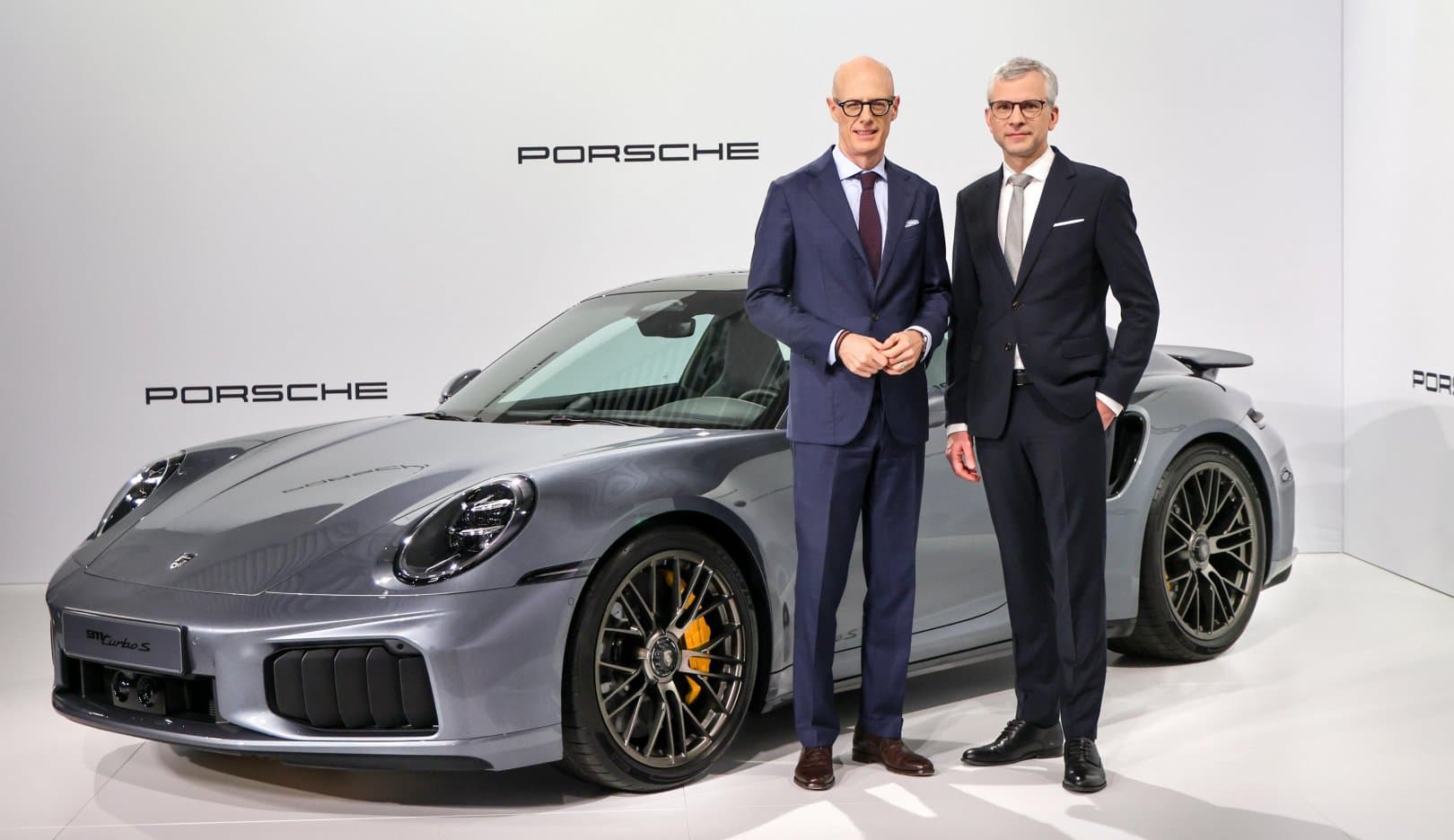
Michael Leiters, Porsche CEO, and Jochen Breckner, chief financial officer, beside a 911 Turbo S. Photo source: Porsche
How Michael Leiters wants to rebuild Porsche: fewer models, lower costs and a focus on sports cars
Michael Leiters took charge of Porsche on 1 January 2026, at a moment when the company had lower sales, high costs generated by the product-strategy shift and pressure in the Chinese market. His first decisions show the direction of the new Strategy 2035: Porsche must produce more efficiently, offer fewer variants and earn more from each car sold.
The plan is neither a simple return to petrol engines nor an abandonment of electric cars. Porsche says it will continue to invest in combustion, hybrid and electric powertrains, but will examine more strictly whether each project is profitable and whether it fits the identity of a sports-car maker.
Why Porsche needs restructuring
The 2025 results show the scale of the problem. Group revenue fell 9.5%, from €40.08 billion to €36.27 billion, and operating profit dropped from €5.64 billion to only €413 million. The operating margin fell from 14.1% to 1.1%.
The company delivered 279,449 cars, 10.1% fewer than in 2024. At the same time, Porsche recorded exceptional expenses of about €3.9 billion, of which €2.4 billion were associated with repositioning the range and resizing the company, €700 million with battery activities and another €700 million with US customs duties.
The first half of 2026 brought 122,306 deliveries, 16% below the comparable period. China fell 32%, and North America 13%. Porsche did, however, improve its operating margin to 7.8%, versus 5.5% in the first half of 2025, a sign that the initial restructuring measures have begun to show in profitability.
"Value over volume"
Leiters is not chasing a rapid return to the largest possible volume. The company's stated principle is Value over Volume: more important than the number of cars sold become price, margin and the models' ability to hold their value.
In practice, Porsche wants to reduce commercial incentives and avoid production that exceeds demand, especially in China. The strategy implies more exclusivity, expansion of the Sonderwunsch personalisation programme and development of high-margin versions.
The company is examining models and derivatives positioned above the current two-door sports cars and above the Cayenne. These are strategic intentions, not cars confirmed for production. The full range and the financial targets of Strategy 2035 are due to be presented in early October 2026.
The Porsche range will have fewer variants
Management considers that the portfolio has become too complex relative to the volume produced. Cutting the number of combinations simplifies development, homologation, supply and production.
Porsche has already given an example in the United States, where it dropped two Taycan body variants that had low demand. The same principle can be applied to other ranges, but the company has not yet published the list of versions that will disappear.
For customers, a simpler range can mean fewer basic configurations, but more well-defined packages and expensive versions. For the company, the aim is to cut the cost of each model and avoid developing derivatives sold in very small volumes without sufficient margins.
Petrol, hybrid and electric, in parallel
Porsche is not abandoning electric cars. Cayenne Electric has entered the new range alongside combustion and plug-in hybrid versions, and the future electric sports cars in the 718 family remain in the company's plan.
At the same time, generations with combustion engines will remain available longer than initially anticipated. The future SUV positioned above the Cayenne, planned at first as electric-only, will appear first with combustion and plug-in hybrid powertrains. Development of a new electric platform for the 2030s has been rescheduled.
This approach reduces the risk of depending on a single technology at a time when the pace of electric-car adoption differs widely between China, Europe and the United States. At the same time, keeping three types of powertrain can retain some of the complexity Leiters is trying to remove.
Almost 9,000 posts cut by 2035
The package negotiated with employee representatives provides for a further 5,000 posts to be cut by 2035, mainly through natural attrition, partial retirements and voluntary agreements. Together with measures announced earlier, the restructuring reaches about 9,000 jobs.
In return, Porsche has extended job and plant protection until 2035 and committed to invest €2.1 billion in Zuffenhausen and Weissach. The money is intended to keep two-door sports-car production at Zuffenhausen, expand Sonderwunsch personalisation and concentrate range development at Weissach.
Employees will also bear other cost-cutting measures. Part of the pay rises will be deferred, the voluntary component of the Christmas bonus will fall gradually, and remote work will be limited to eight days a month, versus 12 previously.
Porsche is also dropping secondary activities
The focus on the car business includes closing or selling some subsidiaries. Porsche has decided to stop Cellforce Group, Porsche eBike Performance and Cetitec, measures that affect more than 500 employees.
Cellforce had developed high-performance battery cells, Porsche eBike Performance worked on propulsion systems for electric bicycles, and Cetitec supplied communications software. The company justified the decisions by market change and the need to concentrate capital and management on cars.
Porsche has also sold its IT consultancy subsidiary MHP to Tata Consultancy Services. The deal is accompanied by a five-year partnership to use artificial intelligence and digital technologies in development, production and customer relations.
What may change for buyers
Leiters's strategy can lead to a narrower offer and higher average prices. Personalisation programmes and special editions will likely have a larger weight, and the company will accept smaller volumes if they protect margin and residual value.
For the Romanian market, the immediate effect will be visible mainly in the available range and in order lead times. Porsche has not announced local price changes or concrete version withdrawals. Any conclusion about which models will remain in the configurator must wait until the full presentation of Strategy 2035.
The stake is difficult: Porsche must cut costs and complexity at the same time, without turning exclusivity into a mere price increase. The outcome will depend on the products the company confirms in October and on their ability to attract customers outside the brand's traditional segments.