
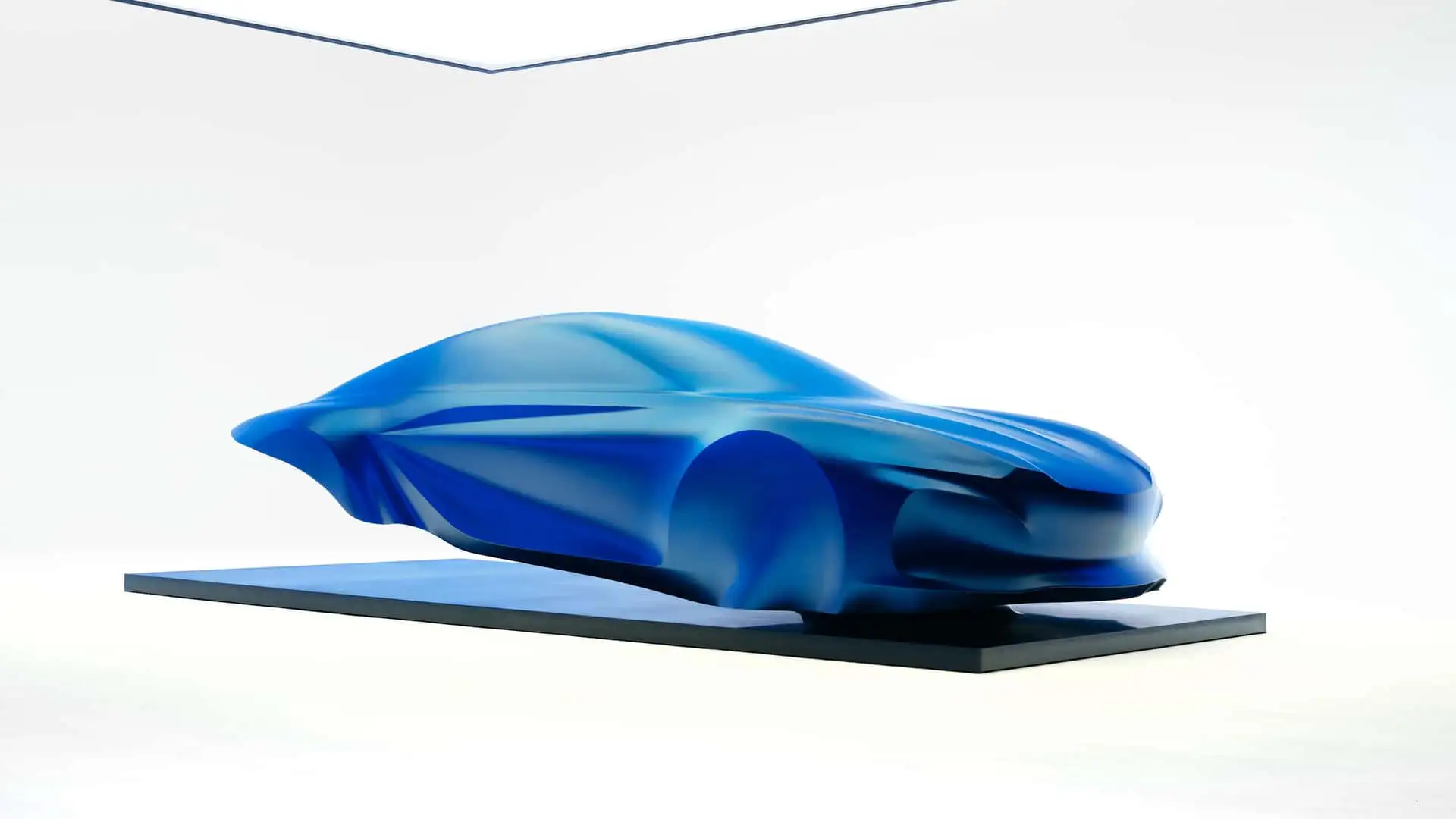
Alpine has previewed the design direction of the next A110 with a sculpture rather than a finished car. The object is an early styling statement, not a production vehicle or a complete specification sheet. It does, however, arrive alongside a clearer technical outline for the third-generation two-seat sports car: the A110 will use Alpine’s Performance Platform, an 800-volt electrical system, two battery packs and a rear dual-motor layout.
A sculpture, not a final body
The sculpture should be read carefully. Alpine has not released the production car’s final dimensions, interior, battery capacity, charging power, kerb weight or performance figures. The piece gives a sense of the intended volume and stance, while the engineering information comes from Alpine’s separate development-car announcements.
That distinction matters for a sports car. A show object can exaggerate surfaces or omit details required by pedestrian protection, lighting regulations, cooling and crash structure. It can suggest a low roof and a compact cabin without confirming the exact wheelbase or overhangs. Alpine has therefore revealed a design direction, not a homologated shape.
The message is nevertheless consistent with the A110’s role in the range. This is meant to remain a low, two-seat coupe rather than becoming a taller crossover. Alpine is trying to move the nameplate into electric propulsion without abandoning the proportions that make the current car recognisable.
The APP platform puts weight distribution first
The next A110 will be the first production model based on Alpine’s Alpine Performance Platform, or APP. Alpine describes the architecture as aluminium-intensive and developed specifically for high-performance cars. The platform is intended to deal with the problem that affects almost every electric sports car: a large battery can add mass and change the balance that a compact combustion coupe relies on.
Alpine’s solution is to divide the battery into two packs, one at the front and one at the rear. The stated target is a 40:60 front-to-rear weight distribution. This is not the same as publishing the final kerb weight, nor does it tell us how the car will behave in every driving situation. It does show where the company is placing its engineering priority: keeping the centre of gravity low and arranging the mass around the occupants instead of simply installing one large pack under the floor.
The architecture also gives Alpine freedom to tune the space around the cabin. The battery modules can be used to preserve a low seating position and the visual relationship between the occupants and the axles. Until the final car is shown, there is no basis for claiming that the electric A110 will match the current car’s mass or dimensions.
800 volts and a rear dual-motor system
The APP platform uses 800-volt cell-to-pack battery technology. A higher system voltage can deliver a given electrical power with less current, which can reduce resistive losses and the size or mass of some high-voltage components. It does not automatically guarantee a particular charging time. Actual charging depends on the pack, thermal management, the charging curve and the station.
Alpine has also announced a rear three-in-one e-axle with two electric motors and a silicon-carbide inverter. Two motors on one axle can provide independent control of torque at the driven wheels. Alpine refers to torque vectoring as part of the system’s ability to create sports-car responses, but it has not published the production car’s power output, acceleration or software calibration.
The company has given one useful target: more than 547 kilometres of range, equivalent to more than 340 miles, for the electric A110. Alpine says this target is intended to let the car complete three laps of the Nürburgring at full potential, rather than simply win a range comparison. The wording describes a design objective. It is not a certified range test, and Alpine has not published the test conditions in the sculpture announcement.
The petrol door remains open, but unconfirmed
The electric A110 is Alpine’s priority. Even so, CEO Philippe Krief told Autocar that the APP architecture was deliberately engineered so it could accommodate an internal-combustion powertrain with relatively limited changes. A petrol version would need an engine, gearbox, fuel tank, exhaust, cooling hardware and different validation work. The rear battery occupies much of the space where the current car’s engine is installed, so compatibility is not the same as a ready-made alternative.
Alpine has not announced an ICE A110, an engine choice, a launch date or a market. The possibility is relevant because the brand has ambitions beyond Europe, where regulatory and commercial conditions differ. For now, the confirmed programme is the electric sports car.
From the current A110 to the next generation
The current A110 ended production at Alpine’s Dieppe site in 2026. Alpine says 35,450 A110s have been assembled there since production began in 1969, including 28,701 examples of the second generation launched in 2017. The factory is being adapted for the APP-based successor, so the electric car is not just a badge change; it is also an industrial transition for Dieppe.
Alpine is also planning a 2+2 sports coupe that will revive the A310 name. The company has mentioned a range target of about 595 kilometres for that more practical model. It is not the subject of this sculpture, and its final technical data are also not available. The A110 remains the first step in the APP story.
The sculpture is due to be shown at the 2026 Paris Motor Show from October 12, according to the supplied report. Until the production reveal, the reliable conclusions are limited but clear: the next A110 is being engineered as an electric two-seater, it will use the APP platform and 800-volt electrical architecture, its battery will be split between the axles, and Alpine is targeting a 40:60 balance with rear dual motors. Price, weight, charging performance and final range remain to be confirmed.


