
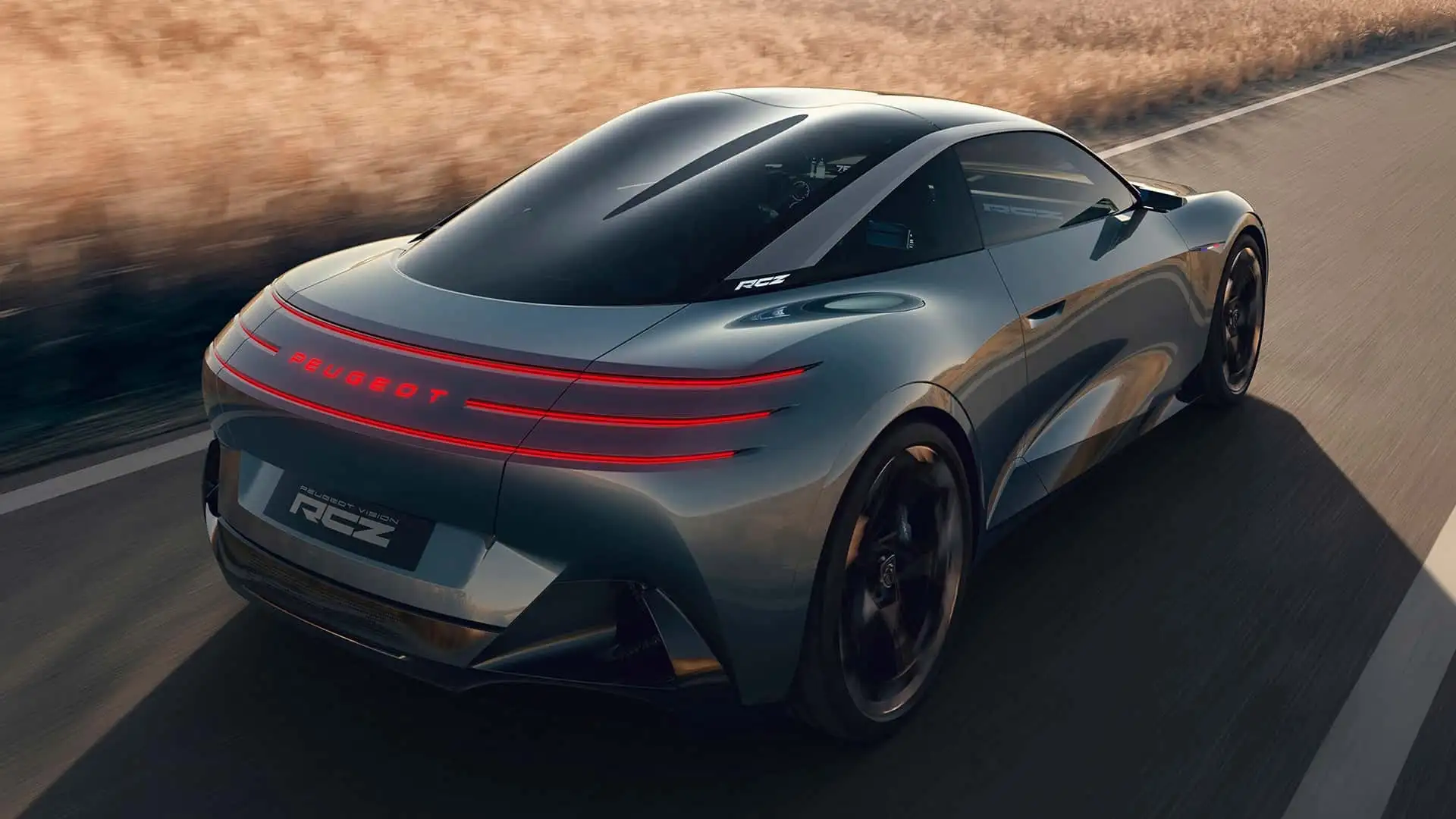
Peugeot has revived the RCZ name at the 2026 Paris Motor Show, but the French brand is careful not to describe the RCZ Vision as a production announcement. The low electric coupe is a technology and design manifesto: a preview of the company’s “Feline Future” language, a showcase for the next Peugeot i-Cockpit and a demonstration of solid-state battery technology developed with Factorial Energy.
The headline numbers are ambitious. Peugeot quotes 500 horsepower, up to 600 kilometres of range and a 10-to-80 percent charging time of under 10 minutes. The concept uses a 1,000-volt electrical architecture and a battery pack only 110 millimetres thick. These are manufacturer claims for a vision car, not independent test results or an approved production specification. Peugeot also says the projected WLTP combined consumption of 11.5 kWh/100 km is still to be confirmed.
A successor in spirit, not yet in showrooms
The original Peugeot RCZ was produced between 2009 and 2015, with the car technically built by Magna Steyr. Its most recognisable feature was the double-bubble roof, a styling cue that helped the front-wheel-drive coupe stand apart from more conventional compact sports cars. The RCZ Vision brings that idea back through a larger, lower and more futuristic body, while changing the powertrain completely.
Peugeot measures the concept at 4.65 metres long, 1.94 metres wide and 1.35 metres tall. The proportions are closer to a grand-tourer than to a small two-seat sports car. The car remains a four-seater, with two individual rear seats designed to accommodate adults. Their backrests fold to increase luggage space, so the concept is not presented as a track-only machine.
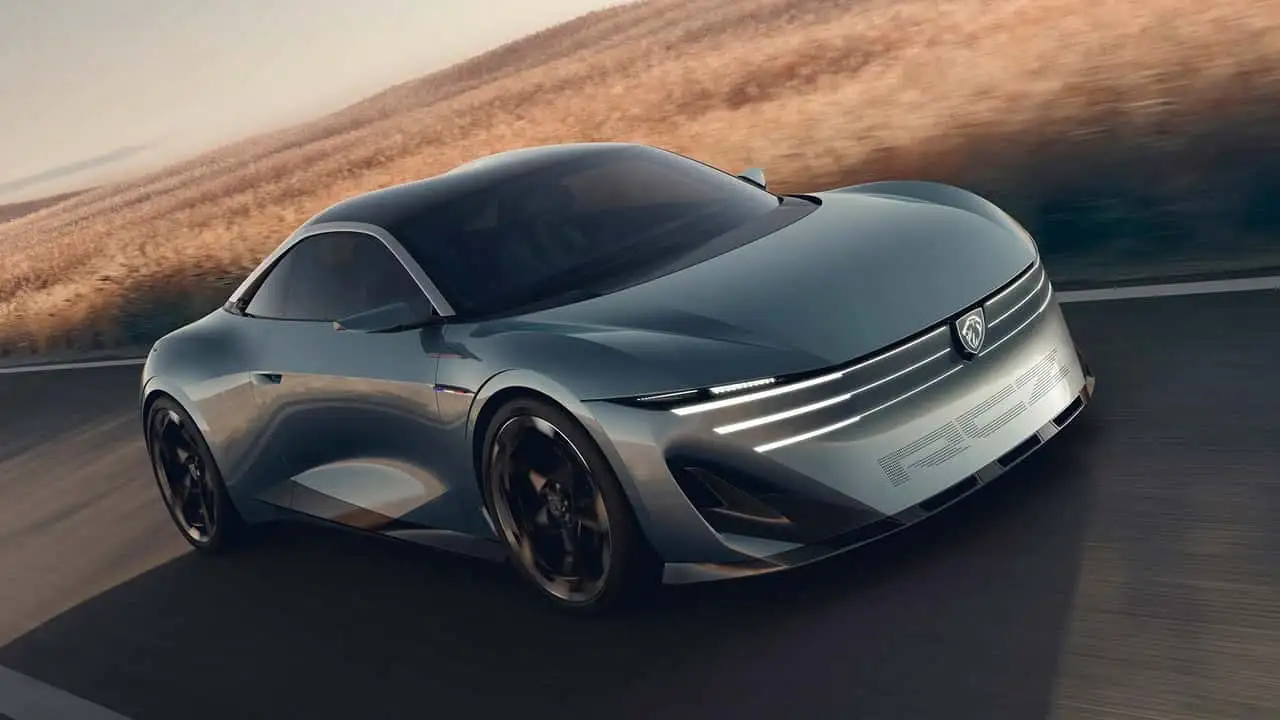
The exterior is organised around a slim transparent cabin and broad, sculpted bodywork. Strong shoulders, rounded flanks and a low nose create a feline stance without relying on sharp lines everywhere. The glass bubble extends from the bonnet toward the rear, and the double-bubble roof is reinterpreted with thinner, apparently floating arches. Peugeot says the form is intended to support both emotional appeal and aerodynamic efficiency.
The familiar three-claw light signature becomes three thin horizontal elements at each end. At the front, they sit above compact Thin Lens LED units and an illuminated Peugeot emblem. The bumper includes a micro-perforated RCZ graphic and air intakes with micro-sculpted RCZ motifs. At the rear, the claws integrate all lighting functions, while an active spoiler stays hidden when the car is stationary and deploys during driving.
The show car uses forged aluminium wheels measuring 21 inches at the front and 22 inches at the rear. Peugeot also replaces the visual effect of solid aluminium with paint made using recycled aluminium. The concept’s design brief therefore links the low stance and the high-performance message to a stated effort to reduce material use and improve efficiency.
Solid-state battery and 1,000 volts
The RCZ Vision is based on an architecture derived from the STLA One platform. Peugeot presents the platform as modular and prepared for future battery options and X-by-Wire systems. The company says modularity should reduce complexity, shorten development cycles and make component reuse and recycling easier at the end of a vehicle’s life.
The battery was developed in collaboration with Factorial Energy. Peugeot highlights solid-state cells, a 110-mm pack and a 1,000-volt system. The claimed charging window is 10 to 80 percent in 10 minutes. The solid-state format is presented as a way to combine higher energy density with a compact battery and strong charging performance.
Important technical information is still missing. Peugeot has not given the usable battery capacity in kWh, charging power in kW, cell chemistry details, battery mass or a charging curve. Real charging time depends on temperature, preconditioning, the charger’s output and the battery’s state of charge. The concept’s headline figure should therefore be treated as a target under specified conditions, not a guarantee for every future Peugeot.
The claimed range of up to 600 km is similarly subject to the final test method and vehicle configuration. The press release labels the 11.5 kWh/100 km combined WLTP consumption figure as still to be confirmed. There is no production car, type approval or independent road test behind these numbers yet.
Hypersquare, steer-by-wire and a quieter dashboard
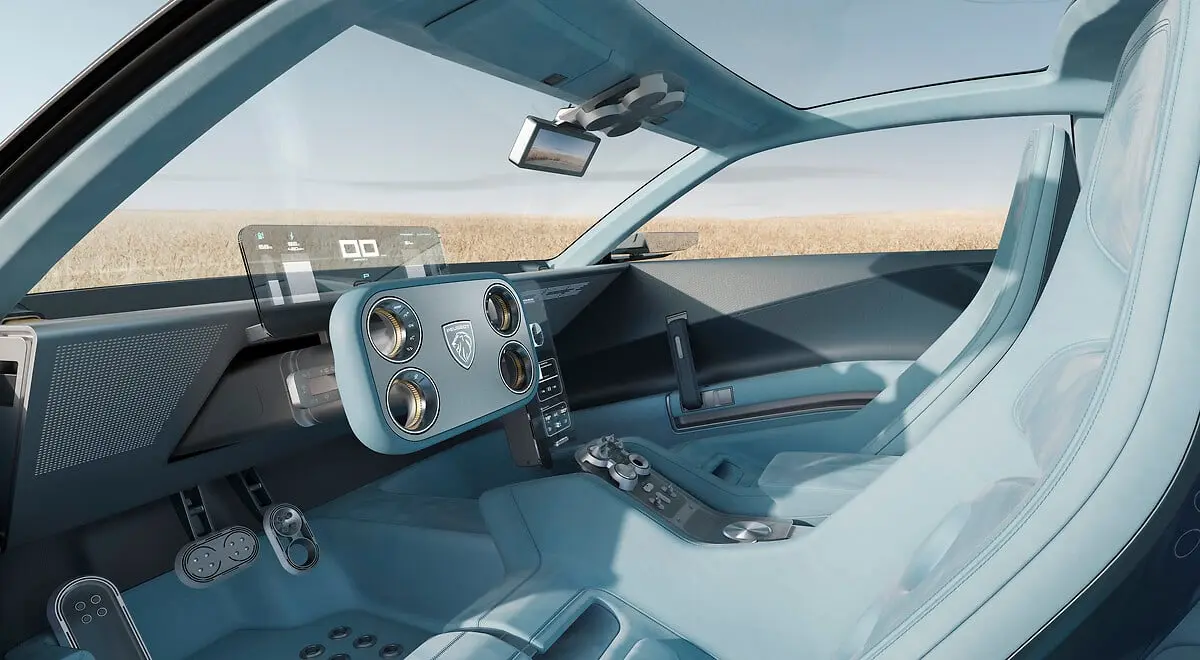
The interior previews another major change. Instead of a conventional round steering wheel, the RCZ Vision uses the rectangular Hypersquare control. It is combined with steer-by-wire, removing the permanent mechanical link between the steering control and the front wheels. Peugeot says the steering ratio can change with speed: manoeuvres should require less rotation at low speeds, while higher speeds receive a calmer response.
The concept is also Peugeot’s first to introduce Brake-by-Wire. The brake pedal command is transmitted electronically rather than through a traditional hydraulic connection. The company says that this can improve brake modulation and the integration of regenerative braking. Production deployment would require redundancy, validation and approval; none of those details are supplied for the concept.
Transparent Micro LED displays sit in the driver’s field of vision. Peugeot’s approach is deliberately restrained: information can be configured, and the central display can be switched off so that it almost disappears into the dashboard. The brand says this reduces visual distraction and keeps only essential information in front of the driver.
The RCZ Vision also previews Level 2++ hands-free automated driving, available on demand in the city and on open roads. That label does not mean the car can operate without driver supervision or that it is a Level 3 vehicle. The operating domain, markets, weather limits and regulatory approvals have not been detailed.
Four seats and recycled materials
The cabin is designed more like a grand tourer than a stripped-down sports car. Alcantara, machined aluminium and PELINOVA recycled leather are combined with a light-blue colour scheme. PELINOVA is made from untanned leather offcuts that would otherwise go unused, according to Peugeot. A clock created with French watchmaker SERICA adds a mechanical object to a dashboard otherwise dominated by transparent displays and digital interfaces.
Peugeot has not confirmed a production programme, price or launch date for the RCZ Vision. The concept’s importance is elsewhere: it shows how the company wants driving pleasure, electric performance, advanced controls and a more emotionally expressive design to coexist. Whether the double-bubble roof and RCZ badge eventually return to a showroom remains open.
Image: Peugeot, published by Motor1.com. The source page does not state a commercial reuse licence; the image is used at the user’s request with the original attribution retained.
A second frame of the concept, published by Motor1.com and credited to the manufacturer.
Official interior image published by Peugeot through Stellantis Media.


