
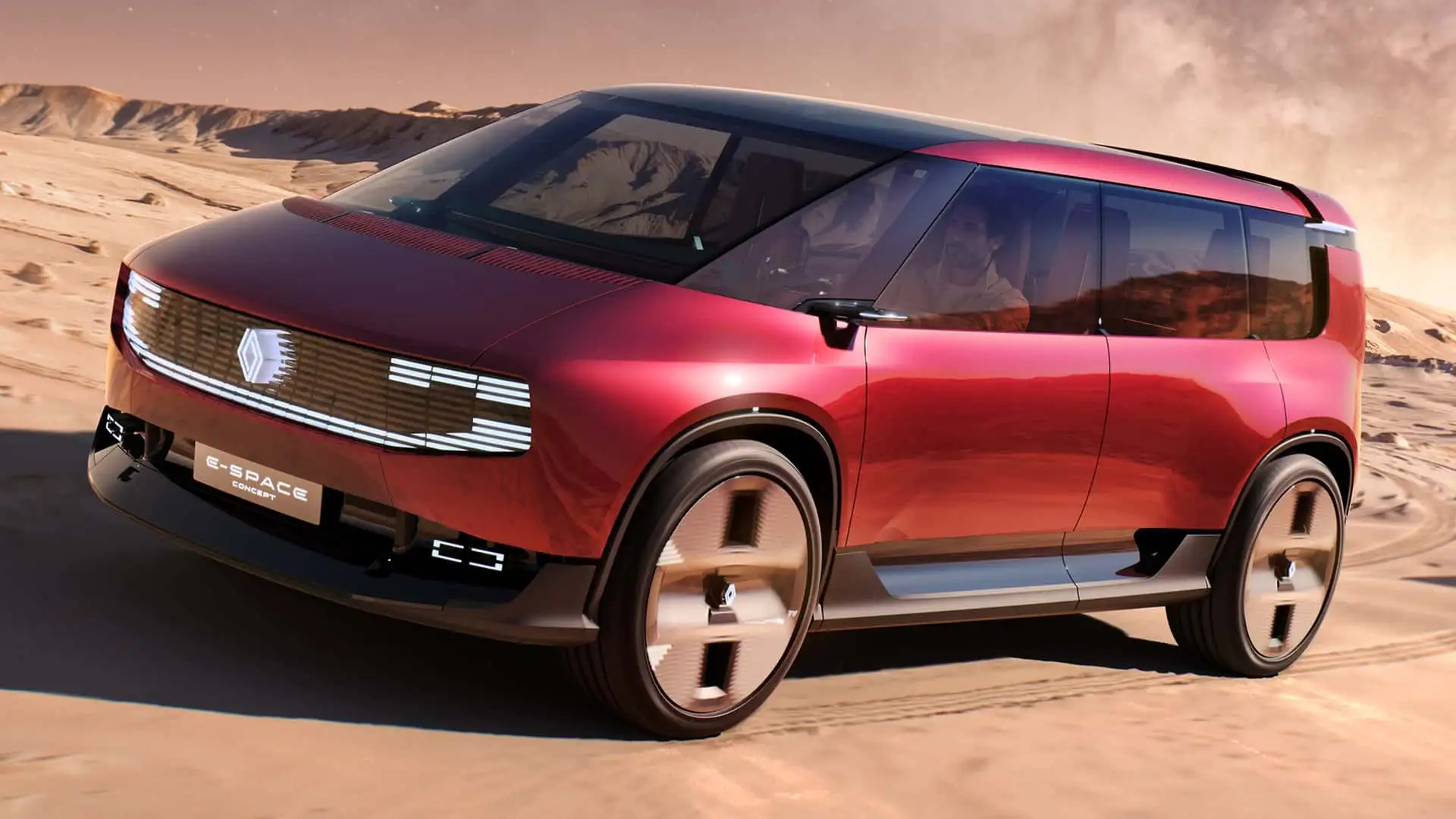
Renault will unveil the E-Space Concept at the 2026 Paris Motor Show on 12 October. The electric prototype is presented as a modern interpretation of the “voitures à vivre” idea: a Renault vehicle designed around the way people use the cabin, rather than around a conventional body style. The company has not said that the concept is approved for production, and it has released no battery, range, power or pricing data.
What Renault has confirmed
Renault Group’s official Paris Motor Show announcement lists the E-Space Concept as a world premiere for the Renault stand in Hall 6. The show runs from 12 to 18 October at Paris Expo Porte de Versailles. Renault will use a 2,500-square-metre stand to display its electric and hybrid range, alongside other concepts and production vehicles. The brand’s press conference is scheduled for 08:30 CET on the first press day.
The official description connects E-Space with family travel and mobility in the electric era. That wording matters. It establishes the design brief, but it does not establish a future model programme. Renault has not published a production timetable, a target market, a seating layout or a technical platform for the concept.
Motor1 reports an approximate length of 4.7 metres, which would put the concept close to the current Espace SUV in overall length. The article also identifies the vehicle as fully electric. Renault’s announcement confirms the electric-era positioning, but the detailed drivetrain information has not been released. The concept should therefore be read as a design and packaging study until the company provides more evidence.
Why the Espace name matters
Renault introduced the Espace concept in 1983 and launched the first generation in 1984 in cooperation with Matra. Renault Group’s own historical material describes it as a new European MPV concept. Its one-box body created a large, airy passenger compartment without the footprint of a full-size van. A flat floor, individual seats and a high driving position gave the first Espace a different set of priorities from the hatchbacks, saloons and estates that dominated the family-car market at the time.
The first Espace could carry seven people. Renault says the seats were folding, removable and, in the case of the front pair, capable of swivelling through 180 degrees when the vehicle was stationary. The rear seats could be rearranged or taken out, turning the cabin into a flexible passenger or load space. The concept was not simply about carrying more people; it treated the cabin as a place that could change according to the journey.
Its start was slow. Renault’s historical account records nine cars sold in France during the first month. At the 1984 Paris show, the company demonstrated the interior rather than relying on conventional performance claims. The first-generation Espace later reached 191,674 units, according to Renault Group. That chronology is useful context for the 2026 concept: the original idea needed to be explained before the market understood it.

From MPV to SUV, then back to the idea of space
The current Espace follows a different route. The sixth-generation model is a five- or seven-seat SUV, based on the CMF-CD platform and offered with Renault’s E-Tech full-hybrid powertrain. Renault’s 2025 press material quotes 200 hp, WLTP consumption of 4.8 litres per 100 kilometres and a total range of up to 1,100 kilometres without recharging. Those figures belong to the production Espace and should not be attached to the E-Space Concept.
The distinction explains what makes the new prototype interesting. Renault has retained the Espace name on an SUV, while using E-Space to explore the visual and functional territory that made the name famous. The Motor1 images show a tall, short-overhang body with a broad glass area and proportions closer to a modern MPV than to a conventional crossover. A retro-futuristic front treatment, illuminated badge and large wheels make the vehicle unmistakably conceptual.
The side profile uses camera-based mirrors in place of conventional units and appears to replace door handles with winglet-like elements integrated into the beltline. These solutions create a clean profile, but Renault has not said whether they are technically or legally intended for a production car. The interior layout has also not been described in enough detail to confirm whether the original seven-seat, lounge-like flexibility has returned.
The electric questions are still open
There is no official battery capacity, charging rate, motor output, WLTP range, kerb weight or luggage volume for the E-Space Concept. Renault has not announced a price or confirmed availability in Europe, Romania or any other specific market. It has also not identified a production plant or said whether the concept shares hardware with the Megane E-Tech electric or Scenic E-Tech electric.
That absence is normal for a show car, but it sets a clear limit on what can be reported. A 4.7-metre electric vehicle can be a styling proposal, a package study or an early preview of a production programme. The public debut may answer some of those questions, yet the existence of a concept alone does not confirm a future showroom model.
If Renault does decide to build an electric MPV, it would enter a narrow but visible part of the market. The Volkswagen ID. Buzz shows that buyers can still be interested in a large electric family vehicle with a recognisable shape. Renault would need to balance the benefits of a high, flexible cabin against battery mass, aerodynamic efficiency, production cost and a market that has increasingly favoured SUVs.
What to watch in Paris
The most useful details at the premiere will be practical ones: whether the displayed cabin has movable or removable seats, whether Renault gives a battery or range target, and whether company executives describe E-Space as a pure design exercise or as a preview of a named programme. Door access, charging hardware and the floor layout will also indicate how seriously the concept treats family use.
For now, the confirmed story is narrower. Renault E-Space Concept will make its world premiere in Paris on 12 October 2026. Renault presents it as an electric vision of family mobility, and the concept is reported at roughly 4.7 metres long. Its production status, specifications, price and launch timing remain unknown.


