Romania’s used electric car market offers a more complicated picture than a headline about rising values might suggest. AutoUncle’s Romanian listing data put the median asking price at €22,878 in August 2026, up 8.9% from August 2025. The mean asking price moved in the opposite direction, falling 2.9% to €26,742. Neither figure records the amount a buyer actually paid.
Autovit has separately reported stronger interest in electric cars. Its August electric vehicle leads rose 40.5% year on year. That provides evidence of more contact activity on one platform, rather than proof that used EV transaction prices across Romania are rising. Keeping those distinctions visible changes how the apparent rebound should be understood.
What the British increase actually covers
The starting point is an Auto Express report citing Solera cap hpi. It describes a 28.3% increase over six months in the trade value of the 2019–2024 MINI Cooper Electric, using a three-year-old car with approximately 48,300 km as the benchmark. This is a particular model and valuation profile in Britain, rather than an index showing every used electric car gaining that much.
The Romanian figures concern advertised prices across a changing selection of vehicles. They do not hold age and mileage constant in the same way. A British trade valuation therefore cannot be treated as a Romanian retail price forecast, even when both series concern used battery electric vehicles.
Romania’s median and mean tell different stories
AutoUncle’s published series includes these reference points:
| Month | Median asking price | Mean asking price |
|---|---|---|
| August 2025 | €21,000 | €27,545 |
| March 2026 | €20,298 | €24,110 |
| August 2026 | €22,878 | €26,742 |
The median increased by €1,878 between the two August observations. The mean declined by €803. A median locates the middle of an ordered price distribution, while a mean includes the value of every observation in its arithmetic calculation. Changes in the number of expensive cars, cheaper models or newer examples can affect those measures differently.
That is a possible explanation of the divergence, rather than a finding that the published table establishes. The data do not isolate how much each model, age group or mileage band contributed. They also do not show a fixed group of cars becoming 8.9% more valuable.
The starting month matters, too. The median stood at €24,500 in both October and November 2025. August 2026 was around 6.6% below that level. Against March 2026, however, the August median was approximately 12.7% higher. There was a recovery from the March reading, but the series does not describe an uninterrupted climb.
An October publication with August price observations
AutoUncle published its analysis on 28 October 2026. Its table explicitly marks September as partial, so August is the last complete month used here. The publication date should not be mistaken for the date of the prices: these are not November quotations.
The provider tracks used car advertisements on Romanian websites from their appearance to their disappearance. It excludes new cars and vehicles with no more than 1,000 km, and describes roughly 700–1,100 observations per month. This is the coverage of its own dataset, rather than a census of Romanian purchases.
An advertisement disappearing does not establish that a sale took place at its final asking price. A seller may accept another amount, and removal alone does not confirm the outcome. That gap is particularly important for anyone trying to estimate what their own car would fetch rather than what competing sellers currently ask.
Model-level figures also show why an aggregate needs care. Across September 2025–August 2026, Renault Zoe had a mean asking price of €10,356 from 312 observations, with median mileage of 75,000 km. Tesla Model 3 averaged €26,129 across 1,317 observations, with median mileage of 86,800 km. These are historical sample summaries, not live offers or a comparison of equivalent specifications.
More enquiries do not establish more completed sales
In its 14 September release, Autovit reported August battery electric vehicle leads up 40.5% from a year earlier and 48.6% from July 2026. The annual and monthly comparisons use different baselines. A lead records contact activity, without demonstrating a completed purchase or identifying a unique buyer.
The release does not separate used cars from new cars for those percentages. It also says mean prices fell in the electric, hybrid and plug-in hybrid categories analysed, without quantifying each decline in that passage. Stronger enquiry activity can therefore coexist with lower average advertised prices in the published material.
An earlier Autovit analysis, published on 26 March, said more than 90% of electric car interest concerned used vehicles. That is useful historical context, but it is not a verified August or November share. Applying it to the later lead growth would combine different snapshots and create a result neither release supplies.
What remains unproven about fuel costs
Cap hpi’s official report for November valuations, drafted on 26 October, gives a provisional positive movement of 0.6% for battery electric vehicles at three years and approximately 96,600 km. Its benchmark and period differ from the MINI example. The figures answer different valuation questions and should not be placed alongside each other as equivalent national growth rates.
For Romania, the sources examined do not quantify a causal effect of fuel prices on used EV transaction values. Assessing an individual listing still requires comparable model years, battery versions, mileage and equipment. The available evidence supports reporting stronger platform interest and a higher listing median, alongside a lower mean. It does not support importing a British model’s 28% rebound into the value of every Romanian used electric car.
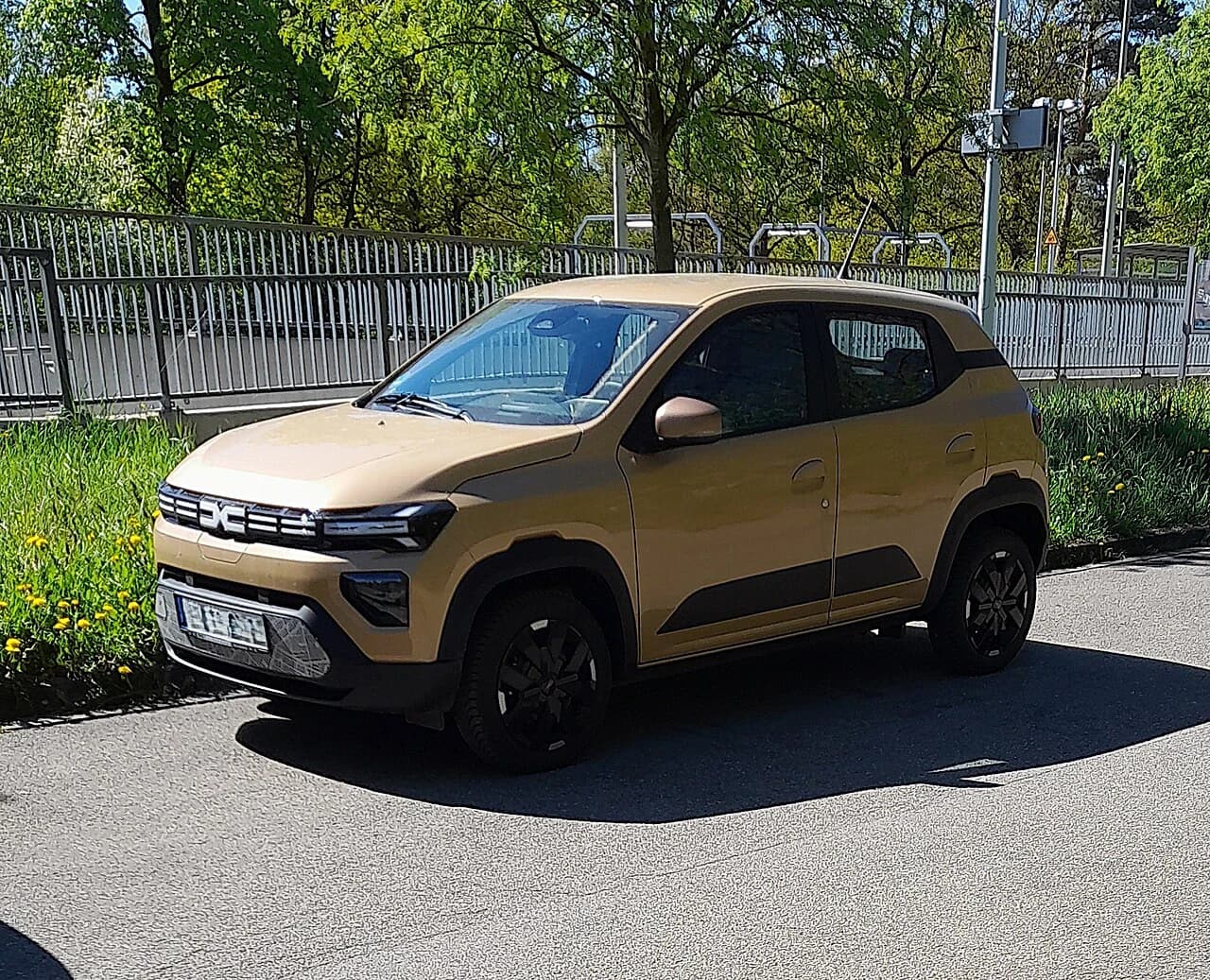
Illustrative photograph: Dacia Spring in Germany, not a verified listing from the analysed sample. Trop86 / Wikimedia Commons, CC0 1.0.