
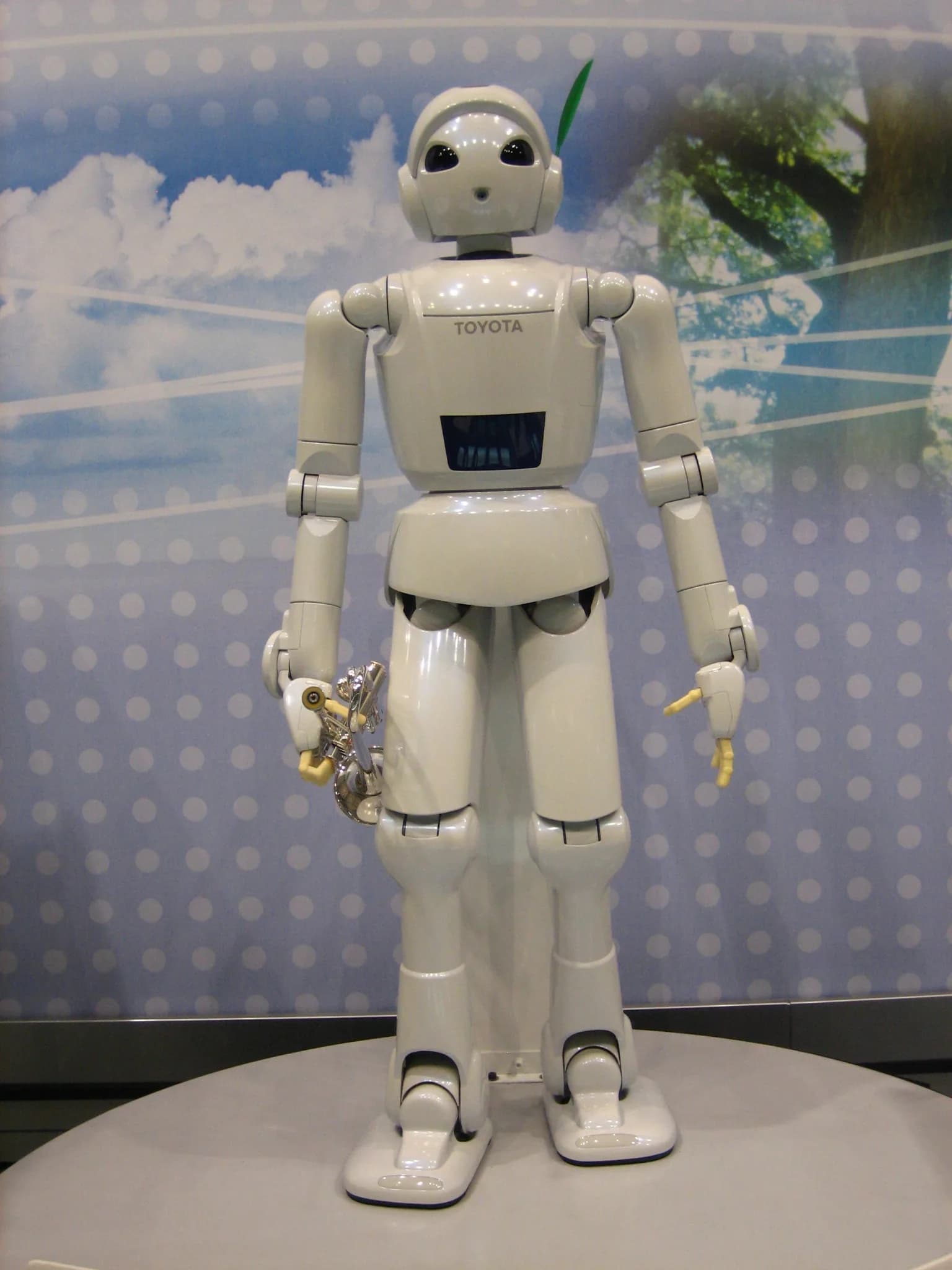
Toyota has discussed a possible factory-modernisation programme that could require about 400,000 robots from 2028. The estimate covers Toyota, group companies and major suppliers, and could involve around ¥1 trillion in annual spending. Reuters valued that amount at roughly $6.4 billion at the exchange rate used in its report. It is not a confirmed order, and the total includes conventional industrial robots, automated logistics and future human–robot collaboration.
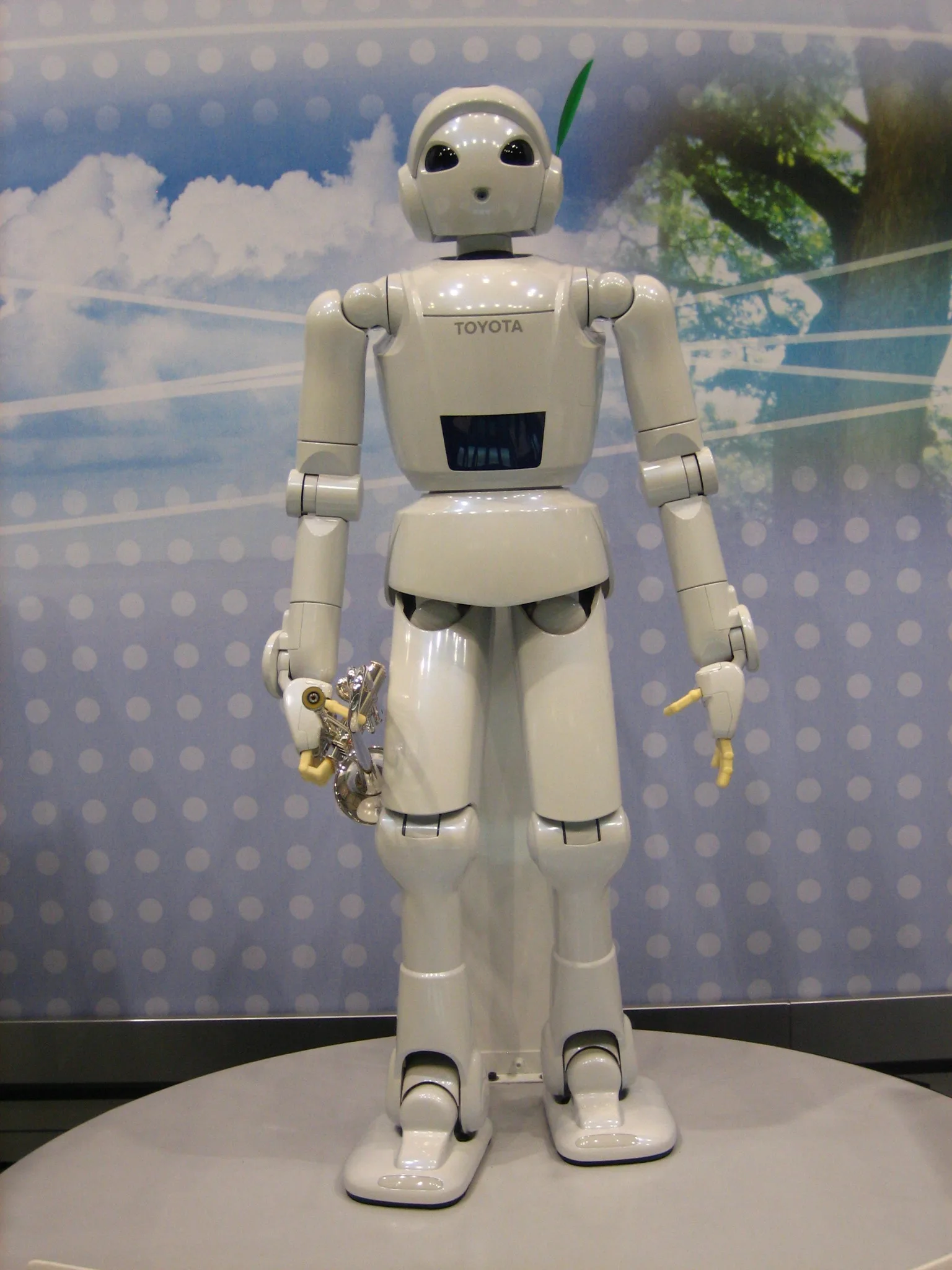
Toyota Partner Robot at the Amlux showroom in 2007. Photo: Luis Vill/Wikimedia Commons, CC BY-SA.
The number is broader than “400,000 humanoids”
The estimate was discussed with investors earlier in September, according to Reuters. Toyota did not say that it had approved ¥1 trillion every year, nor did it specify how long such spending might continue. The figure describes possible demand created by the renewal of a large manufacturing network rather than a firm purchasing contract.
It also includes more than humanoid robots. Reuters says the total covers replacements for existing machines, new installations, automated material handling and future systems designed for people and robots to work together. Toyota has not published the share that would be made up by humanoids.
That distinction changes the story. A fixed industrial arm, an automated guided vehicle and a human-shaped machine are different tools. A robot does not need legs to move components between stations, and a biped is not necessarily the most efficient choice for welding, painting or heavy lifting. A humanoid could be useful where factories are built around human reach, tools and walkways, but this remains a deployment decision rather than a confirmed product plan.
Why the programme could begin in 2028
The spending estimate is connected to plant renovation and reconstruction. Rebuilding a factory can make it easier to redesign material flows, add sensors and prepare production for more automation. The year 2028 is a possible starting point for that cycle; it does not mean that all 400,000 robots would be installed at once.
Factory automation needs more than robots. It requires control software, safety systems, power or charging infrastructure, spare parts, maintenance teams and training. A machine that works in a laboratory still needs extensive validation before it can run for long shifts beside vehicle assembly lines.
Toyota’s broad programme could cover component handling, internal logistics, inspection and repetitive operations. The company has not published a final list of plants, suppliers or employee groups affected by the estimate. It has also not said whether most of the equipment would be developed in-house or purchased from specialist manufacturers.
Toyota’s robotics work predates the current humanoid boom
Toyota has researched partner robots and the Human Support Robot for years. Its Frontier Research Center has worked on force control, object handling, remote operation and machine learning for tasks in environments that are not perfectly structured. The company’s stated aim is to create mobility and support technologies that can coexist with people.
In March 2026, Toyota published details of research into humanoid motion control using reinforcement learning. Researchers trained walking and basketball-dribbling behaviours in simulation and then tested them on physical hardware. Toyota highlighted the Sim2Real gap: a behaviour that looks stable in a simulator can behave differently on a real machine because of friction, sensor noise, latency and actuator characteristics.
That is an important limitation for factories. A robot may demonstrate walking, grasping or folding in a controlled video without being ready for industrial work. Production systems require repeatability, controlled recovery from errors, protection for vehicle components and rapid service intervention. They also have to communicate with existing logistics and production software.
In 2025, Toyota Research Institute and Boston Dynamics announced joint research on a Large Behavior Model for the Atlas humanoid robot. The work covers whole-body manipulation, locomotion and human–robot interaction. It is a research partnership; Toyota has not confirmed that Atlas will be deployed across its factories or that it is the basis for the 400,000-robot estimate.
The connection with the Toyota Production System
Toyota’s production system is organised around “jidoka”, often translated as automation with a human touch, and just-in-time production. Jidoka requires a process to stop when an abnormality is detected, preventing a defect from moving to the next stage. Automation therefore has to support quality control, not simply remove manual movements.
The potential programme could fit that approach if robots supply components consistently, identify anomalies and remove physically demanding tasks. It could also introduce new risks if employees cannot understand an automated stoppage or if a machine behaves unpredictably around people. Safety has to be demonstrated in the actual plant, not only in a laboratory.
Toyota says its research is intended to support human–robot coexistence. That statement does not provide an employment forecast. The public material reviewed for this article does not give a final number of jobs to be removed or protected by the programme. The likely effect is a change in the work mix: supervision, maintenance, programming, quality control and process improvement become more important, while some repetitive operations may be automated.
Why investors are watching the estimate
Automakers already use large numbers of industrial robots for body welding, painting and parts handling. The possible change is the expansion into logistics and more flexible tasks, combined with ageing plants and labour shortages. A group-wide project could create demand for sensors, actuators, software, safety systems and service networks.
The figure is also easy to misread financially. The ¥1 trillion estimate covers Toyota, group companies and major suppliers, so it is not Toyota Motor’s single annual robotics budget. Reuters says Toyota did not specify whether the full amount would be spent every year. Comparing it directly with current factory capital expenditure would therefore be premature.
The 400,000 estimate could change as Toyota defines plants, tasks and timing. Some machines may replace equipment already in service; others may be added to new production lines. The total may combine systems with very different prices and capabilities.
What has not been confirmed
Toyota has confirmed research into humanoid robots and advanced robot control. It has not publicly confirmed a final global rollout of 400,000 humanoid robots, a production start for a named factory robot or a fixed annual investment beginning in 2028. The Reuters figure should be described as an estimate for a broad automation programme.
There is also no immediate model, price or production change for European customers. Any local effect would depend on later decisions about plant upgrades, equipment suppliers and workforce planning. The next useful facts will be the facilities included, the technologies selected for each task and a published investment budget.

.jpg)