
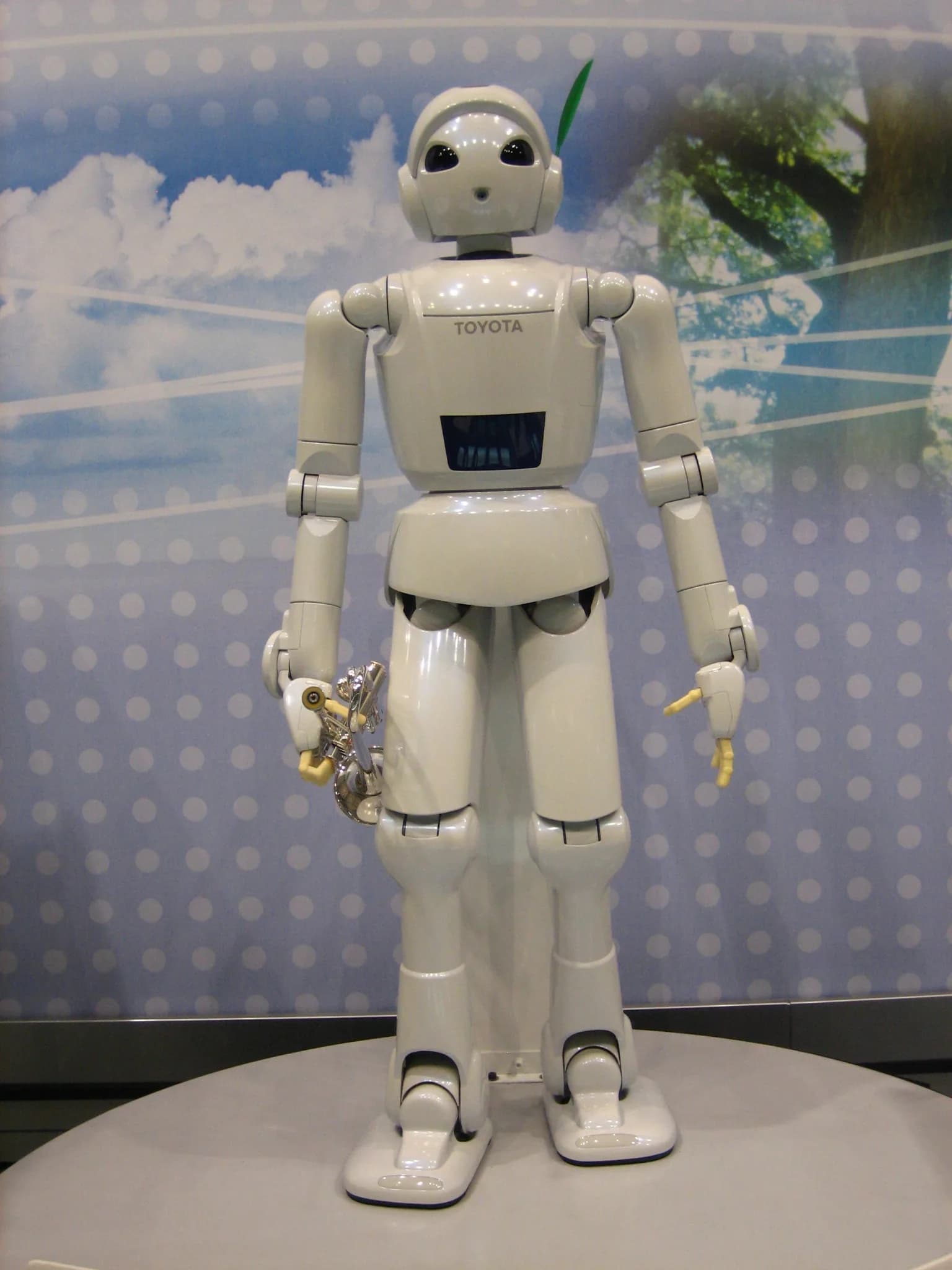
Toyota has discussed a possible factory-modernisation programme that could require around 400,000 robots from 2028. The estimate covers Toyota, group companies and major suppliers, and could involve annual spending of roughly ¥1 trillion, or about €5.7 billion using a simple conversion from the dollar figure cited by Reuters. It is not a confirmed order, and the total includes industrial robots, automated logistics and future humanoid applications.
Un Toyota Partner Robot fotografiat la Amlux în 2007. Foto: Luis Vill/Wikimedia Commons, licență CC BY-SA.
A forecast, not a 400,000-unit humanoid order
The number comes from an estimate Toyota discussed with investors earlier in September, according to Reuters. The company did not commit to spending ¥1 trillion every year or specify how long such a programme would continue. The figure is therefore a measure of possible demand created by factory upgrades, rather than a purchase contract or a production target.
The total is also broader than the wording used in some headlines. Reuters says it includes replacements for existing machines and new installations, covering conventional factory robots, automated material handling and future human–robot collaboration. Toyota has not disclosed what share, if any, would be humanoid.
That distinction matters because a fixed industrial arm, an automated guided vehicle and a human-shaped machine solve different problems. A robot does not need legs to move components between stations, and a bipedal design is not automatically the best choice for welding or painting. A humanoid could be useful where a plant is designed around human reach, tools and walkways, but that remains a technology and business question.
Why 2028 appears in the plan
The possible spending is linked to factory renovation and reconstruction. Modernising a plant can create an opportunity to redesign material flows, install new sensors and prepare production lines for a different level of automation. The year 2028 is presented as a possible starting point for this investment cycle; it does not mean that all 400,000 robots would arrive at factories at the same time.
Factory automation requires more than machines. Toyota would need control software, safety systems, charging or power infrastructure, spare parts, maintenance teams and new procedures for workers sharing space with robots. A robot that works in a laboratory may still need substantial development before it can operate for long shifts beside vehicle assembly lines.
The investment could cover the handling of components, internal logistics, inspection and repetitive operations. Toyota has not published a final list of plants, suppliers or job categories affected by the estimate. It has also not stated whether the group would build most of the equipment itself or buy systems from specialist suppliers.
Toyota has been researching robots for years
The company’s interest in robotics predates the current humanoid boom. Toyota has worked on the Human Support Robot and other partner robots designed to operate around people. Its Frontier Research Center has researched force control, object handling, remote operation and machine learning for tasks where the environment is not perfectly structured.
Toyota’s official research page published in March 2026 describes work on humanoid motion control using reinforcement learning. Researchers trained walking and basketball-dribbling behaviours in simulation before testing them on physical hardware. The company notes the “Sim2Real” gap: a behaviour that appears stable in simulation can behave differently on a real robot because of friction, sensor noise, latency and actuator characteristics.
This is relevant to the factory discussion. A robot can demonstrate walking, grasping or folding in a controlled video without being ready for industrial deployment. A production system needs repeatability, predictable recovery from errors, protection of vehicle parts and fast service intervention. It also needs to communicate with the factory’s existing software and logistics infrastructure.
In 2025, Toyota Research Institute and Boston Dynamics announced joint research on a Large Behavior Model for the Atlas humanoid robot. The partnership concerns whole-body manipulation, locomotion and human–robot interaction. Toyota’s announcement describes a research collaboration; it does not confirm that Atlas will be deployed across Toyota factories or that Toyota will purchase 400,000 humanoids.
The link with Toyota’s production system
Toyota’s production system is built around “jidoka”, often described as automation with a human touch, and just-in-time production. Jidoka means that a process should stop when an abnormality is detected, so a defect is not passed to the next stage. Automation therefore has to support quality control, not merely reduce the number of manual movements.
The possible robot programme could fit that philosophy if machines are used to detect anomalies, supply parts consistently and remove physically demanding tasks. It could also create new risks if workers cannot understand why an automated station stopped or if a robot behaves unpredictably around people. The safety case must be demonstrated in the actual factory environment.
Toyota says its future research aims for robots and people to coexist. That does not provide a forecast for employment. No public Toyota document identified in this review gives a final number of jobs to be removed or protected because of the proposed automation. The most defensible conclusion is that human roles would change towards supervision, maintenance, programming, quality control and process improvement, while some repetitive tasks could be automated.
Why the estimate is commercially relevant
Automotive factories already use thousands of industrial robots for body welding, painting and parts handling. The new element is the possible expansion to logistics and more flexible tasks, combined with ageing facilities and labour shortages. A group-wide programme would create demand for sensors, actuators, software, safety systems and service networks.
It would also be expensive. The ¥1 trillion figure includes Toyota, group companies and major suppliers, so it cannot be treated as Toyota Motor’s single annual robotics budget. Reuters also notes that the company did not specify whether the full amount would be spent every year. Comparisons with a factory’s current capital expenditure would therefore be premature.
The 400,000 estimate may change as Toyota defines the facilities, tasks and time horizon. Some units could replace machines already in service, while others could be added to new lines. The total may also combine machines with very different costs and capabilities.
What remains unconfirmed
Toyota has confirmed that it is researching humanoid robots and advanced robot control. It has not publicly confirmed a final global rollout of 400,000 humanoid robots, a production start for a specific factory robot or a fixed annual investment from 2028. The number reported by Reuters should be described as an estimate for a broad automation programme.
For European factories, including plants supplying the Romanian market, there is no immediate model, price or production change announced. Any local effect would depend on later decisions about plant renovation, equipment suppliers and workforce planning. The next useful facts will be a list of facilities, the technology selected for each task and a published budget.

.jpg)