Volkswagen is looking at potential exports of 200,000–300,000 China-built vehicles by 2030 while preparing to remove more production capacity from its Chinese operations. Chief financial officer Arno Antlitz outlined the approach during the group’s nine-month results conference on 29 October 2026, linking the factory adjustment to a lower assessment of future domestic demand.
The comments do not establish that Volkswagen has decided to leave a particular Chinese joint venture. Asked about the future number of partners and corporate entities, Antlitz said it was too early to answer. Capacity, overhead costs and export opportunities are being examined; the eventual legal structure of the business was not announced.
The market assumptions behind the capacity cut
Antlitz described a planning scenario in which the relevant Chinese vehicle market reaches 19–21 million units in 2030. An approximately 11% Volkswagen share would translate into around 2.1–2.3 million vehicles. Those are prospective domestic sales derived from management’s assumptions, rather than a claim that Volkswagen has already lost that many sales.
The distinction matters because the export discussion accompanies a reassessment of the production footprint. A smaller expected market gives Volkswagen a lower domestic volume against which to plan its factories. Antlitz compared the latest outlook with earlier, higher planning assumptions when explaining the need for additional adjustment.
He discussed removing roughly another 500,000 vehicles of annual manufacturing capacity. That is a measure of what the production network can build, not a headcount figure or a tally of cancelled customer orders. The comments did not provide a complete plant-by-plant allocation or a schedule establishing which individual factories would carry each part of the reduction.
Exports could provide additional business alongside the forecast domestic volume. The 200,000–300,000 range was presented as potential by 2030, with management seeking further opportunities. It should not be read as vehicles already shipped, signed orders covering the entire amount, or an assurance that export demand can keep all existing capacity occupied.
Where the China-built cars are going
A Volkswagen Group China release published on 29 October, following a technology presentation in Hefei on 28 October, sets out a more specific geographical picture. The company said exports of Volkswagen and JETTA vehicles, undertaken with its joint ventures, had already started to the Middle East, Uzbekistan, Kazakhstan and sub-Saharan Africa.
The same release envisaged expansion to Mexico, Egypt and Vietnam by the end of 2026. That describes the timetable announced in the document; it does not, on its own, establish that deliveries to all three destinations have already taken place. Further ASEAN, South American and African markets were identified for the coming years.
During the financial conference, Antlitz cited Brazil, South Africa and Mexico among the examples relevant to the export discussion. He also explained that opportunities depend on individual market circumstances and the adaptations needed for particular products. Right-hand-drive requirements, for example, can prevent a straightforward transfer of a model developed in a different configuration.
Consequently, a country’s inclusion in the strategic discussion does not amount to a complete product announcement. Volkswagen has not attached a public model-by-model allocation of the estimated export volume to these comments. The aggregate opportunity and the commercial launch of an individual vehicle remain separate stages.
Exporting engineering as well as finished vehicles
The Hefei announcement also describes using Chinese-developed technology in products for other regions. Volkswagen identifies CMP, the Compact Main Platform, and CEA, the China Electronic Architecture, as foundations for its next generation of vehicles aimed at markets in the Global South.
South America is named as the first region to localise these technologies within its portfolio before the end of the decade. South Africa is among the additional markets envisaged. Localising a platform or electronic architecture is different from importing a finished car: a regional product using Chinese-developed engineering does not automatically have to be assembled in China.
Volkswagen describes this extension of its strategy as “In China, Beyond China”, building on “In China, for China”. The scope therefore includes vehicles and technical building blocks. The announcement does not supply a Romanian launch, European prices or a promise that every China-developed product will be sold in every overseas market.
The distinction also prevents the technology programme from being counted automatically within the 200,000–300,000 finished-vehicle export opportunity. A platform used in a locally manufactured South American vehicle and a complete car shipped from China are different industrial flows. The release discusses both without publishing a combined volume measure for them.
The financial pressure has distinct accounting boundaries
Volkswagen’s official nine-month figures show a proportionate operating result of minus €113 million for Chinese companies accounted for using the equity method, compared with a positive €744 million a year earlier. This is the result of that category of investments, rather than the operating result of the entire Volkswagen Group.
Separately, the reporting identifies approximately €1 billion of non-cash impairment charges at fully consolidated Chinese subsidiaries. These charges should not be described as the same loss as the proportionate joint-venture result. Fully consolidated subsidiaries and equity-accounted investments occupy different places in the group’s financial statements.
Antlitz warned that the full-year proportionate operating result from the Chinese joint ventures could turn negative. His response on the partnerships left their eventual structure open. Further announcements would be needed to establish a specific joint-venture exit, a factory closure or the precise distribution of the additional capacity reduction; none follows automatically from the export estimate.
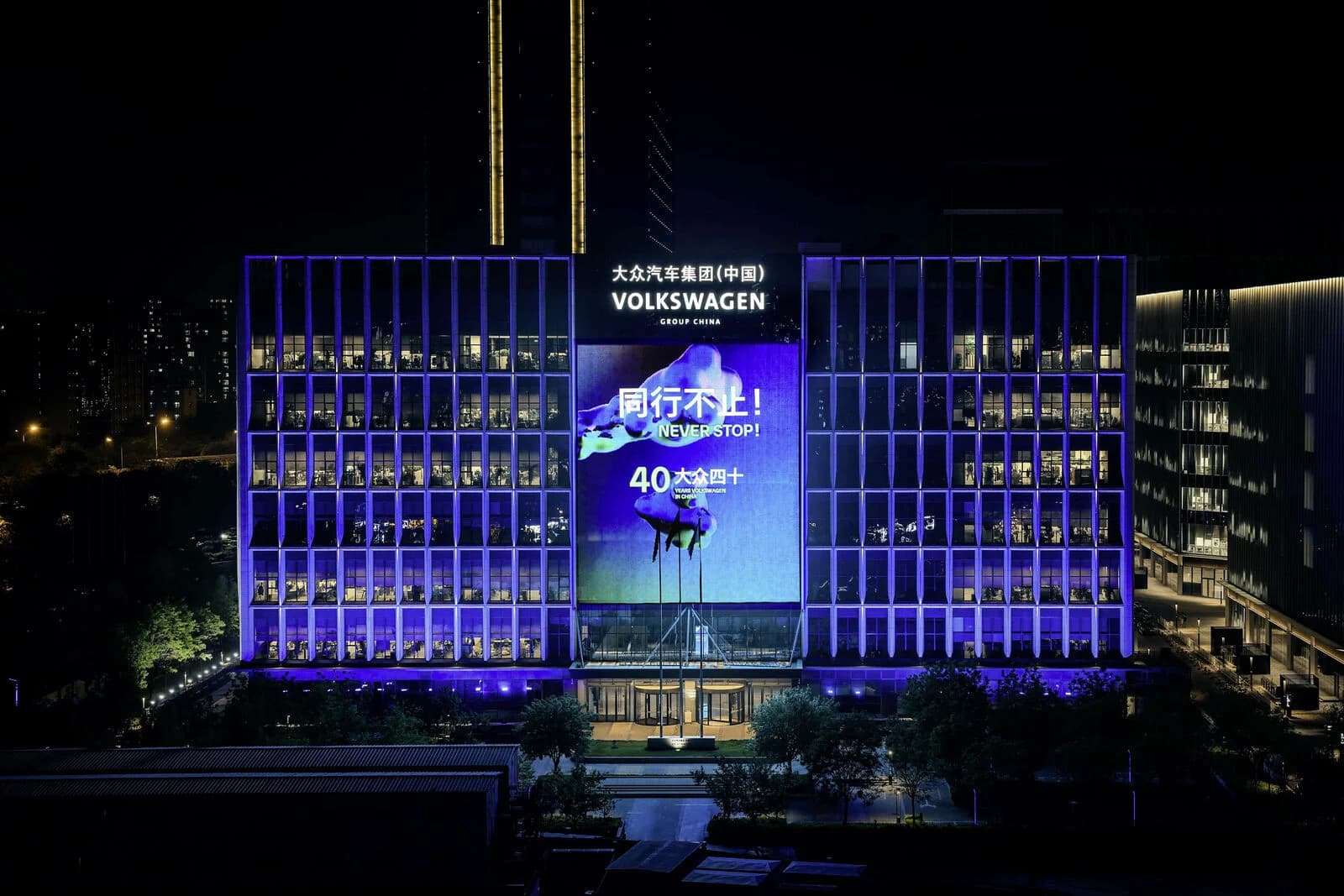
Archive photograph of a Volkswagen Group China building; not a factory announced for closure. © Volkswagen AG, DB2024AL00229. Free editorial use under Volkswagen Newsroom terms.