Chinese car brands are increasingly visible outside their home market, particularly in electric and plug-in hybrid vehicles. Their progress is not based on a single advantage. It combines the scale of China’s domestic market, extensive battery production, fast product development and a willingness to enter regions where established manufacturers have left gaps in affordable cars.
The United States is an exception to this expansion. Its connected-vehicle rules and national-security concerns make direct sales by Chinese manufacturers far more difficult. Europe, Southeast Asia, the Middle East and Latin America offer a different commercial environment, even though each market has its own regulations, tariffs and consumer expectations.
Scale created a head start in electric cars
China is the world’s largest electric-car market. That gave local manufacturers a large customer base on which to develop batteries, electric platforms, software and production processes. The International Energy Agency estimates that around 44 million electric cars were on Chinese roads at the end of 2025, about 13% of the country’s total car stock.
A company selling at high volume can spread development costs across many vehicles and negotiate components at a larger scale. It can also introduce revisions quickly because the domestic market is already familiar with electric powertrains. This does not make every Chinese model automatically better than a European or Japanese rival. It does explain why Chinese companies reached a level of industrial maturity that some overseas competitors are still building.
The battery supply chain is central to the story. ACEA’s fact sheet on battery imports says Chinese producers accounted for 83% of global battery-cell production in 2023. China also dominates several upstream steps, including refining and the production of active cathode and anode materials. A manufacturer with easier access to cells and materials has more control over one of the most expensive parts of an electric car.
Value is visible before the test drive
Chinese brands often enter a market with a straightforward proposition: an electric family car, a large central screen, connected functions, driver assistance and a long equipment list for a price that competes with established brands. Customers may not know every detail of the battery chemistry, but they can compare the equipment shown in a configurator.
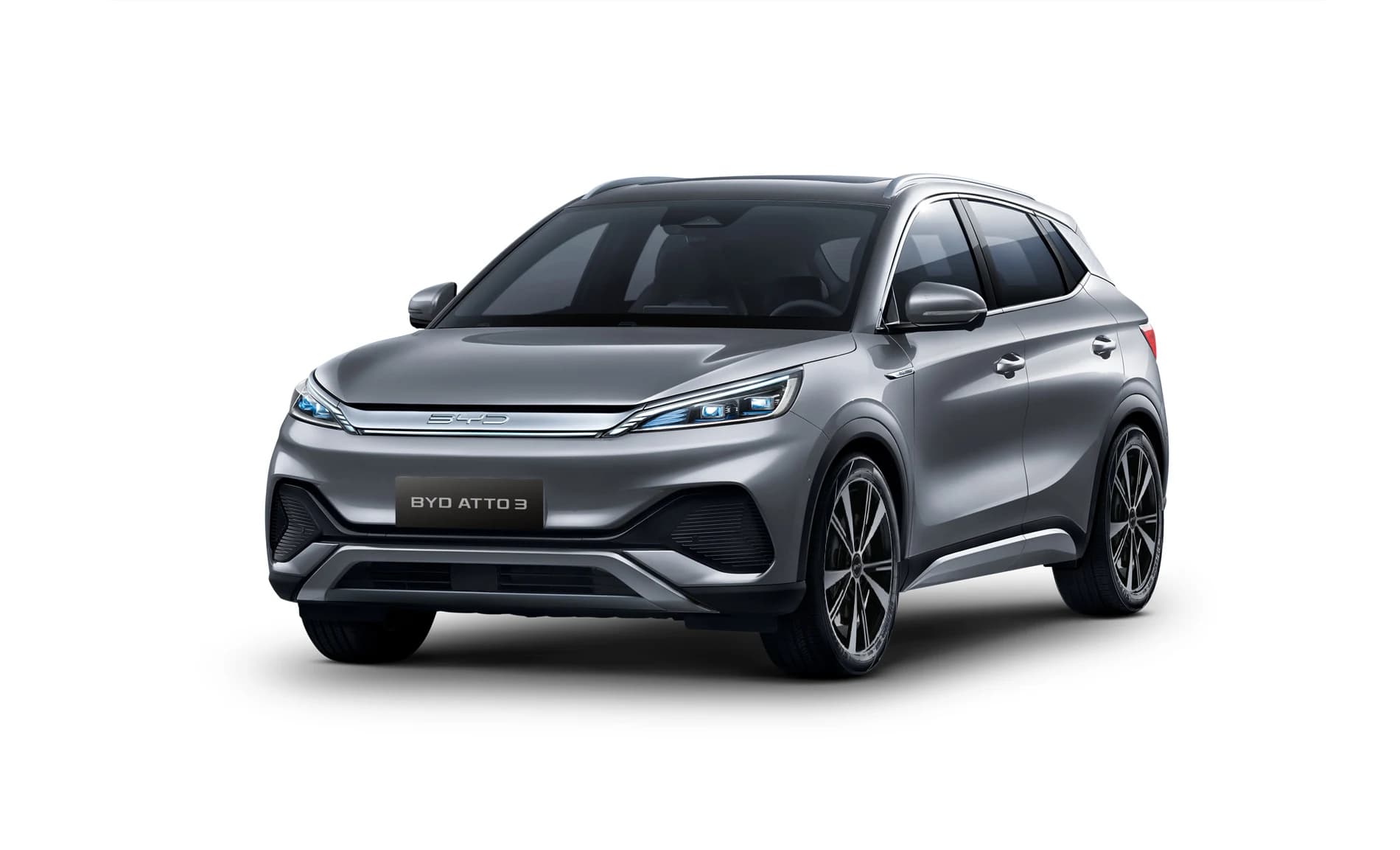
The BYD Atto 3 illustrates the package. BYD’s official model page lists the e-Platform 3.0, a Blade Battery, up to 420 km of combined WLTP range and a 150 kW motor. The manufacturer quotes 0–100 km/h in 7.3 seconds. These figures do not by themselves prove that the model is the best choice, but they show why a Chinese electric car can be considered alongside familiar compact SUVs.
Standard equipment is another part of the calculation. Some buyers prefer to see connectivity, cameras, a large display and assistance systems included from the start instead of paying for several option packages. The trade-off may appear later in service coverage, parts availability, software support or resale value. The first comparison is nevertheless easy to understand: how much equipment is included for the purchase price?
Europe already imports cars made in China
The European Union is a large market with common approval rules and rising demand for electrified vehicles. ACEA reported that 1,002,742 passenger cars made in China were imported into the EU in 2025, with a value of €13.7 billion. Battery-electric vehicles represented 42.9% of that total. Cars made in China accounted for 7% of EU car sales and 20% of battery-electric car sales.
Those figures include vehicles from Western brands that manufacture in China, not only Chinese brands. The distinction matters: the country of production and the nationality of the badge are different questions. The data still show that Chinese factories have become a significant part of the European supply picture.
Europe is also attractive because consumers are already familiar with electric cars, charging networks and plug-in hybrids. A Chinese brand can therefore focus on pricing, design, warranty and dealer coverage instead of explaining the basic idea of an electric vehicle to every customer.
Why the United States is a different case
The U.S. Department of Commerce’s Bureau of Industry and Security adopted a final connected-vehicle rule in January 2025. It restricts certain imports and sales involving vehicle connectivity systems and automated-driving software with a sufficient link to China or Russia. The measures include timelines for model year 2027 software and sales restrictions and model year 2030 hardware restrictions, with some provisions applying earlier to components without a model year.
The rule was justified by the department through national-security and data-access concerns. For a Chinese carmaker, that creates a market-entry problem that cannot be solved simply by offering a lower sticker price. The manufacturer must also demonstrate that its connected technology and supply chain fit the American framework. This helps explain why Chinese companies have focused more attention on other regions.
Overseas demand is spreading beyond Europe
The IEA says Chinese electric-car exports doubled in 2025. More than half of overseas Chinese electric-car sales were recorded in markets other than Europe and the United States. Southeast Asia was particularly strong, with growth of 130% compared with 2024. The IEA also reports increases of 60% in the Middle East and 55% in Latin America.
These regions do not have identical needs. In some countries, the priority is a low purchase price and manageable running costs. In others, buyers want large SUVs, seven seats or a plug-in hybrid that can cover long distances without depending entirely on public charging. Chinese automakers can vary their product mix and distribution strategy rather than relying on one global model.
The same international push is visible in manufacturing. IEA points to overseas production in places such as Thailand, Brazil, Indonesia and Malaysia. Building locally can reduce exposure to tariffs on completely built-up vehicles and can shorten delivery routes. It also creates a local workforce and service network, although neither develops instantly.
Popularity does not remove the risks
Chinese brands still have to prove long-term reliability, software support, crash-repair capacity and residual value. A competitive equipment list can attract a buyer, but ownership also depends on parts arriving on time and on a dealer being able to diagnose the vehicle years later.
Trade policy is another uncertainty. Europe is reviewing how imports from China affect local manufacturers, while Chinese companies respond with local plants, partnerships and different powertrain mixes. The market share of Chinese-made cars does not automatically translate into the same share for Chinese brands, and export growth is not the same as sustainable profitability.
Chinese cars are popular outside the United States because several advantages meet at the same time: batteries produced at scale, rapid electrification, competitive pricing, extensive equipment and a willingness to enter markets with different needs. The U.S. regulatory wall limits one important destination, but it does not close the rest of the world. Europe and emerging markets are already large enough to support a global strategy built around more than one region.