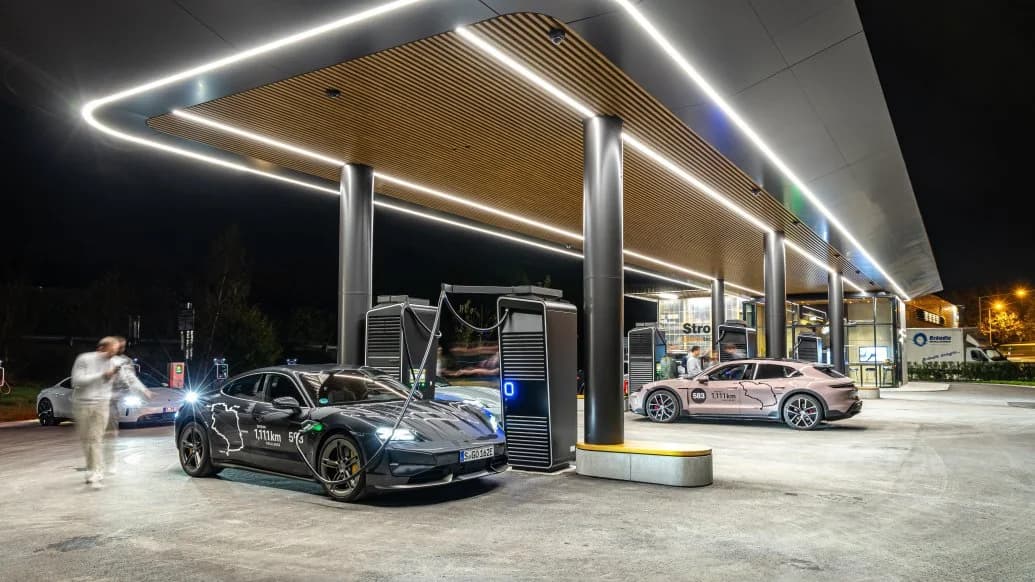
A Porsche Taycan at a rapid charger. The car, not the charger alone, determines how much power the battery can accept. Source: Porsche AG, Porsche Newsroom
Why EV fast charging slows as the battery fills
An electric car may briefly accept several hundred kilowatts with a low, warm battery, then draw progressively less power as the display moves towards 100%. That reduction is normally intentional. The battery-management system, or BMS, limits current so that individual cells remain within their permitted voltage and temperature range.
The familiar 80% figure is useful for journey planning, but it is not a universal electronic switch. One model may begin tapering well before that point, while another holds a relatively high rate into the seventies. Battery chemistry, pack design, temperature, starting charge, age and software all shape the curve.
Peak power is only one point on the curve
A specification such as 150, 250 or 320 kW describes the best part of a charging session under defined conditions. It does not mean the car will take that power from arrival to departure. Journey time depends more on the average power maintained through the useful charging window.
Porsche quotes up to 320 kW and 18 minutes from 10 to 80% for the current Taycan in its stated conditions. The company says the Performance Battery Plus can remain above 300 kW for as long as five minutes and above 200 kW to roughly 75%. Beyond 80%, the rate falls significantly. Those figures illustrate one particular car, not a template for every EV.
A 350 kW charger also does not push 350 kW into any vehicle connected to it. Charger and car negotiate continuously. The station reports what it can supply; the BMS requests what the pack can safely absorb. The effective ceiling is set by the weakest constraint, including the charger, cable, shared site power, vehicle voltage architecture and battery condition.
What changes inside a nearly full cell
During charging, lithium ions travel through the electrolyte and are stored in the anode material. As the cell fills, its voltage approaches the manufacturer's upper limit and it becomes harder to insert ions at the same rate without creating excessive electrochemical stress.
Lithium-ion charging therefore commonly uses a constant-current, constant-voltage process, abbreviated CC-CV. The charger can deliver high current during the earlier constant-current phase. Once cell voltage reaches its target, the control system holds voltage below the ceiling and lets current decline. The last portion of energy consequently takes longer.
NREL material on extreme fast charging highlights a related constraint: high current and high voltage should not occur together. If lithium ions cannot enter the anode quickly enough, metallic lithium can be deposited on its surface. This lithium plating can consume active lithium, accelerate degradation and create a safety concern. Tapering is one of the controls used to avoid that combination.
Temperature can rewrite the session
A cold pack cannot usually accept the same current as a pack in its preferred temperature range. Ion transport and the relevant reactions slow down, while the risk of lithium plating rises. The BMS therefore holds power back until the thermal system has warmed the cells.
Excess heat produces a different limit. Rapid charging generates heat in the cells and electrical components. If the coolant circuit, pumps, fans and chiller cannot keep temperatures within bounds, the car will reduce the charging request. This explains why the same vehicle can produce different curves on two visits to the same working station.
Battery preconditioning addresses the cold-start problem. Tesla advises navigating to a Supercharger so the vehicle can prepare its high-voltage battery before arrival. Porsche's Charging Planner also incorporates thermal preparation. The precise trigger varies by model: entering an address in a phone application does not necessarily tell the car to begin preconditioning.
Why the final percentages seem disproportionately slow
The BMS watches groups of cells rather than treating the pack as one perfectly uniform container. A pack reaches its upper boundary when the cell with the highest voltage approaches its limit, even if other cells remain slightly behind. Near the end, the system may use small currents while it balances these differences.
That is why a time estimate may advance slowly or be recalculated close to full. Tesla's charging instructions note that charging to 100% can continue at low power when the display appears nearly complete and that only a small amount of energy is being added in this stage.
The effect also exists on AC charging, but it is less dramatic to the driver. A fall from 250 kW to a few tens of kilowatts is obvious at a motorway charger. At home, where many cars already receive 7 or 11 kW, the final taper is less striking even though the battery still controls its limits.
Eighty percent is guidance, not a prohibition
The US Department of Energy says most batteries slow their fast-charging rate between 80 and 100%, and advises choosing the target according to the journey and conditions. On a route with reliable chargers, leaving around 80% can shorten the stop and free the connector. If the next site is distant, the weather is severe or no charging is available at the destination, the extra energy may be worth the wait.
Daily charge advice also differs between vehicles. Some cars using lithium iron phosphate cells ask for an occasional 100% charge so the state-of-charge estimate can remain calibrated. Other models suggest a daily limit of 70, 80 or 90%. The owner's manual and the recommendation displayed by the vehicle take priority over a generic rule.
Charging to 100% shortly before a long journey is not the same as leaving the car full for days. Where a manufacturer advises minimising time at a high state of charge, scheduled charging can arrange for the session to finish near departure.
A faster way to plan a long trip
Arrive with enough reserve for safety but a sufficiently low charge to use the fast part of the curve. Set the charger as a destination in the car's navigation when that is required for preconditioning. Choose a site compatible with the vehicle's maximum voltage and power, then watch the live kilowatt figure as well as the percentage.
If another dependable stop is within reach, two shorter sessions can beat one long wait to nearly full. Porsche says charging beyond 80% seldom produces an earlier arrival where infrastructure is good. The calculation changes on sparse routes, in winter or when the destination lacks charging, so the quickest target is a route decision rather than a fixed commandment.
The falling power near full is therefore not wasted capability. It is controlled behaviour that keeps voltage, temperature and electrochemistry within the pack's design limits. The peak figure tells drivers how fast a session may begin; the complete charging curve tells them much more about how long the journey will take.