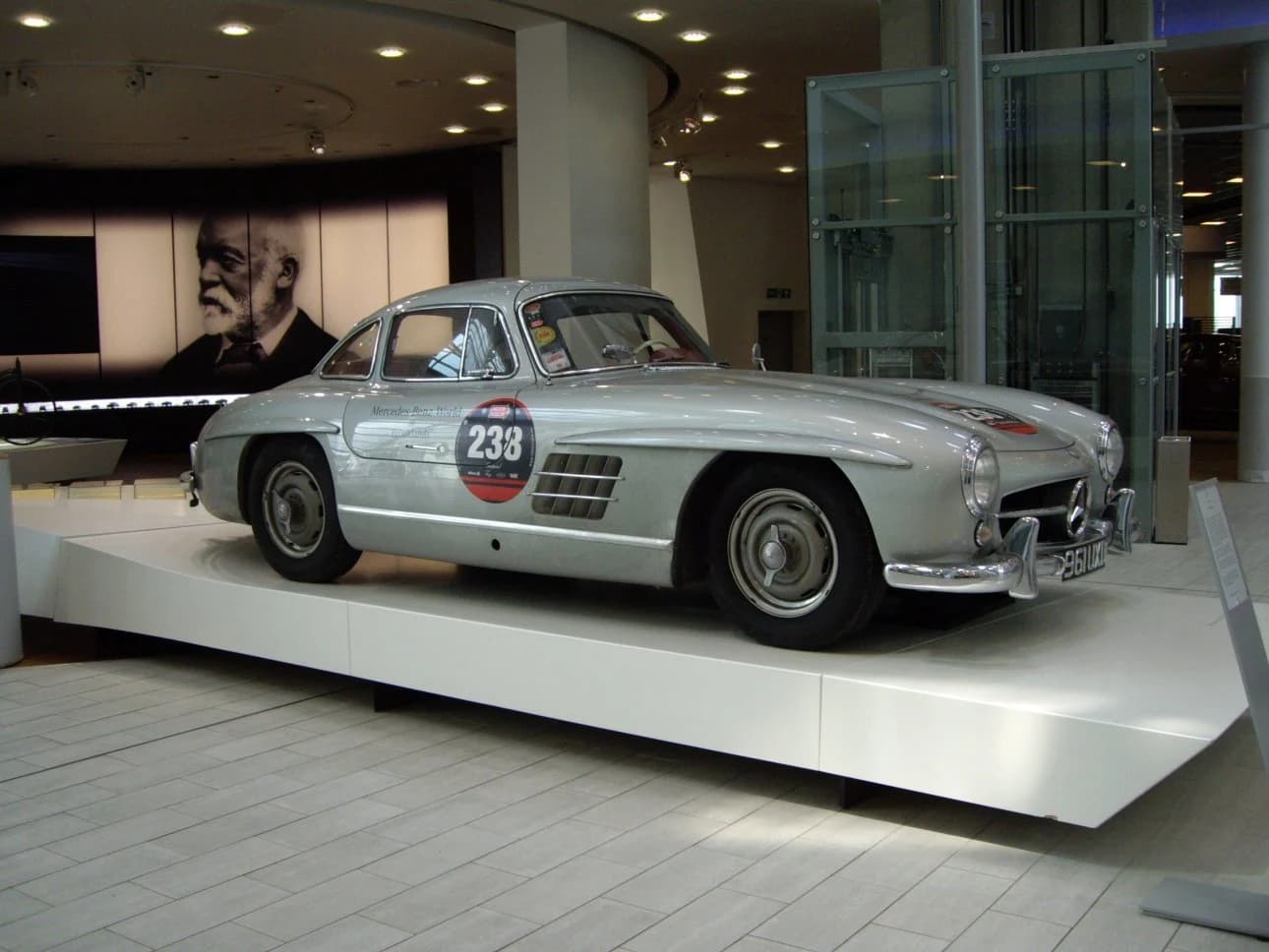
The Mercedes-Benz 300 SL’s gullwing doors were born from a packaging problem. The road car kept the racing car’s unusually tall tubular space frame, and that frame occupied the side structure where a conventional door would normally sit. Hinges mounted near the roof were therefore a practical way to provide an opening without cutting through the frame. The shape became famous, but the engineering decision came first.
The racing car came first
Mercedes-Benz unveiled the 300 SL racing sports car, internally known as the W 194, on 12 March 1952. The company was returning to competition after the Second World War, and the new car was designed around low mass, aerodynamic efficiency and a rigid structure rather than the requirements of a normal road-going saloon.
The official Mercedes-Benz history records a strong first season. The 300 SL finished second and fourth in the Mille Miglia, won the Bern sports car race with a triple victory, took a one-two result at the 24 Hours of Le Mans, scored a quadruple victory at the Nürburgring and achieved another one-two finish in the Carrera Panamericana. Those results made a production version commercially interesting, but they did not make the race car easy to turn into a road car.
Max Hoffman, Mercedes-Benz’s US importer, pushed for a customer model. Mercedes-Benz presented the production 300 SL Coupé, designated W 198, in New York in February 1954. The car looked related to the W 194 because it was related to it technically. Its most visible feature was also the one that revealed the underlying structure: the doors opened upwards from hinges in the roof.
A frame that left little room for doors
The space frame was made from a network of welded tubes. Mercedes-Benz describes the racing frame as weighing about 50 kilograms. Its tubes were arranged to carry loads mainly through tension and compression, giving the structure high rigidity for its mass. That arrangement required the side members to rise high beside the cabin.
The consequence was straightforward. A conventional door needs a vertical opening through the side of the body, a hinge area and enough clearance to swing outward. On the 300 SL, the tall tubes ran through the side structure and made that arrangement impractical. The roof-hinged door opening avoided the main tubes while retaining the frame layout.
Mercedes-Benz’s public archive is unusually clear on this point: the doors were not intended as a publicity stunt. Their unusual movement was a construction necessity inherited from the racing car. The English-language nickname “gullwing” came later, describing the shape of the open doors rather than the original design brief.
The wide sill was part of the compromise
The solution did not make entry as easy as it looks in photographs. The large side sill remained because the frame still needed to carry loads. The driver had to step over it, lower into the seat and then pull the door down. A low garage roof could restrict the opening, and the mechanism introduced practical concerns that would not affect a conventional door in the same way.
This is why the 300 SL is better understood as a road-legal sports car developed from competition hardware than as an ordinary coupé with an extravagant door design. Mercedes-Benz made the openings somewhat larger for series production than on the original racer, but it kept the basic frame and the wide sill.
More than one unusual feature
The door arrangement was only one of the W 198’s technical decisions. The production car used a straight-six engine with mechanical direct fuel injection. Mercedes-Benz describes it as the brand’s first series-production car with fuel injection and says the system increased output by 40 hp compared with the carburetted racing version.
The engine was installed at an angle, helping the designers keep the nose low and the body streamlined. The complete car, including its spare wheel, tools and fuel, weighed 1,295 kilograms according to the Mercedes-Benz Public Archive. Depending on the final-drive ratio, the archive lists a top speed between 235 and 260 km/h.
Those figures were not the result of one isolated trick. The car combined the rigid space frame, a lightweight body, a low frontal shape, the inclined engine and the direct-injection system. The doors attracted the cameras, but the same structure that created the visual signature also formed the basis of the car’s low weight and racing identity.
Production numbers and the move to a roadster
Production of the gullwing coupé ran from August 1954 to May 1957 at Sindelfingen. Mercedes-Benz records 1,400 cars, including 29 with a light-alloy body and one experimental car with a glass-fibre-reinforced plastic body. The figures explain why surviving examples are treated as historic vehicles rather than ordinary used cars, but they do not change the original reason for the doors.
In March 1957, Mercedes-Benz showed the 300 SL Roadster at the Geneva Motor Show. The open car used a revised version of the architecture. By modifying the side sections of the space frame, engineers lowered the entry height enough to fit normal doors. The change is a useful technical comparison: when the side structure was altered, the roof-hinged solution was no longer necessary.
The Roadster also received a revised rear suspension. Both 300 SL versions remained in production until 8 February 1963, when production of the 300 SL and 190 SL ended at Sindelfingen. The separate-chassis era at Mercedes-Benz came to an end with that production decision.
An engineering answer that became a design icon
The 300 SL doors are now usually discussed as a styling signature. Historically, that reverses the sequence. Mercedes-Benz first needed to package occupants inside a car built around a tall, light and rigid tubular frame. The roof-hinged doors solved the access opening problem. Their visual effect was so strong that the solution outlived the original explanation.
The image used here was made by FotoSleuth and is available on Wikimedia Commons under the Creative Commons Attribution 2.0 licence. It was resized and converted to WebP for this article.