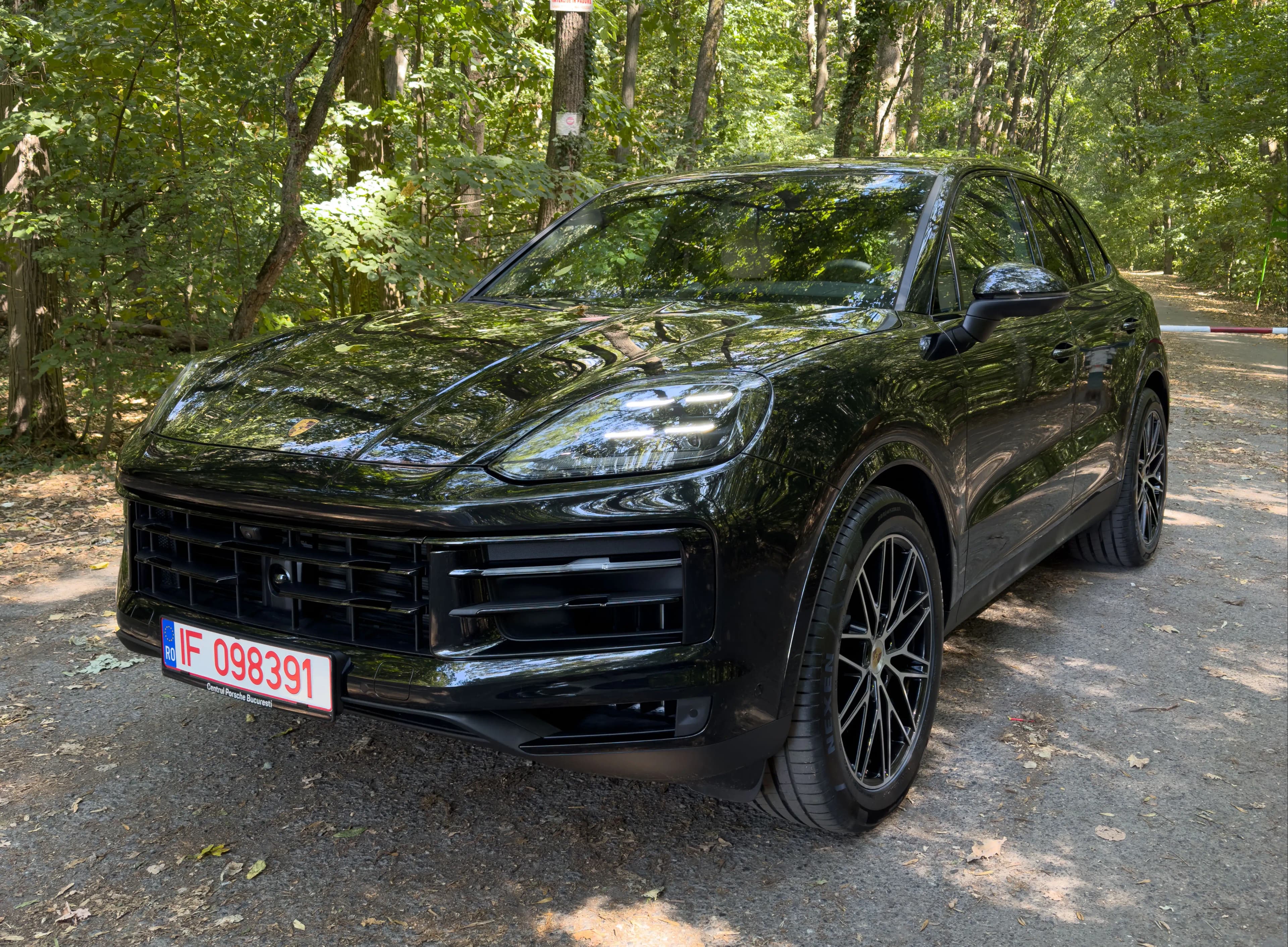
The 2024 Porsche Cayenne goes further than earlier facelifts to cover more use cases — family SUV, long-distance cruiser and, when asked, something close to a sports car.
If you appreciate the special Porsche sports models of the last two decades, you partly have the Cayenne to thank. It accounts for roughly 30% of global Porsche sales, funding increasingly focused sports cars since the model debuted in 2002. It was not Germany’s first premium SUV, but it was the first from a company built around sports cars — and rivals have copied that high-volume strategy ever since.
Technically still the third generation on the same body structure, the 2024 Cayenne nevertheless looks and feels substantially new. Porsche did not reshape the exterior radically; changes are subtle but effective. The nose appears more sculpted, with larger air intakes, revised headlights, stronger wings and a slightly raised bonnet line. The tail received less work, yet thin 3D-effect LED lights spanning the width and a tailgate that emphasises width still matter. Moving the number plate from the tailgate to the bumper on the standard Cayenne aligns it with the Coupé — a small physical change with a big visual payoff.
Interior changes are obvious the moment you open the door. A new 12.6-inch curved digital instrument panel replaces the classic five-dial cluster and sits beside the PCM 6.0 infotainment with its 12.3-inch central touchscreen. Removing the traditional binnacle for one subtle curved display creates a driver-focused cockpit that feels surprisingly free of distraction given the screen area. One of five digital layouts is a minimal view showing only speed — a welcome nod to drivers who want to focus on the road, even in an SUV.
Gear selection moves to a small stalk between the steering wheel and the centre screen. We adapted quickly while driving several 2024 Cayennes and now miss it in other cars. Freed centre-console space brings more storage, a haptic climate panel done well, and a wireless charging pad that works as a sensible phone shelf whether or not you need a charge.
Crucially, the grab handles that have been a Cayenne signature since the first generation remain, angled out from the centre console at roughly 45 degrees. Mirrored on the front door trims, they remain a cabin trademark. A 10.9-inch passenger display, as on the Taycan, lets the front passenger stream entertainment and control selected vehicle functions. Its polarising filter renders it a black panel from the driver’s seat, so distraction is limited — though premium trim might have suited that space better than another screen.
Visual updates help, but constant refinement of an already strong chassis and powertrain is what makes the update credible. The return of a V8 to the Cayenne S, standard Porsche Active Suspension Management, and a larger battery in the Cayenne S E-Hybrid (17.9 kWh to 25.9 kWh usable) are predictable Porsche progress rather than surprises. Each ticks a box for different buyers.
Not everything satisfied us. Ambient lighting feels sparse for a car this modern — personal taste, but more light might suit the updated design language. Without a central gear lever there is nowhere obvious to rest your hand, and with climate controls in the centre stack you can end up in an awkward posture. Small details, but they affect daily driving.
The Cayenne line is now simplified to four core models: Cayenne, Cayenne S and Cayenne S E-Hybrid in SUV or Coupé form, plus the Coupé-only Cayenne Turbo GT. GTS, louder Turbos and a Turbo S E-Hybrid blending both worlds may follow; even without them, the range feels stronger than before, with a configuration for most luxury performance SUV buyers.