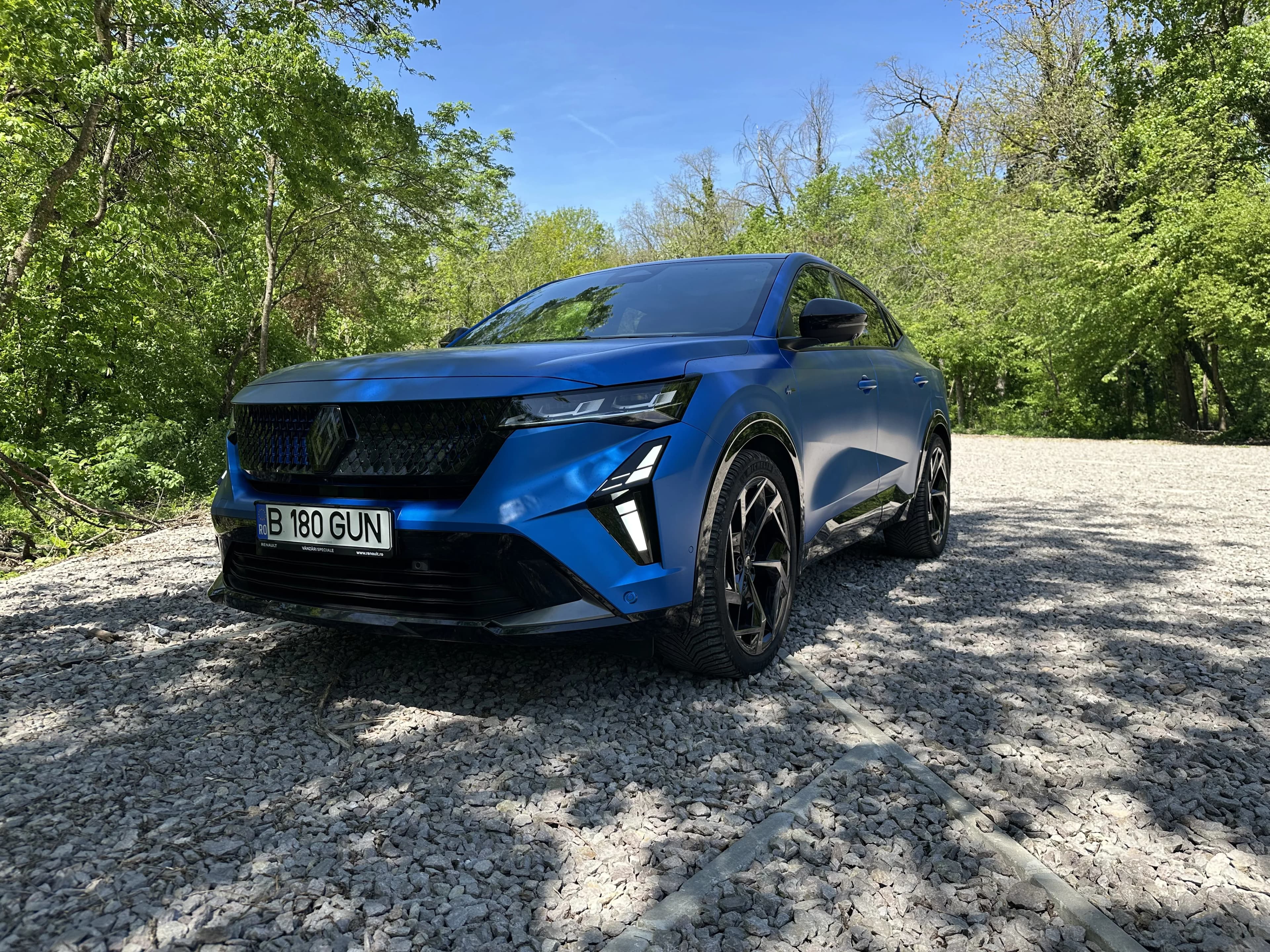
The Renault Rafale E-Tech 4x4 300 PHEV is the kind of car that shows Renault no longer wants to play only in the rational corner of the market. It is not a classic family SUV, not merely an economy hybrid, and not a timid premium attempt. It is a statement: Renault believes it can build a large, technology-heavy, powerful coupé SUV refined enough for buyers who previously looked only at premium badges.
The tested 300 hp plug-in hybrid version best expresses that ambition: 300 hp, electric all-wheel drive, a 22 kWh battery, up to 105–110 km WLTP electric range, and a complex hybrid system built around a 1.2-litre turbo petrol engine plus several electric machines. In Romania, pricing starts at €49,450 for esprit Alpine and from €53,950 for Atelier Alpine.
That is a lot for a Renault — but the right question is not whether Rafale is expensive for the badge, but whether it delivers enough where PHEV SUVs above 250 hp quickly pass €50,000.
Design: Rafale looks more expensive than it is
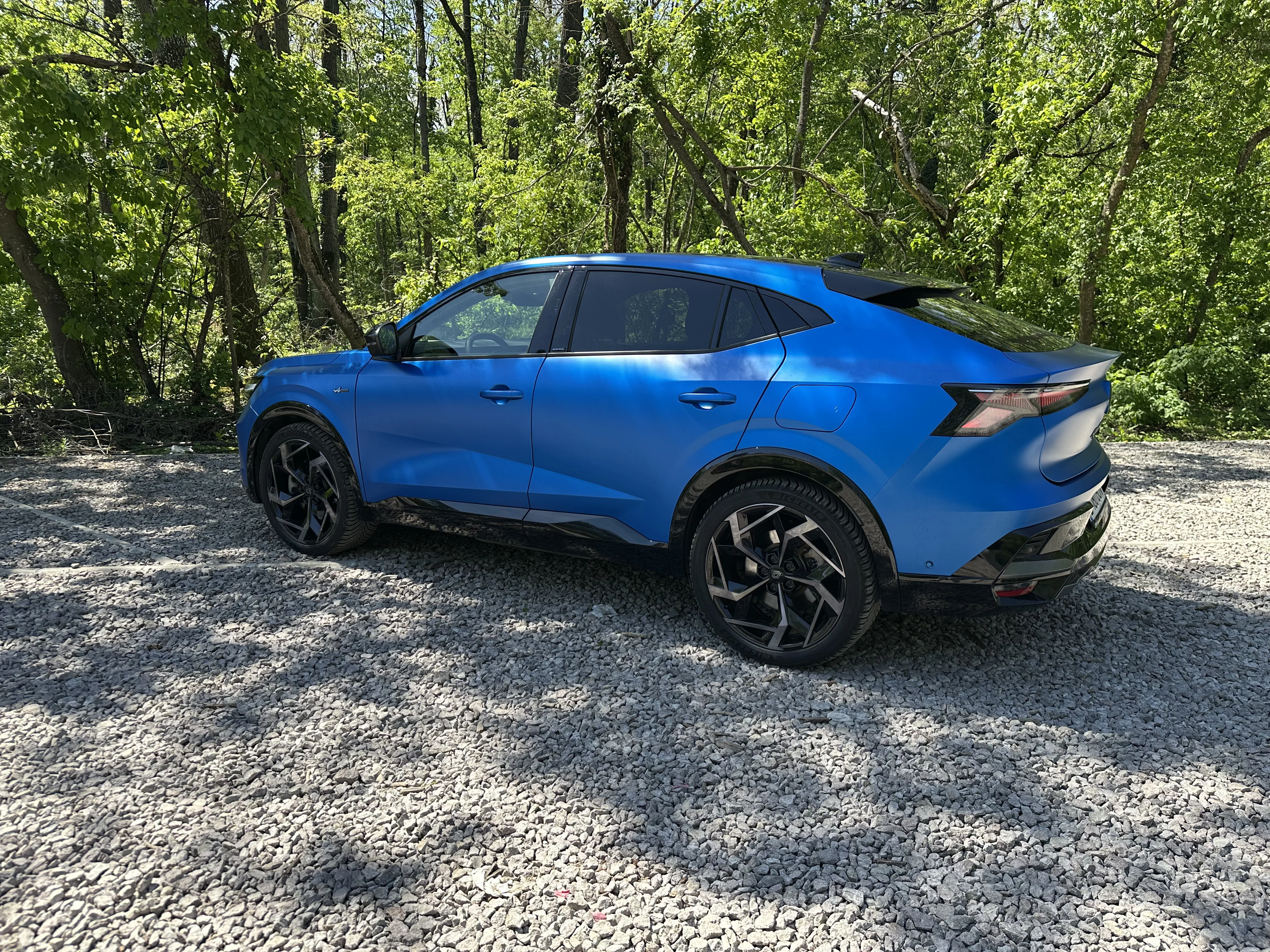
Visual presence hits first. It does not read as a stretched Austral despite sharing the CMF-CD platform. Rafale sits lower, the roofline falls toward the rear, the nose is assertive and the light signature is distinctive.
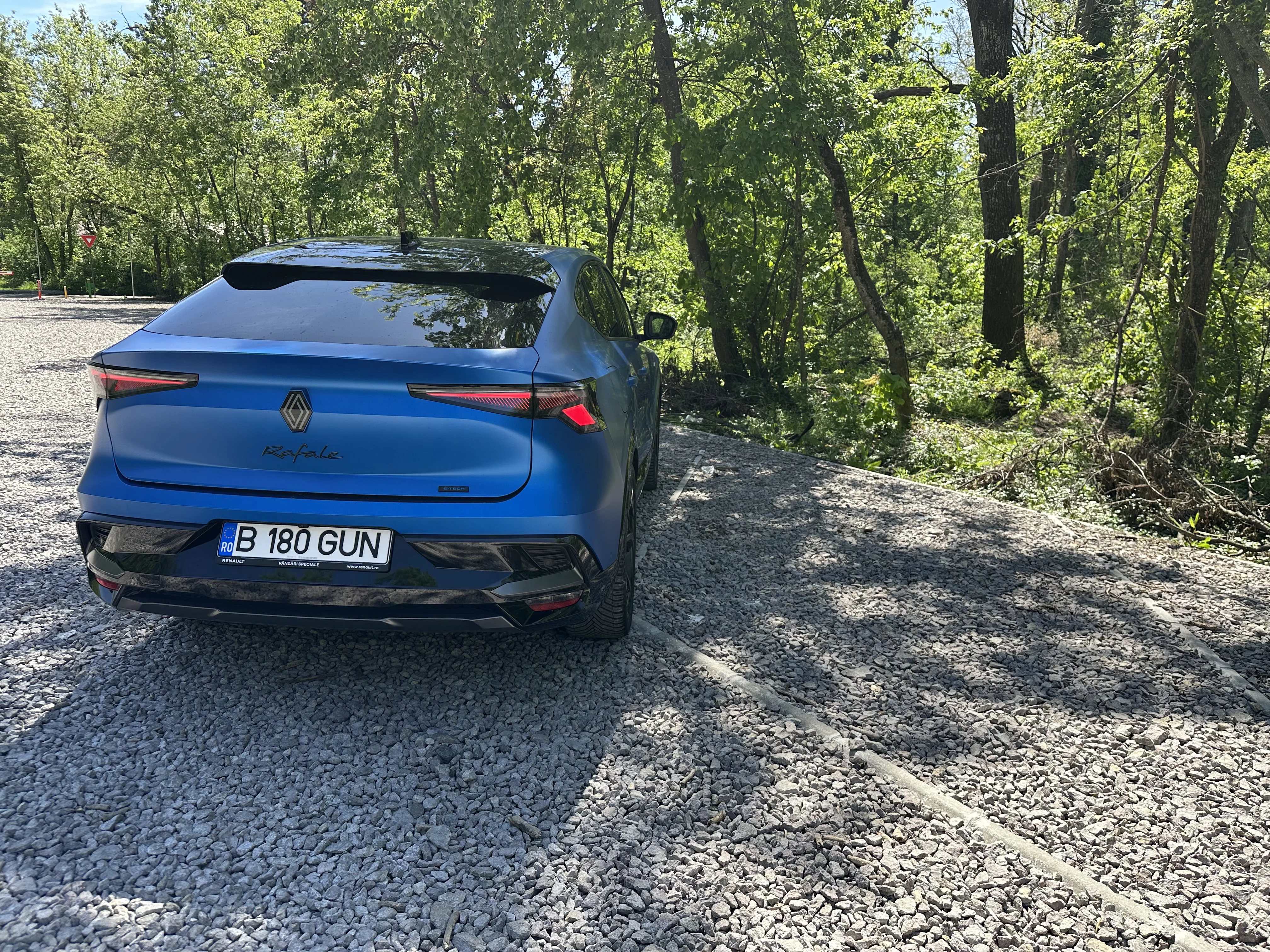
Renault wanted personality beyond a volume SUV. The front is massive, the grille intricate, slim headlights almost concept-like. Side profile shows coupé-SUV proportions without excess drama. The tail is arguably the best angle — thin lights and a sloping rear window add dynamism most family SUVs lack.
In esprit Alpine or Atelier Alpine trim, sport details and large wheels push the car toward a quasi-premium zone. It lacks the sobriety of an Audi Q5 or the polish of a Lexus NX, but looks newer, bolder and braver.
For buyers who want family space without driving something anonymous, image works strongly.
Interior: technology, space and a modern atmosphere
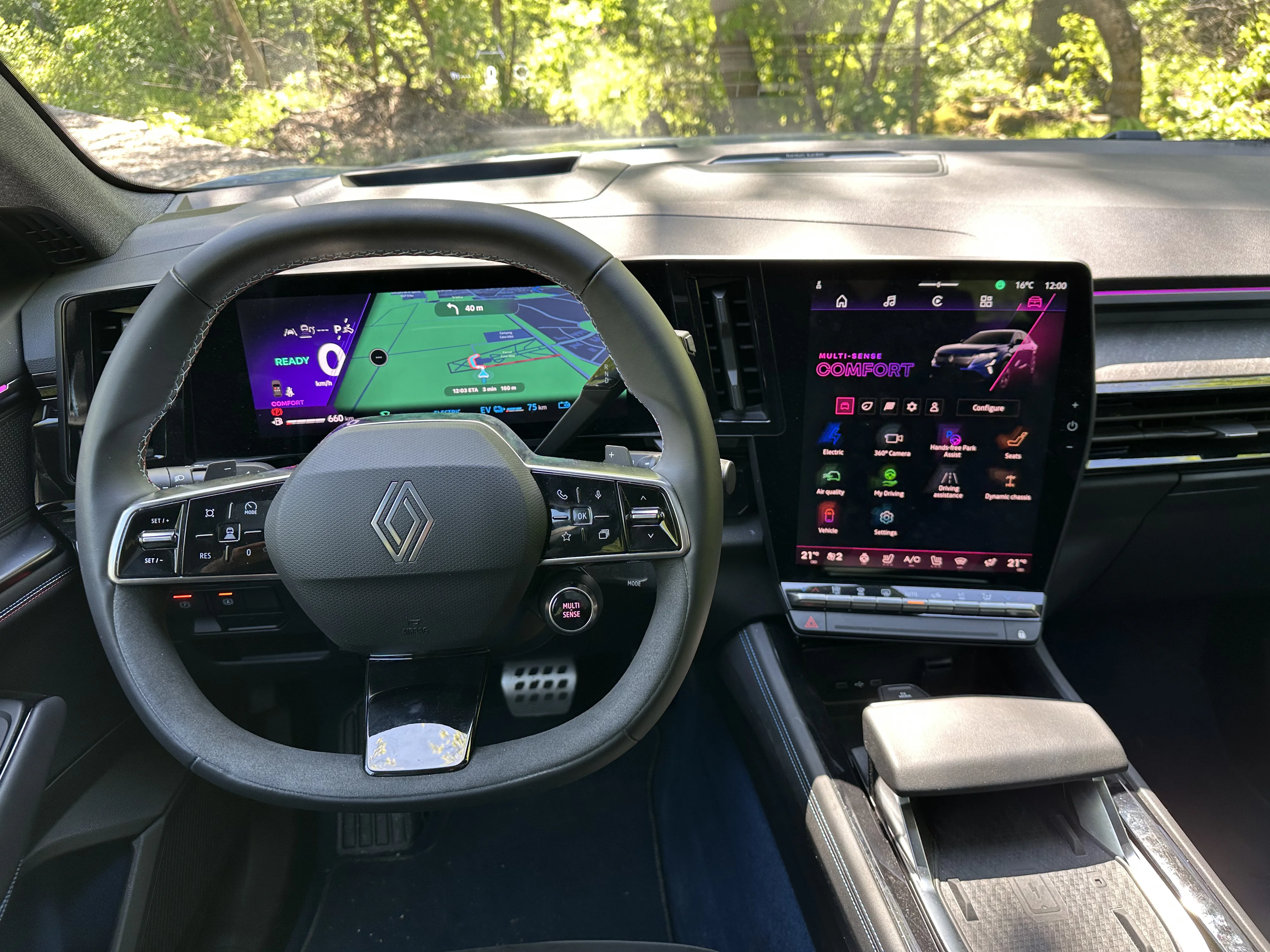
The cabin is one of Rafale’s best parts. Renault has improved interiors sharply in recent years; Rafale carries that further. OpenR dominates with a 12.3-inch digital cluster and vertical 12-inch centre screen; native Google integration is a major advantage over many rival interfaces.
The multimedia stack is fast, logical and closer to a modern phone than many in-house systems. Integrated Google Maps, more natural voice control and apps reduce daily frustration in a family car.
Materials are good where you touch them often; lower dashboard and some door areas use harder plastics. Overall it feels solid — not cheap or improvised like a volume SUV pushed upmarket with trim alone.
Driving position is good, seats offer decent support, and Alpine atmospheres feel special enough to partly justify price. Rear space is surprisingly good for a coupé SUV; wheelbase helps knee room even with a falling roofline.
The boot stays practical for family use despite the larger PHEV battery. Rafale does not feel chosen for design alone.
Powertrain: 300 hp PHEV with electric AWD
The 300 PHEV combines a 1.2-litre three-cylinder turbo with electric machines and a 22 kWh battery. Total system output is 300 hp; all-wheel drive comes from a rear electric motor.
On paper it is impressive: enough punch for safe overtakes, AWD for grip, and WLTP electric range high enough for many commutes if you can charge. With a full battery Rafale leaves quietly, accelerates cleanly and can run electrically in most urban situations. For 30–60 km daily trips with home or office charging, it can behave like an EV much of the time.
Hard acceleration blends petrol and electric power. It is not a pure sports SUV, but 300 hp is felt on national roads and motorways.
The system is not flawless. The 1.2-litre engine becomes vocal with a depleted battery or under heavy demand. In a car past €50,000 some buyers will expect more mechanical refinement — where Lexus NX 450h+ or German PHEVs can feel smoother, Renault compensates with tech and strong EV range.
Driving Rafale PHEV
Rafale is surprisingly agile for its size. 4Control rear steering changes behaviour: tighter in town, more stable and precise on twisty roads. Atelier Alpine adds predictive active suspension with a road-reading camera — a good comfort/control compromise. It is not a hot hatch on stilts, but more pleasant and secure than expected.
Steering is light in town, precise enough at speed — well calibrated for a family PHEV, not a sports car. AWD helps on wet exits. PHEV weight shows under hard braking and quick direction changes but does not ruin the experience. Rafale is a fast, comfortable, secure SUV rather than a truly sporty one — logical for its audience.
Consumption and range: excellent if you plug in
Like any PHEV, Rafale has two personalities. Charge regularly and it can be extremely efficient on commutes and short trips; declared WLTP EV range above 100 km is a real advantage. Many drivers could go days without starting the petrol engine.
AC charging at up to 7–7.4 kW fits PHEV use: about 2 h 45 min 0–100% at 7.4 kW, roughly 2 h to 80%. Home overnight charging remains usable.
Without charging, Rafale loses much of its point. It still hybridises and recuperates, but you carry a large battery unused. Real motorway consumption with an empty battery moves toward a petrol SUV, not headline WLTP figures.
Rule of thumb: Rafale PHEV pays off if you charge often. No charger at home? The 200 hp full hybrid may make more financial sense.
Pricing in Romania
Rafale E-Tech 4x4 300 PHEV starts at €49,450 (esprit Alpine). Atelier Alpine from €53,950 adds predictive active suspension, hands-free power tailgate and a more flagship presentation.
At nearly €50,000–55,000 competition is serious — not only mainstream SUVs but recent premium used cars and established PHEVs.
Technical data
| Specification | Rafale E-Tech 4x4 300 PHEV |
|---|---|
| Powertrain | Petrol PHEV |
| Total power | 300 hp |
| System power | 221 kW |
| Petrol engine | 1.2-litre turbo |
| Drive | AWD with rear electric motor |
| Transmission | Multi-mode automatic |
| Battery | 22 kWh |
| WLTP EV range | 105–110 km (trim dependent) |
| AC charging | Up to 7–7.4 kW |
| WLTP fuel use | From ~1.7 l/100 km (charged battery) |
| CO₂ | 122–133 g/km (trim dependent) |
| Price Romania | From €49,450 |
| Atelier Alpine | From €53,950 |
Strengths
- Strong coupé-SUV design with premium presence
- Large PHEV electric range
- 300 hp total output
- Electric all-wheel drive
- Useful 4Control in town and on bends
- Modern, spacious, tech-rich interior
- OpenR Link with Google
- Predictive active suspension on Atelier Alpine
- Very efficient when charged daily
- Distinct positioning vs classic segment SUVs
Weaknesses
- High price for a Renault badge
- 1.2-litre engine not always refined enough for the money
- PHEV logic requires frequent charging
- Extra weight felt under hard braking and quick direction changes
- Not the premium image of some German or Japanese rivals
- Some interior materials below absolute premium
- 200 hp full hybrid may suit non-charging users better
Rivals
Toyota RAV4 plug-in hybrid
The Toyota RAV4 plug-in hybrid is one of the most direct rivals for Rafale, especially for buyers focused on reliability, consumption and resale value. It has a very efficient PHEV system, strong power and an excellent reputation. Rafale looks more striking, offers a more modern interior and a better multimedia experience.
Lexus NX 450h+
The Lexus NX 450h+ is the more premium, more refined alternative. It has a very well calibrated plug-in hybrid, excellent comfort and superior brand image. Rafale responds with a more accessible price, bolder visual personality and more agile road behaviour thanks to rear-axle steering.
Mazda CX-60 PHEV
The Mazda CX-60 PHEV brings 327 hp, all-wheel drive and an interesting position for those who want a large SUV with an elegant interior and some sportiness. Mazda uses a larger petrol engine and a different architecture, but Rafale feels more modern in interface, technology and urban efficiency.
Cupra Formentor e-Hybrid
The Cupra Formentor e-Hybrid is more compact, sportier and younger in character. It can suit buyers who want a more dynamic car and do not need Rafale’s space. Renault wins on electric range, interior space and a more mature overall impression.
Peugeot 408 plug-in hybrid
The Peugeot 408 PHEV is an interesting French rival with equally bold design and fastback crossover positioning. Rafale E-Tech 4x4 300 is more powerful, more spacious and more advanced technically, especially through all-wheel drive and rear steering.
Who it suits
Families wanting space without a boring SUV; commuters who can charge and want long EV stretches without full-EV range anxiety; tech-focused buyers who value 4Control and predictive suspension on Atelier Alpine.
Less ideal for mostly motorway use with no charging — diesel, conventional hybrid or Rafale 200 may be smarter.
Verdict
Rafale E-Tech 4x4 300 PHEV is among Renault’s most interesting recent launches. It is not perfect, not cheap, and will not convince everyone that Renault belongs above €50,000. After driving it, the pricing logic becomes clearer: design, technology, space, strong PHEV EV range and better-than-expected dynamics — 4Control and Atelier Alpine matter.
The challenge is positioning: at this money Rafale must win buyers who never shortlisted Renault. Judge the product, not only the badge, and it is a serious PHEV alternative.
Renault is not trying to sell Rafale on heritage alone. The brand bets on design, Google-based connectivity, 4Control and a plug-in hybrid system with class-leading electric range on paper. That combination is credible enough that dismissing the car because of the badge alone would mean ignoring how far the product has moved.
Best version? Atelier Alpine for image, tech and comfort; esprit Alpine PHEV for value; Rafale E-Tech full hybrid 200 if you cannot charge at home.
Rafale is not a perfect SUV, but an important one: proof Renault can build an aspirational model without copying the German recipe.