
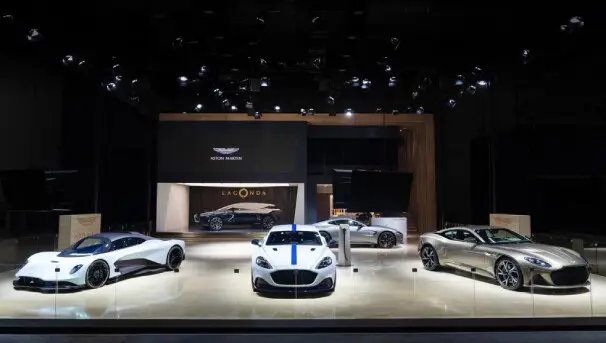
Aston Martin previously presented its electric direction through the Rapide E. Photo source: Aston Martin.
Aston Martin delays its first EV to 2033–2035 and keeps V8 and V12 engines
Aston Martin is no longer setting its first fully electric production car for the beginning of this decade. Chief executive Adrian Hallmark says the launch could take place in 2033 or 2035, and the company is not ready to name one exact year. Until then, Aston Martin plans to keep V8 and V12 engines in its range and use hybrid systems to meet emissions requirements.
The change does not cancel the electric programme. Aston Martin describes itself as a company delaying battery-electric vehicles rather than rejecting them. It is still assessing markets, legislation and technology before deciding when an EV can be launched with the performance, price and character expected from the brand.
From 2027 to a 2033–2035 window
Aston Martin’s electric timetable has moved several times. Previous management targeted the first EV for 2027. After Hallmark joined the company, the target shifted to 2030. The latest position is less precise: the first car could arrive in 2033 or 2035, within a three-year window that does not include 2031.
Hallmark said EV demand and regulation are changing faster than car companies can comfortably respond. Aston Martin is therefore stress-testing several scenarios for individual markets and regions instead of preparing one identical global launch. That wording describes an open product decision, not a production car with confirmed specifications.
For buyers, the delay means that Aston Martin will remain primarily a combustion-engine manufacturer throughout the rest of this decade. The company already has hybrid models, but it has not announced the body style, battery size, range, price or market availability of its future BEV. There is no confirmed Romanian launch schedule either.
Why regional demand matters
Aston Martin sells cars in markets with different regulations and customer preferences. An electric model would need to make sense in Europe, North America, China and other Asian markets, even though charging access, incentives and luxury-car demand differ between them. Launching too early could commit a low-volume manufacturer to a costly product before demand becomes predictable.
The company is also watching battery and electric-motor development. Hallmark said the technology Aston Martin eventually receives through its Lucid partnership will be very different from what was included in the original agreement because the delay gives the supplier relationship more time to evolve. That could improve energy density, cooling, software or cost, but Aston Martin has not published technical figures for the future vehicle.
The Lucid agreement remains part of Aston Martin’s electrification plan. It gives the British company access to electric powertrain and battery technology. Aston Martin has not said whether its first new BEV will be a grand tourer, an SUV or a separate model line. The company previously showed the production-ready Rapide E, but that project did not become the foundation of a series EV range.
V8 and V12 engines through 2035
Alongside the EV delay, Hallmark says Aston Martin has a roadmap to keep its V8 and V12 engines compliant through 2035. These engines sit beneath much of the brand’s sports-car, grand-tourer and SUV range, and the company intends to keep them in production longer than earlier plans suggested.
Hybridisation is part of that roadmap. Aston Martin can use mild-hybrid or other non-plug-in assistance to support emissions compliance and efficiency without adding the mass and charging requirements of a large plug-in battery. Hallmark indicated that plug-in hybrid technology is unlikely to be the answer for every model. This is a strategic direction, not a complete list of future engines or variants.
The Valhalla is already Aston Martin’s first plug-in hybrid model. Its V8 works with electric components, and customer deliveries began in 2025. It shows that Aston Martin is willing to electrify a car when the system can be integrated with the brand’s performance goals. It is not, however, the same thing as the first battery-electric Aston Martin.
Regulation sets the deadline
Customer demand is only one part of the decision. In the European Union, fleet rules are designed to reach a 100 per cent reduction target for new-car CO2 emissions compared with the 2021 reference level by 2035. The United Kingdom is also moving towards zero-tailpipe-emission new cars while allowing a transition that includes hybrids until 2035 under current policy.
Low-volume manufacturers can face different conditions from large car companies, but exemptions do not remove the need for an electric plan. Aston Martin must combine homologation, limited production volumes, battery costs and demand for expensive sports cars and SUVs. That is why the 2033–2035 window matters more than a single launch date presented as certain.
Aston Martin’s current corporate position still refers to alternatives to the internal-combustion engine, including plug-in hybrids and BEVs. The company’s recent product and financial planning indicates that investment has been rescheduled rather than abandoned. The first electric Aston Martin remains on the roadmap, but it is now a project for the second half of the next decade, while V8 and V12 engines are expected to remain central until then.


