
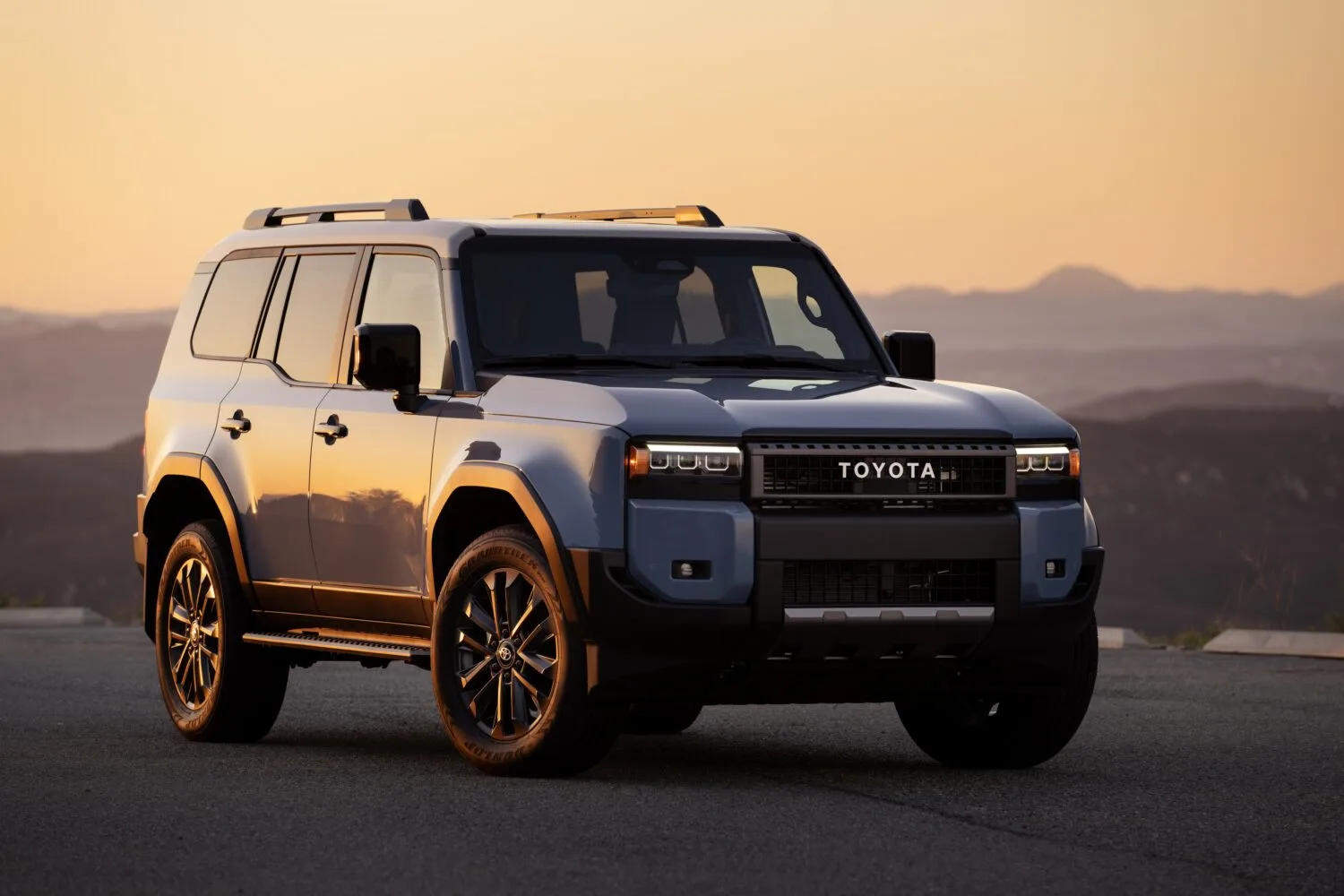
Toyota Land Cruiser. Official Toyota Motor Sales, U.S.A., Inc. photograph licensed by the newsroom for editorial use.
AWD vs 4WD: the hardware and use cases that separate them
All-wheel drive normally varies torque between the axles automatically and is designed to stay available on ordinary roads. Traditional four-wheel drive usually adds a transfer case, driver-selectable modes and, on serious off-road vehicles, low-range gearing. Both can drive four wheels, but they are intended to solve different problems.
That distinction is a useful starting point rather than a universal engineering standard. Carmakers do not apply AWD, 4WD and 4x4 labels consistently. Some 4WD systems have a centre differential and an automatic road mode, while some AWD vehicles can temporarily lock their centre coupling. The badge is less informative than the hardware and the instructions in the owner's manual.
Why an AWD system allows speed differences
During a turn, the outside wheels travel farther than the inside wheels. The front axle also traces a different arc from the rear axle. An axle differential allows its left and right wheels to rotate at different rates. A vehicle driving both axles needs another mechanism to accommodate the speed difference between the front and rear on a high-grip road.
Full-time AWD may use a centre differential that continuously feeds both axles. An on-demand design can drive one axle in normal conditions and close an electronically controlled multi-plate clutch to connect the other. A viscous coupling is another possible solution. None of these layouts requires an equal 25% share at every wheel.
Modern control systems do not necessarily wait for wheelspin. Honda says Real Time AWD assesses steering angle, yaw rate, accelerator position, wheel speed and transmission gear, among other inputs. Subaru describes its Symmetrical AWD as continuously evaluating acceleration, braking and cornering. These are two different implementations within the broad AWD category.
Battery-electric AWD can be more different still. A motor on each axle lets software adjust front and rear torque without a propshaft, mechanical centre differential or transfer case. Some hybrids drive the front axle with the combustion powertrain and the rear with a separate electric motor. Their function is still all-wheel drive even though the power path bears little resemblance to that of a conventional 4x4.
What a traditional transfer case changes
A part-time 4WD vehicle often drives its rear axle in 2H. Selecting 4H through the transfer case connects the front and rear driveline for snow, gravel, mud or other loose surfaces. Selecting 4L introduces an additional reduction ratio for slow, demanding terrain.
Low range does not increase engine power. It trades road speed for greater wheel torque, helping a vehicle creep up a steep slope, cross rocks or maintain control on a difficult descent. Engagement procedures vary: some vehicles require a complete stop and neutral, while others allow particular shifts on the move. The owner's manual is the authority for speed and selection limits.
Many part-time systems have no centre differential when 4H or 4L is engaged. Front and rear propshafts are then forced to turn at the same average rate. Loose ground lets a tyre scrub enough to release the difference generated in a corner. Dry tarmac does not. The resulting driveline wind-up can make the steering resist, cause tyres to hop and load shafts, joints and the transfer case. A locked part-time mode should therefore not be used on a high-grip surface unless the manufacturer specifically permits it.
Auto 4WD and full-time 4WD blur the labels
Not every vehicle follows the simple rule. GMC's Autotrac example includes an AUTO setting that varies power between the axles according to road conditions and can be used on paved roads. A vehicle marketed as 4WD can therefore act much like an on-demand AWD in that mode.
Full-time 4WD can incorporate a centre differential, remain engaged on dry roads and add a separate centre lock for loose terrain. At the other side of the overlap, a crossover's AWD Lock button may command a firmer front-rear split only at low speed before automatically returning to normal operation. AWD Lock is not another name for 4L: without reduction gears it cannot deliver the same low-speed ratio.
US regulator NHTSA acknowledges the conventional distinction while recognising the overlap. Its rulemaking documents associate AWD with variable operation of one or both axles in light-duty road vehicles, and 4WD with truck-based platforms, a locked driveline configuration and/or low-range gearing. “Associated with” matters here; it is not a guarantee about every model.
Driving four wheels is not the same as locking four wheels
A locked connection between the axles only governs the average speed of the front and rear drivelines. Open differentials at the axles can still allow one wheel to spin. Brake-based traction control may slow that wheel so torque can reach the opposite side, while a locking axle differential makes a mechanical connection between its two half-shafts.
Off-road capability therefore depends on more than AWD or 4WD terminology. Low range, axle locks, ground clearance, suspension travel, underbody protection, approach and departure angles and the fitted tyres all affect where the vehicle can travel. A low passenger car with two electric motors remains limited by its body and tyres, however quickly its software can change torque.
Four driven wheels do not shorten a stop
AWD and 4WD can improve acceleration on a slippery surface because engine or motor torque is shared across more contact patches. Under braking, a conventional two-wheel-drive car already brakes all four wheels. The driveline cannot create extra friction between rubber and road.
Michelin states that AWD helps a vehicle accelerate in snow but does not improve its ability to stop or turn. The company recommends four winter tyres rather than fitting them to one axle only. A front-wheel-drive car on suitable winter tyres can outperform an AWD car on all-season tyres in braking and cornering on snow.
That difference can catch drivers out: easy acceleration may imply more grip than is available at the next bend. Speed and following distance still need to reflect the tyres and surface. Neither an AWD logo nor a 4H indicator changes the friction available for an emergency stop.
Ownership brings tyre and maintenance requirements
An extra driven axle adds hardware, mass and mechanical or electrical losses. Compared with an otherwise similar two-wheel-drive version, purchase price, energy use and repair costs may be higher. A transfer case and differentials can have their own oil-change requirements; an on-demand clutch can also be a costly component if neglected or overloaded.
Tyre matching matters. Michelin advises that AWD and 4WD vehicles typically need similar rolling circumference at all four corners because even small differences can stress driveline components. Replacing one badly worn tyre with a full-depth tyre can keep a centre coupling working when the car is travelling straight. Manufacturers specify their own permitted tread-depth or circumference difference, so there is no single tolerance for every car.
When buying used, inspect all four tyre sizes and tread depths, listen for binding or knocking during slow tight turns and test every selectable mode according to the manual. Service records should show the specified fluids for the transfer case and differentials. A flashing 4WD light or a selector that refuses to change mode is not something to dismiss as an unused feature.
Choosing by journey rather than badge
AWD is usually the logical choice for everyday driving, wet motorways, ploughed winter roads and occasional gravel. It works in the background and does not ask the driver to decide when the second axle should join. It still needs appropriate tyres.
Traditional 4WD earns its extra complexity where low range and a locked driveline are genuinely useful: deep mud, rocks, steep unsealed routes or towing on loose ground. Someone who stays on paved roads may carry that weight and cost without using its defining capability.
Before buying, ask specific questions. Does the vehicle have 2H, 4H and 4L? Can its four-wheel mode remain engaged on dry tarmac? Does it use a centre differential or a clutch? Are there axle locks, or only brake-based traction control? Those answers describe the drivetrain far better than AWD or 4x4 lettering on the tailgate.
Sources
- NHTSA — regulatory treatment of AWD and 4WD
- Mazda — official AWD versus 4WD explanation
- Honda — Real Time AWD technology
- Subaru — Symmetrical All-Wheel Drive
- GMC — 2WD, 4WD High, Auto and Low modes
- Michelin — AWD and winter tyre safety
- Michelin — matching tyres on AWD and 4WD vehicles
- Toyota USA Newsroom — Land Cruiser image and editorial-use terms


