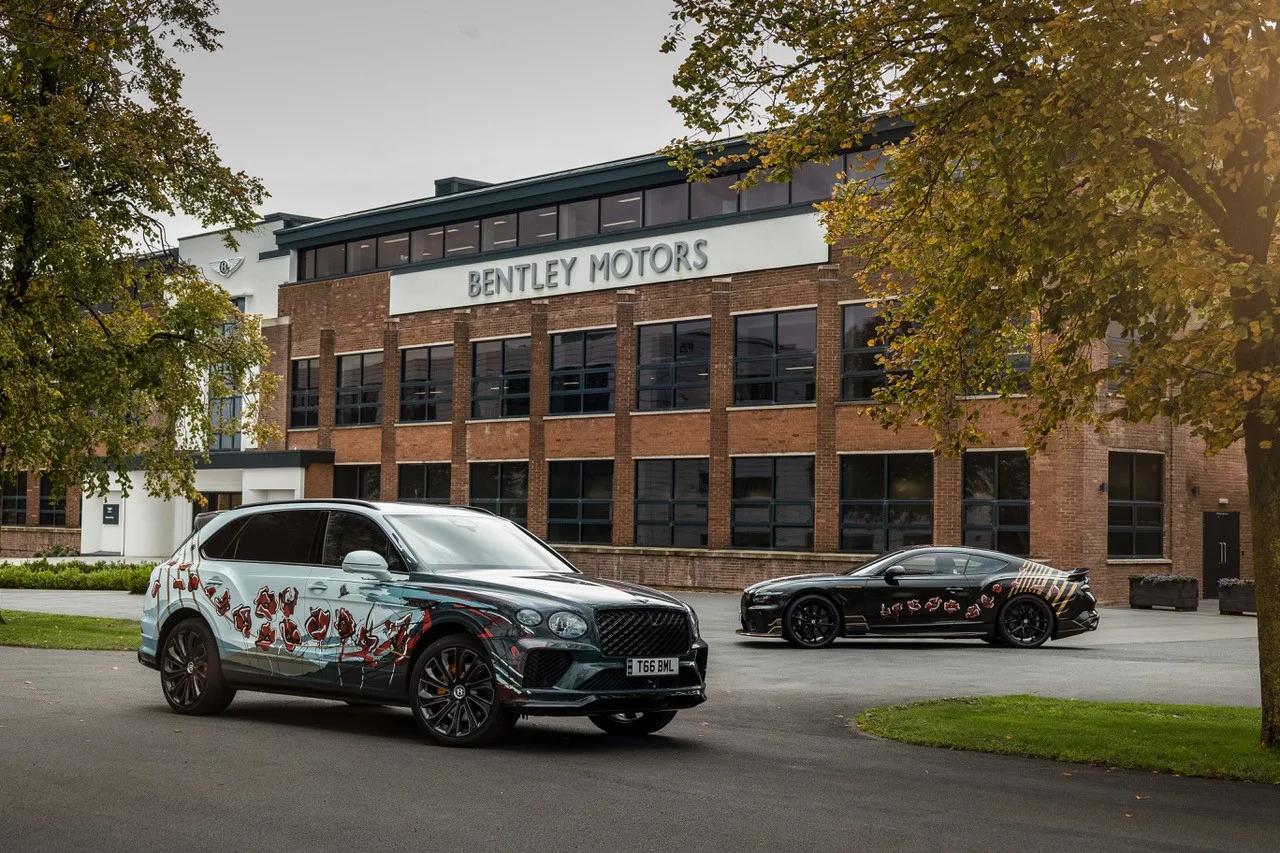
Bentley has created two one-off Remembrance cars for 2026: a Bentayga Extended Wheelbase Artenara and a Supersports. Both carry exterior artwork built around red poppies, a disrupted battlefield landscape and imagery inspired by John McCrae's 1915 poem “In Flanders Fields”. They are commemorative vehicles rather than customer editions, and Bentley has announced no production run, price or sales plan for the designs.
Remembrance Day is observed on 11 November in the United Kingdom and elsewhere in the Commonwealth. Its date comes from the armistice that took effect at 11am on 11 November 1918 and ended fighting between the Allies and Germany on the Western Front. Modern ceremonies remember military and civilian people who died in the two world wars and later conflicts; the occasion is not limited to the First World War.
One story applied to two very different cars
Bentley colleagues call the vehicles the “Poppy Cars”. The Bentayga EWB Artenara, seen closest to the camera in the official group photograph, combines red flowers and dark stems with a blue-green, fractured landscape. The black Supersports continues the poppy theme along its flanks and adds a pale graphic treatment around the rear quarters.
According to Bentley, the design moves from resilience and hope towards remembrance and responsibility. Poppies bloom across the depicted battlefield while larks fly above it, two direct references to McCrae's poem. The central imagery remembers those who died as ordinary people who loved and were loved, rather than as remote historical figures. Its final passage is intended as a request that later generations protect their memory and the freedoms for which they served.
The work was developed by Bentley's design team with BeReady, the company's colleague-led network for veterans, serving reservists and their families. BeReady is one of five internal diversity, equity, inclusion and belonging networks. The project is not presented as an option from Mulliner's customer commissioning catalogue, even though bespoke production techniques are part of Bentley's normal work.
Crewe service, Anglesey race and a return to the factory
The two cars took part in Bentley's on-site Remembrance service in Crewe. The company says dignitaries attended from the Ministry of Defence, the local Royal British Legion and Crewe Town Council. They then participated in Mission Motorsport's Race of Remembrance at the Anglesey circuit before returning to Crewe, where employees gathered.
The commemoration also has a direct connection to the plant. Bentley annually remembers 17 colleagues killed when a bomb fell on the Crewe factory during the Second World War. They had been working on production of the Rolls-Royce Merlin aero engine. The attack occurred 86 years before the 2026 event, and the 17 employees are named explicitly in Bentley's announcement alongside the wider remembrance theme.
Manufacturing employees crocheted poppies by hand to raise money for the Royal British Legion. The charity supports serving and former members of the British Armed Forces and their families. Bentley also connects the event with receiving Gold status in the UK's Employer Recognition Scheme during 2026, the highest level in a programme that recognises organisations supporting the Armed Forces community.
Why the red poppy matters
The red poppy became a remembrance symbol after the First World War. The flowers grew in ground disturbed by fighting in Belgium and northern France, and McCrae's poem, published in 1915, embedded the image in public memory. The Royal British Legion adopted the poppy after it was founded in 1921 and continues to use it for the annual Poppy Appeal.
The UK House of Commons Library notes that the Legion assigns the poppy no political or religious meaning and considers wearing one a personal choice. On the two Bentleys, the flower is used as a narrative device rather than a repeated badge. It sits beside the devastated terrain and the continuing flight of the larks, connecting loss with survival.
Bentley design director Robin Page said in the official release that design's value lies not only in appearance but also in how it makes people feel. Product line director Chris Cole described craftsmanship as a way to tell stories that matter. Both comments relate to the commemorative project; they do not indicate a new commercial derivative.
The production cars beneath the artwork
The Bentayga EWB Artenara is the long-wheelbase form of a limited-time edition named after Roque Bentayga in Gran Canaria, the geological formation that gave Bentley's SUV its name. The EWB version is offered with a 4.0-litre V8. Bentley quotes 0–100 km/h in 4.5 seconds and a top speed of 290 km/h for the standard model. Those numbers describe the underlying production derivative, not a separate mechanical specification for the Remembrance car.
Supersports is a two-seat, rear-wheel-drive V8 coupé limited to 500 customer cars. Bentley states 666 PS, 800 Nm, a kerb weight below 2,000 kg and a maximum speed of 320 km/h. Its equipment includes a carbon-fibre aerodynamic package, carbon-ceramic brakes and an Akrapovič titanium exhaust. Bentley has disclosed no mechanical changes for the commemorative example.
The pair therefore use opposite ends of Bentley's range to deliver the same message: one is a long luxury SUV focused on passenger space, the other a two-seat performance coupé. Their confirmed role covers the ceremonies, Race of Remembrance and fundraising activity. There is no evidence that a Remembrance specification will be offered to customers.