
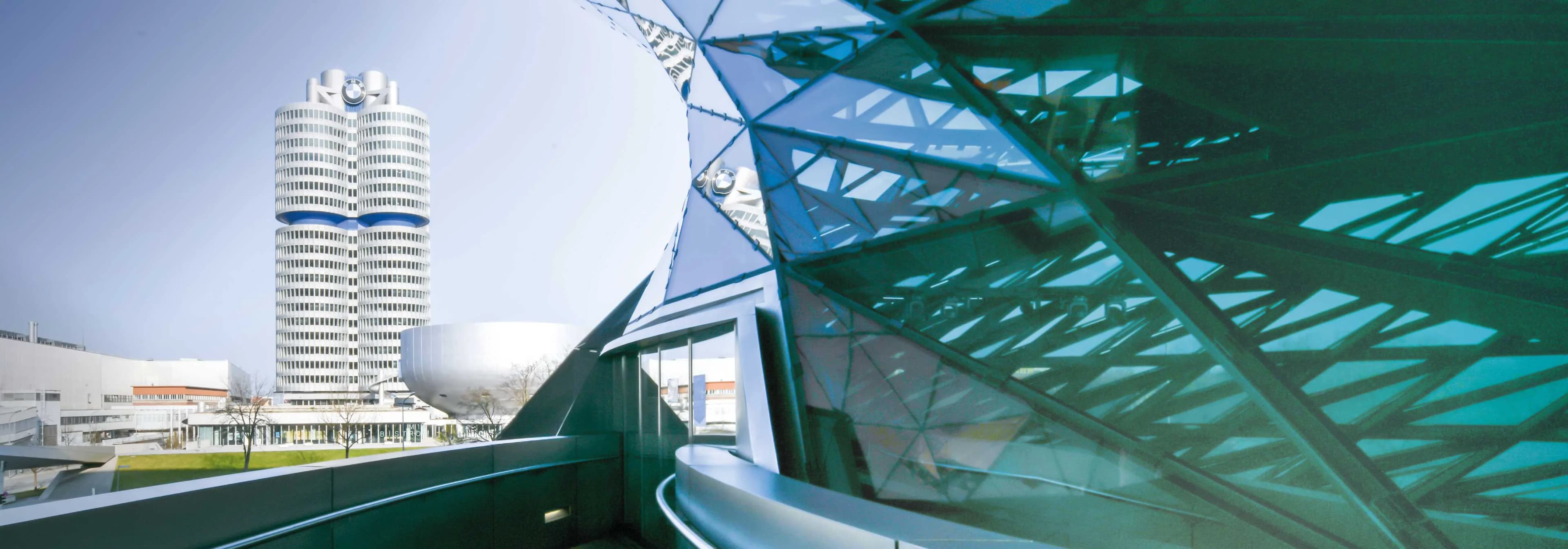
Photo: BMW Group. Official corporate headquarters image, downloaded from BMW Group PressClub and converted locally to WebP, 4286 × 1500 pixels.
BMW Group expects the EBIT margin of its Automotive segment to reach 3–5% in 2028. The figure is an interim target presented at the company’s 2026 Capital Market Day, as BMW responds to weaker Chinese demand, sharper competition, tariffs and a cost base that has become harder to carry during the transition to new vehicle technology.
The longer-term goal is an Automotive EBIT margin of 8–10% by the beginning of the next decade. BMW links that recovery to a more focused product portfolio, a stronger regional approach to production and development, and leaner organisational structures. The company has not yet disclosed the full timetable for every measure. Several further decisions are expected by spring 2027.
The starting point is a difficult 2026
BMW’s first-half figures explain why the group describes 3–5% as a step on the way rather than an immediate return to earlier profitability. Automotive EBIT margin was 3.6% for the first six months of 2026 and 2.3% in the second quarter. For the full year, BMW continues to guide to a 1–3% margin for the Automotive segment.
Automotive revenue reached €54.321 billion in the first half, down 7.4% from the same period of 2025. Segment EBIT fell 45.6% to €1.974 billion. BMW cited lower volumes, stronger competition, foreign-exchange and commodity effects, and the cost of depreciation and amortisation as pressures on the result.
China has been the clearest regional problem. BMW Group deliveries in China fell 20.4% in the first half to 261,773 vehicles. The second quarter was worse, with a 30.2% decline. Europe and the United States moved in the other direction, growing 5.4% and 3.9% respectively in the first six months, according to BMW’s financial release.
Import duties also reduced the segment’s operating margin. BMW estimated that expenses linked to US and EU import duties represented a headwind of about 1.25 percentage points in the second quarter. It separately identified roughly 1.2 percentage points from depreciation and amortisation of BBA assets following the purchase price allocation connected with BMW Brilliance Automotive.
A smaller and more regional line-up
BMW plans to review the number of variants across its portfolio. The stated aim is to concentrate on products that can deliver customer value and stronger contribution margins in each market. One specific example is the BMW 2 Series Active Tourer, which will not receive a successor.
The change does not amount to a decision to use one drivetrain everywhere. BMW continues to describe technology openness as a central part of its strategy, covering combustion engines, plug-in hybrids and battery-electric vehicles. Its wider 2028 technology plan also includes hydrogen fuel-cell vehicles. The commercial question is which technology, model and body style can generate a sustainable return in each region.
China is a major part of that regional plan. BMW wants at least 95% of the vehicles sold there to be locally produced and developed with Chinese customer preferences in mind by 2030. The company is also reviewing exports of China-built vehicles to Southeast Asian markets. Imports into China are expected to be limited to products with the highest margins while Neue Klasse production expands in higher-volume segments.
BMW is considering a new Sports Activity Vehicle above the current BMW X7 for the United States. The company has not confirmed a name, price or launch date. It says Plant Spartanburg, its US production centre, is already operating at full capacity in the “home of X” product area. More regionalised production would allow BMW to supply different sales regions more directly and limit the distance between production and customers.
New products are part of the margin plan
In 2028, BMW plans another fully electric model in the compact entry segment, with a focus on Europe. The car will bring Neue Klasse technology into a higher-volume area after the BMW iX3 and BMW i3. BMW has not yet published the new model’s name, battery specifications, range, price or production location, so those details remain open.
At the opposite end of the portfolio, BMW Group plans to bring the first BMW ALPINA model under the new structure to market in 2027. Inspired by the BMW 7 Series, it will sit between BMW and Rolls-Royce. The announcement establishes the positioning and timing but does not provide a confirmed powertrain, output or price.
BMW also wants artificial intelligence to be used across development, purchasing, production, sales, marketing and aftersales. In vehicle development, the company says AI agents can support technical requirements, testing and release processes, while manufacturing systems can automate and analyse routine steps. These are company objectives and examples of intended use; they are not a published calculation of how much EBIT each application will add.
Organisation and cost discipline
The restructuring programme includes a 20% reduction in the number of divisions and associated management roles. BMW has already announced an agreement with its Works Council covering a workforce restructuring programme and voluntary severance packages. The Capital Market Day material does not give a final headcount target or a complete list of affected jobs.
The organisational changes are connected to the financial target. BMW wants fewer layers, faster decisions and lower recurring costs. During 2025, the group said reductions in research and development, sales and administrative expenses, manufacturing and material costs produced a total cost benefit of about €2.5 billion. In the first half of 2026, research and development spending fell to €3.714 billion and capital expenditure to €1.900 billion.
The 3–5% target needs to be read against the current base: a 3.6% first-half margin, 2.3% in the second quarter and a 1–3% full-year forecast. It is not a promise of net profit and does not describe the margin of the BMW Group as a whole. It applies to the Automotive segment’s EBIT, before interest and taxes, and remains exposed to Chinese demand, tariffs, exchange rates, the model mix and launch costs.
BMW’s next-decade ambition is an 8–10% Automotive EBIT margin and at least €7 billion of Automotive free cash flow. Whether the group can reach that range will depend on the Neue Klasse ramp-up, the contribution of higher-margin products, production localisation and the scale of the planned efficiency programme. For now, BMW’s plan combines new electric models with fewer variants, regional product decisions, more local production in China and a leaner organisation.


