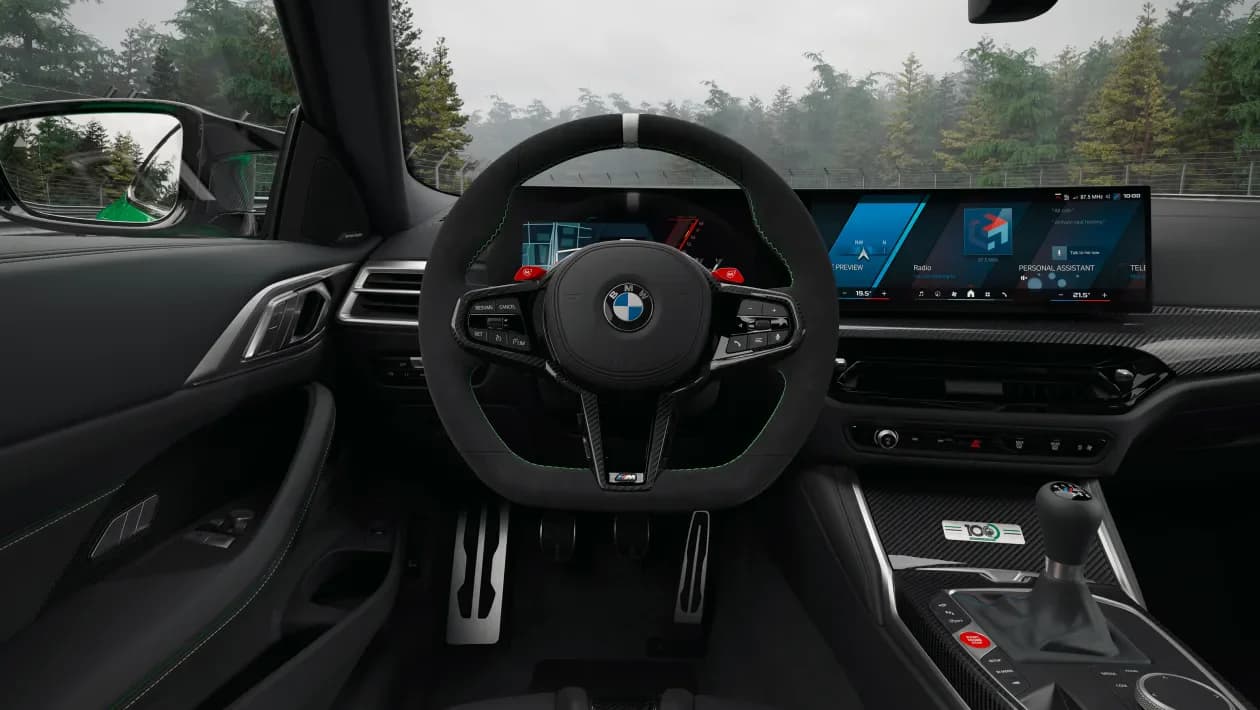
BMW M has not officially cancelled the manual gearbox, but the company says the next generation of performance cars will make the technology much harder to keep. BMW M CEO Frank van Meel told BMW Blog, in comments reported by Motor1, that the manual is “not off the table”. He also refused to promise that it will survive on future M models.
The timing matters because demand for the current BMW M2 remains unusually strong. Motor1 reports that about half of recent M2 sales in the United States were ordered with the six-speed manual. That result shows that enthusiasts still choose the clutch pedal when BMW offers it alongside a faster automatic. It does not, however, remove the engineering, emissions, supplier and cost problems surrounding a new manual transmission.
A careful answer from BMW M
Van Meel described keeping manuals in the lineup as “really difficult”. He acknowledged that demand is high and that the subject is emotional for customers, but he did not give a date or a product promise. “Not off the table” is therefore not the same as “confirmed for the next M3” or “available on every future M2”.
The current M2 is expected to retain a manual option for at least the next few years, according to the report, but that statement applies to a limited horizon. A buyer interested in a manual M car should check the specific model year and market rather than assume that a new generation will keep the same configuration.
Why 48 volts changes the engineering task
A conventional manual performance car is built around an engine, clutch, gearbox, differential and driven axle. A 48-volt mild-hybrid system adds an electric motor, battery, power electronics, extra wiring and control software. That does not make a manual mechanically impossible, but it affects packaging, cooling, mass distribution and the way torque reaches the driveline.
BMW M’s problem is especially demanding because the S58 twin-turbocharged straight-six produces substantial torque. Motor1 notes that the current manual gearbox cannot handle the full output of the engine in its most powerful calibrations. This is why automatic-only M3 and M4 Competition versions exist alongside rear-wheel-drive models that can still be specified with a stick shift.
An electric motor can deliver torque immediately. The control system then has to coordinate that output with the clutch, the driver’s shift timing and the protection limits of the gearbox. A human shift is less predictable than an automatic shift, so engineers may need torque intervention or software safeguards. Any intervention must still feel appropriate in a high-performance BMW M car.
The issue is not merely whether a clutch can be installed. A new gearbox must survive repeated launches, track use and high thermal loads, while also meeting noise, emissions, safety and durability requirements. It has to fit alongside the hybrid hardware and remain economically defensible in a small-volume application.
M2 demand is real, but the absolute volume is small
The M2 is evidence that a manual performance car can still attract buyers. BMW’s official M2 information lists a rear-wheel-drive version with an optional six-speed manual. BMW quotes a 0–100 km/h time of 4.2 seconds for that configuration. The automatic is quicker, but speed is not the only reason a customer chooses the manual.
The appeal is the direct work involved in launching, selecting a gear and matching the engine’s speed to the next ratio. BMW includes a Gear Shift Assistant that rev-matches downshifts and can be disabled in the M Setup menu. The system helps reduce driveline shock, but it does not remove the driver’s decision about when to change gear.
The sales percentage still needs context. The M2 is a niche product compared with BMW’s high-volume cars. A 50-percent manual take rate in one market can represent a limited number of units globally. Developing, testing and certifying a new manual gearbox costs broadly the same whether the percentage is high or low, while the business case depends on the total number of cars and the number of markets involved.
BMW is still building manual special editions
BMW has not treated the manual as only a historical feature. BMW M announced the 2027 M3 CS Handschalter for North America as a limited rear-wheel-drive model with a 473-horsepower inline-six and an exclusive six-speed manual transmission. BMW describes it as the only M3 CS offered with a manual and says production will be very limited.
The company has also presented the 2026 M2 Turbo Design Edition, a limited North American model offered exclusively with a six-speed manual. These products show that BMW can justify a manual when the market, price, volume and enthusiast positioning support the investment.
They do not guarantee a manual for the next M3, M4 or M2. A special edition can recover development and certification costs through limited production and a higher price. A regular model must meet broader targets for efficiency, safety, emissions, noise and profitability.
What is known about the next generation
Industry reports expect the next M3 generation to use a straight-six engine with mild-hybrid assistance, but BMW has not publicly confirmed every technical detail. There is no official confirmation that the next M3 will be automatic-only, just as there is no confirmation that a manual will remain. The combination of electrification, high torque and all-wheel-drive requirements makes a manual less likely in the most powerful versions.
BMW M is also developing fully electric high-performance cars. BMW says future electric M models will preserve the division’s character through response, sound and simulated shifts. A software simulation is not a mechanical manual gearbox: it can reproduce some cues without providing the same physical connection between clutch, engine and driven wheels.
For customers, van Meel’s answer describes a transition rather than a final decision. Demand for the M2 manual is genuine, and BMW continues to announce limited manual cars. At the same time, the company will not promise that every new generation will keep the third pedal. Anyone who wants a manual M car should check the exact market, production window and specification before treating the option as secure.