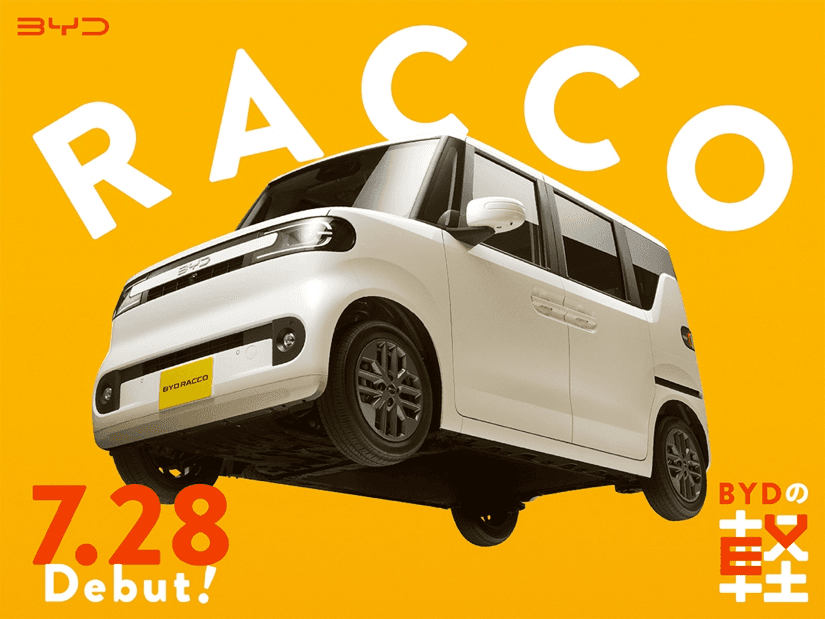
The BYD Racco was designed for Japanese kei-car rules. The future European model has not been shown yet. Photo source: BYD Auto Japan
BYD is preparing an electric smaller than the Dolphin Surf for Europe, using Racco technology
BYD is working on a city electric car for Europe that would use the compact X-Pack technology developed for the Japanese Racco. The project would let the Chinese manufacturer enter a class below the current Dolphin Surf and compete with models such as the Leapmotor T03, Dacia Spring and the forthcoming urban electrics from European groups.
The information was first reported by the Japanese publication Nikkei and picked up by the international motoring press. BYD has not yet shown the European model, nor announced its name, price, battery or launch date. Racco should therefore be treated as a technical source, not as a car that will be imported into Europe unchanged.
What the X-Pack system is
On a very small car, the space taken by the battery, inverter and electronic systems directly reduces room for passengers and luggage. X-Pack groups the battery and several electrical components, including the inverter that converts voltage, into a compact assembly mounted under the floor.
BYD developed the solution for the Racco, where every centimetre matters. The model meets Japanese kei-car limits and is 3,395 mm long, 1,475 mm wide and 1,800 mm tall. The wheelbase measures 2,520 mm.
The pack uses Blade cells with lithium iron phosphate chemistry, integrated into the body structure through Cell-to-Body technology. According to BYD, moving the electronics into the same assembly enlarges the areas available to absorb crash energy and reduces the risk of contact with high-voltage components.
For a future European minicar, the main advantage would be a more efficient floor. The manufacturer could obtain four usable seats and a battery sufficient for urban trips without stretching the car’s length or height excessively.
Racco offers two range levels
The Racco went on sale in Japan on 28 July 2026. It is the first electric car designed by a foreign manufacturer specifically for the kei category and is offered in three versions.
The base Racco 200 has a locally homologated range of 210 km, while the 300 Plus and 300 Premium versions reach 320 km. These figures are measured using the procedure applied in Japan and should not be confused with the WLTP range that would be published for a European model.
The front-mounted motor develops 47 kW, equivalent to 64 hp, and 160 Nm. The car has front-wheel drive, four seats and sliding side doors, a practical solution for the tight parking spaces of Japanese cities.
Japanese prices start at 2,145,000 yen and run to 2,497,000 yen, local taxes included. A direct conversion into euros would not indicate the price of a future European model, because taxes, safety standards, equipment and production costs are different.
The European car will not necessarily be an adapted Racco
Kei-car rules do not exist in the European Union. The Racco’s very tall, narrow body is the result of Japanese limits and of the tax advantages granted to that category. A European model can use X-Pack, but with different proportions, structure and equipment.
European homologation standards and Euro NCAP requirements also influence the design of crash zones, driver-assistance systems and the car’s mass. BYD will have to adapt the platform if it wants a strong safety-test score and use at higher speeds than those typically seen in Japanese urban traffic.
The European Commission has meanwhile proposed the M1E subcategory for small, affordable electric cars, with a maximum length of 4.2 metres. Manufacturers could receive benefits in emissions accounting if the cars are built in the European Union and meet origin conditions. The rules are still part of the legislative process, and the final form may change.
BYD’s Hungary plant is a possible option
Reports on the project point to BYD’s Szeged plant as a possible production site. The Hungarian factory is due to start car production in the last quarter of 2026, and the company has so far confirmed the Dolphin Surf and Atto 2 for that site.
Building a minicar in Hungary would have two advantages: it would reduce exposure to the extra tariffs applied to electric cars imported from China, and it could help the model meet future European criteria for small cars produced locally.
Those benefits do not, however, confirm the factory choice. BYD has not announced that the future minicar will go onto the Szeged lines, nor has it communicated the investment needed to adapt the plant.
Why BYD needs a model below the Dolphin Surf
The Dolphin Surf is currently the smallest BYD electric sold in Europe, but it is almost four metres long and uses a battery of about 43 kWh in the higher versions. It does not occupy the same market slot as a simple minicar designed first of all for the city.
The very small electric segment is growing against a backdrop of high new-car prices. Dataforce figures cited by Automotive News Europe indicate more than 102,000 electric minicars registered in Europe in the first seven months of 2026, 75% more than in the same period of 2025. The entire minicar segment grew by 12%, to about 318,000 units.
For BYD, a car below the Dolphin Surf would open access to customers who do not need long range or a crossover body. In Romania, such a model would compete mainly on price, battery warranty, insurance cost and the availability of a service network, not only on claimed range.
What is known and what remains unconfirmed
It is confirmed that X-Pack exists and is used on the Racco, and that BYD is developing European production in Hungary. Japanese sources indicate that this technology would be used for a family of small cars aimed at Europe as well.
The European model’s name, design, dimensions, battery capacity, WLTP range, price, plant and exact launch year are not confirmed. Until BYD publishes those figures, direct comparisons with the Dacia Spring, Leapmotor T03 or the future Renault Twingo E-Tech remain indicative.