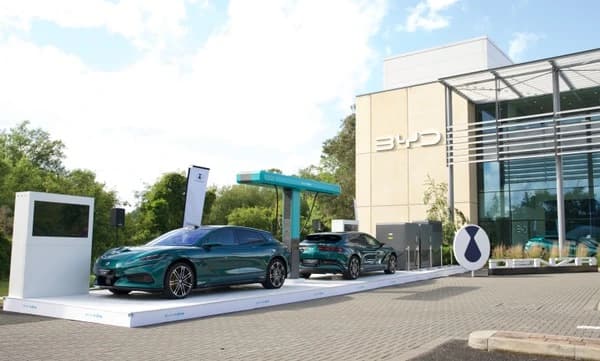
Photo: BYD. Demonstration installation in Uxbridge, United Kingdom; editorial use under the official gallery terms.
BYD executive vice president Stella Li visited Bucharest on 30 October 2026 to discuss rapid charging, local business relationships and possible industrial cooperation with Romanian automotive suppliers. Her visit did not confirm a Romanian car factory. The distinction matters because supplying BYD's European operations, installing charging infrastructure and building an assembly plant are separate projects with different commitments.
Romanian business newspaper Ziarul Financiar reported Li's comments during her first official visit to the country. She identified Romania's automotive expertise, skilled professionals and suppliers as potential contributors to the group's European operations. That was an expression of interest, rather than an announcement of awarded component contracts or a production site.
Charging investment and manufacturing are separate discussions
A subsequent HotNews report published on 31 October included Li's intention to use BYD's own funding to develop Romanian charging infrastructure. She did not provide a precise investment figure or timetable. The report identified motorways and other busy locations as priorities for installations.
These statements add substance to the charging discussion without establishing an operating network. They do not provide a complete set of Romanian sites, opening dates or customer tariffs. Drivers therefore cannot yet treat the visit as a map of available charging stops, while suppliers cannot treat it as confirmation of a Romanian vehicle manufacturing programme.
What the five-minute charging claim actually covers
BYD's official UK technical questions and answers, published in August 2026, explain the system Li discussed. The manufacturer quotes five minutes to charge a compatible vehicle from 10% to 70%, and nine minutes from 10% to 97%. Its cold-weather figure is 12 minutes from 20% to 97% at −30°C.
The starting and finishing percentages are essential. Nine minutes is not a zero-to-full result, and the low-temperature example starts at a higher battery charge level. These are manufacturer figures for suitable equipment and vehicles. They are not Carboratory measurements of a Romanian installation, nor a guarantee that an existing electric car will reproduce those times.
The same document specifies a maximum output of up to 1,500 kW through one connector. Each charger has two connectors and can supply up to 1,000 kW to each when both are used simultaneously. Output capacity at the charger and energy accepted by the car are different limits; the lower limit constrains the charging session.
Compatibility is more important than the logo on the charger
According to BYD, the advertised charging speeds require its second-generation Blade Battery technology. The UK document names the DENZA Z9 GT as the first car coming to that market capable of taking advantage of those speeds. That market-specific statement should not be read as a Romanian launch date or specification announcement.
Owners of other brands can use the infrastructure if their vehicles have CCS2 connections, BYD says. However, their cars remain restricted by their own charging capabilities. This also prevents a misleading assumption about BYD's existing range: being a BYD vehicle does not by itself establish that a particular version has Blade Battery 2.0 or supports the headline charging performance.
For a buyer comparing cars, the useful questions concern the exact battery, maximum DC input and charge window used for the published time. A charging station rated at 1,500 kW does not convert a car's original hardware into a megawatt-capable system. Any Romanian model claim needs to be checked against that model's local specification.
Stationary batteries explain the grid connection
The UK technical explanation describes two stationary storage units of 185 kWh each, giving 370 kWh per charger. Depending on infrastructure and demand, that storage can take electricity from the grid at roughly 100 kW to 560 kW. Stored energy is then delivered to an arriving vehicle at a higher power than the immediate grid supply would allow.
That is a description of the announced configuration, not proof that every proposed Romanian site will have identical equipment. It explains why the charger's peak output should not be confused with a continuous request for 1,500 kW from the local grid. Site design still has to account for the connection, storage equipment and how vehicles enter and leave the charging area.
BYD also describes an overhead T-shaped structure supporting the cables. Its stated purpose is to keep cables off the ground and make the connector easier to handle. The official photograph accompanying this article shows a demonstration installation in Uxbridge in the United Kingdom; it does not show a completed Romanian site.
Hungary provides a documented industrial reference
BYD's European localisation programme already has named locations. On 15 May 2025, the company announced a commitment to establish its European business headquarters in Budapest, supported by a research and development centre. The release also identified its bus factory in Komárom, facilities in Fót and Páty, and the passenger-car project in Szeged.
The Budapest announcement covered collaboration with at least three Hungarian universities and initial research projects focused on intelligent mobility and electrification. BYD also described cooperation with Hungarian suppliers and start-ups. Those commitments belong to Hungary; they cannot be counted as Romanian investment or employment promises.
They do, however, clarify the context of Li's supplier discussions. A Romanian component business could participate in a European supply chain without a vehicle assembly plant being located in Romania. The Bucharest statements did not identify a signed Romanian supply agreement, order volumes or a production schedule.
What Romanian customers still need to know
BYD's Romanian website lists both battery-electric cars and plug-in hybrids, including DOLPHIN SURF, ATTO 2, SEALION 7 and SEAL U DM-i. Their appearance in the local catalogue establishes a commercial presence, rather than universal compatibility with the new charging technology.
The UK charging document describes per-kWh billing and payment methods including cards, an app, automatic identification and RFID roaming. Those provisions are useful background, but they do not set Romanian terms. For an actual journey, the decisive local information will be public access, site address, the rate available to the specific car and the tariff. Publishing those details will turn the charging intention discussed in Bucharest into a service drivers can assess.